
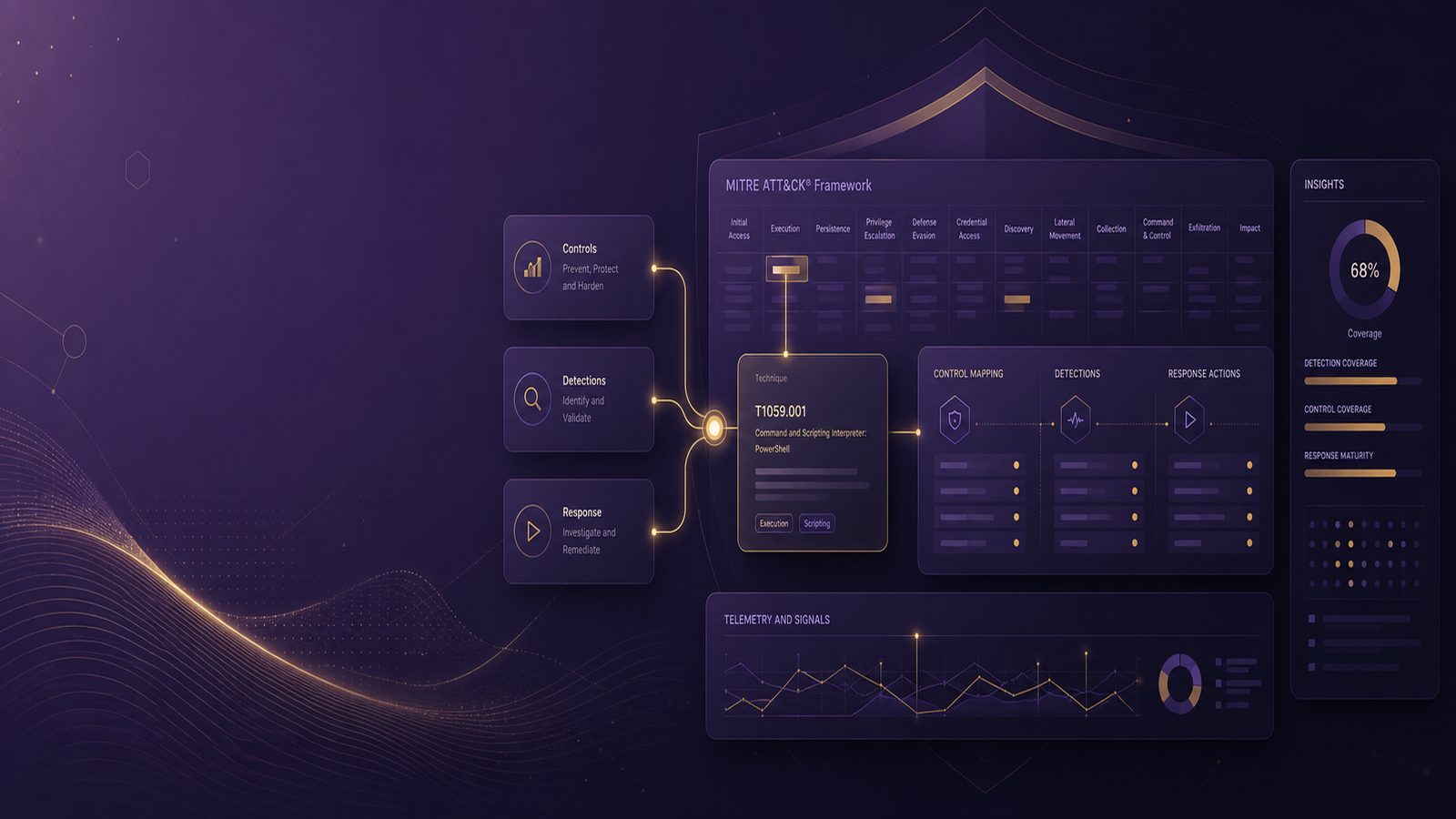
Mapping detections and controls to MITRE ATT&CK: a practical guide for technical teams
MITRE ATT&CK is useful because it gives technical teams a common language for describing adversary behaviour. For a UK SME, that matters less as an abstract framework and more as a way to answer practical questions: which techniques are we actually protected against, which ones can we detect, and where are the blind spots?
Used well, ATT&CK mapping helps you connect preventive controls, detective controls, and response actions to real-world attack paths. It also stops security conversations drifting into vague statements such as “we have endpoint protection” or “the SIEM is covered”. Those statements are not enough on their own. A control only has value if you know what it blocks, what it sees, and what happens next when it fires.
For technical practitioners, the value is in turning a broad framework into an operational model. That means mapping telemetry sources, detection logic, and response playbooks to ATT&CK techniques and sub-techniques, then using the result to prioritise engineering work.
Why ATT&CK mapping is useful in a defensive programme
How ATT&CK helps connect control coverage, detections, and response priorities
ATT&CK is not a control framework in the same sense as ISO 27001 or NIST CSF. It is a knowledge base of adversary tactics and techniques. That makes it especially useful for defensive engineering because it describes how attackers behave, not just what policies exist.
In practice, ATT&CK mapping helps you:
- show which techniques are blocked by preventive controls such as MFA, application control, or network filtering
- show which techniques are visible through logging, EDR, XDR, or SIEM detections
- identify where response actions, such as account disablement or host isolation, are available
- spot techniques that are only covered by one layer, which is often a weak position
- prioritise tuning and engineering work based on likely attack paths rather than generic alert volume
This is particularly useful for small security teams that need to make trade-offs. You rarely have the time or budget to cover every ATT&CK technique equally. A mapping exercise helps you focus on the techniques that matter most for your environment, identity stack, cloud services, and business-critical systems.
Where ATT&CK fits alongside NIST CSF, ISO 27001, and internal risk management
ATT&CK should sit underneath your broader governance and risk model, not replace it. NIST CSF can help structure outcomes across Identify, Protect, Detect, Respond, and Recover. ISO 27001-aligned work can help you manage risk, define responsibilities, and evidence control operation. ATT&CK then gives you a technical lens for understanding whether the controls and detections you have are actually relevant to the threats you care about.
A simple way to think about it is:
- NIST CSF tells you what security outcome you want
- ISO 27001 helps you manage the system and evidence around it
- ATT&CK helps you test whether the technical implementation is meaningful against real attacker behaviour
That combination works well for UK SMEs because it avoids over-engineering. You do not need a large threat intelligence function to start. You need a clear scope, a repeatable method, and enough telemetry to make the mapping useful.
Start with the right scope and assumptions
Choosing the environment, business unit, or threat scenario to map first
Do not try to map the whole enterprise in one pass. Start with a bounded scope. Good starting points include:
- Microsoft 365 and identity infrastructure
- endpoint estate for corporate laptops and servers
- internet-facing services and remote access paths
- a regulated or business-critical business unit
- a specific threat scenario, such as credential theft, ransomware, or initial access through phishing
For most UK SMEs, identity and endpoint are the best place to begin. Many attacks rely on account compromise, token theft, or living-off-the-land activity after initial access. If you can map those paths well, you will usually get more value than starting with niche techniques that are unlikely in your environment.
Be explicit about assumptions. For example, note whether the environment uses Microsoft Defender for Endpoint, Microsoft Sentinel, a third-party SIEM, or a mixed stack. Note whether you have admin audit logs, PowerShell logging, Sysmon, email security telemetry, firewall logs, or cloud control-plane logs. ATT&CK mapping is only as good as the telemetry you can actually collect.
Defining what counts as a control, a detection, and a response action
These terms are often blurred together, which makes mapping messy. Keep them separate:
- Control: a preventive or limiting measure, such as MFA, device compliance, application allow-listing, or conditional access
- Detection: a rule, analytic, or hunt that identifies suspicious behaviour, such as impossible travel, suspicious PowerShell, or unusual service creation
- Response action: a containment or remediation step, such as disabling an account, isolating a host, revoking tokens, or blocking a hash
A single ATT&CK technique may have all three, but not always. If you only have a preventive control and no detection, you may miss control bypass. If you only have detection and no response, you may know about an incident but struggle to contain it quickly. If you only have response and no detection, you are relying on luck or manual discovery.
Build a practical ATT&CK mapping method
Using techniques, sub-techniques, and tactics without overcomplicating the model
ATT&CK can become unwieldy if you try to model every detail at once. Keep the first pass simple. Use tactics as the high-level phase of the attack, such as Initial Access, Execution, Persistence, Privilege Escalation, Defence Evasion, Credential Access, Discovery, Lateral Movement, Collection, Exfiltration, and Impact. Then map the techniques that matter most within each tactic.
Sub-techniques are useful when the difference matters operationally. For example, PowerShell abuse, scheduled task abuse, and service creation are all different enough that they may need separate detections and different response actions. But do not force sub-technique detail where it adds no value. The goal is not taxonomy perfection. The goal is operational clarity.
A practical mapping record for each technique should include:
- technique ID and name
- tactic
- relevant assets or identity scope
- preventive controls
- telemetry sources
- detection logic
- response action
- owner
- coverage status
- review date
That structure is enough to support a working matrix in a spreadsheet, a GRC tool, or a detection engineering backlog.
Creating a simple matrix for preventive, detective, and corrective coverage
A useful pattern is to score each technique across three dimensions:
- Preventive: can we stop or reduce the technique?
- Detective: can we see it reliably?
- Corrective: can we contain or recover quickly?
You can use a simple status model such as covered, partial, or gap. If you want more precision, add confidence and evidence fields. For example, “covered” should mean there is a documented control or detection, it has been tested, and the team knows how to operate it. “Partial” might mean the control exists but only covers a subset of users, devices, or attack variants.
This is where many teams discover that their coverage is uneven. A technique may be blocked for managed Windows endpoints but not for unmanaged devices. Or a detection may exist in Sentinel but only for one log source, leaving a blind spot in another business unit.
Map common defensive controls to ATT&CK techniques
Identity, endpoint, email, network, and logging controls
Identity controls often map to the earliest and most common ATT&CK techniques. MFA, conditional access, privileged access management, and strong password policy all reduce the success rate of credential-based access. They are especially relevant to techniques involving valid accounts, phishing, token theft, and brute force.
Endpoint controls such as application control, attack surface reduction rules, EDR prevention, and hardening baselines can reduce execution, persistence, and defence evasion. CIS Benchmarks and vendor hardening guidance are often useful here, but the ATT&CK mapping should focus on the behaviour they disrupt. For example, blocking unsigned scripts or restricting LOLBin abuse may help against execution and defence evasion techniques.
Email security controls map strongly to phishing-related initial access. Mail filtering, attachment sandboxing, URL rewriting, and impersonation protection can reduce the chance that a malicious message reaches the user. However, email controls are rarely sufficient on their own. If a user still clicks through, identity and endpoint detections become the next layer.
Network controls are useful for command-and-control, lateral movement, and exfiltration. DNS filtering, proxy logging, egress restrictions, and TLS inspection where appropriate can all contribute. For SMEs, the key point is not to chase perfect network visibility, but to know which network paths matter and what telemetry you can realistically collect.
Logging controls are the foundation of detective coverage. Audit policy, Sysmon, PowerShell logging, cloud audit logs, identity logs, and EDR telemetry all support ATT&CK mapping. Without them, many techniques will remain invisible even if the control exists.
Examples of control-to-technique relationships and typical coverage gaps
Some examples illustrate the pattern:
- MFA helps reduce account takeover, but it does not by itself detect token replay or session hijacking
- Application allow-listing can reduce unauthorised execution, but it may not stop abuse of trusted binaries
- EDR can detect suspicious process trees, but only if the relevant telemetry is enabled and retained
- DNS filtering can disrupt command-and-control, but it may not see encrypted traffic over allowed domains
- Central logging can support detection, but only if the logs are normalised and monitored
The common gap is assuming one control covers an entire technique. In reality, ATT&CK techniques are often broad. A single technique may be executed in many ways, and your control may only cover one of them. That is why mapping should always include the specific implementation and the assumptions behind it.
Map detections to ATT&CK with implementation detail
Translating telemetry into detection logic in SIEM, XDR, or EDR platforms
Detection mapping should start from telemetry, not from the ATT&CK matrix. Ask first: what data do we actually have? Then decide what behaviour can be expressed in the platform you use.
For example, if you have Windows event logs and Sysmon, you can detect suspicious process creation, command-line abuse, remote thread injection indicators, service creation, and scheduled task changes. If you have Microsoft 365 audit logs and Entra ID sign-in logs, you can detect risky sign-ins, consent grants, mailbox rule abuse, and unusual token use. If you have network telemetry, you can detect unusual outbound destinations, beaconing patterns, or DNS anomalies.
In a SIEM or XDR platform, the mapping should record the analytic type as well as the ATT&CK technique. For instance:
- correlation rule
- threshold alert
- anomaly detection
- hunt query
- response automation
That distinction matters because not all detections are equal. A hunt query may be useful for periodic review but not suitable for real-time alerting. A threshold alert may be noisy unless enriched with context. A response automation may be effective but should be carefully gated to avoid accidental disruption.
Using Sigma, KQL, and Windows event sources to anchor detections
Sigma is useful as a portable detection format for expressing logic across multiple SIEMs. It works well as a common layer for ATT&CK mapping because you can link a rule to a technique, then translate it into platform-specific syntax later. For example, a Sigma rule for suspicious PowerShell can be mapped to ATT&CK techniques involving command and scripting interpreter abuse, then adapted for your SIEM.
KQL is particularly useful in Microsoft Sentinel and related Microsoft security tooling. A practical workflow is to build the detection in KQL, validate the data source, then map the query to the relevant ATT&CK technique and sub-technique. Keep the query close to the telemetry source so that future analysts can understand what it is looking for.
Windows event sources remain important in many SME environments. Common examples include:
- Event ID 4688 for process creation, where enabled and collected
- Event ID 4624 and 4625 for logon activity
- Event ID 4672 for privileged logons
- Event ID 4697 and service creation related telemetry
- Sysmon Event ID 1 for process creation
- Sysmon Event ID 3 for network connections
- Sysmon Event ID 7 for image loads
- Sysmon Event ID 11 for file creation
Do not collect these blindly. Choose the events that support your highest-priority ATT&CK techniques, then tune retention and parsing so the data is usable. A noisy log source that nobody trusts is not a control.
Measure detection quality, not just coverage
Tracking fidelity, false positives, alert volume, and time to detect
Coverage on paper is not the same as operational effectiveness. A technique marked as “covered” may still be weak if the alert is too noisy, too delayed, or too hard to triage. Measure quality using a small set of practical indicators:
- precision or fidelity of the alert
- false positive rate
- alert volume per day or week
- mean time to detect
- mean time to investigate
- mean time to contain, where response is in scope
If a detection fires frequently but rarely leads to action, it may need tuning, enrichment, or removal. If a detection is high value but only runs once a day, it may be too slow for the threat it is meant to catch. If a detection is technically correct but impossible to investigate because the context is missing, it is not yet mature.
It is also worth testing detections against benign and adversarial-like activity in a controlled way. That does not mean building exploit chains. It means validating that the telemetry arrives, the rule triggers, the alert is understandable, and the response path works. Tabletop exercises and purple-team style validation are often enough to expose weak assumptions.
Identifying techniques that are covered on paper but weak in practice
Common examples include:
- detections that rely on a log source which is not enabled everywhere
- alerts that only work for administrators, not standard users
- rules that trigger, but without enough context to triage quickly
- controls that exist only on managed devices, leaving BYOD or contractor endpoints exposed
- detections that are tuned so aggressively they miss the behaviour they were meant to catch
These are not failures of the framework. They are useful findings. ATT&CK mapping should surface them early so you can decide whether to improve the control, add telemetry, or accept the gap as a conscious trade-off.
Use ATT&CK mapping to prioritise improvement work
Ranking gaps by likelihood, impact, and operational feasibility
Once you have a mapping, do not treat every gap equally. Prioritise by a combination of likelihood, impact, and feasibility. A technique that is common in your sector, easy for an attacker to use, and likely to affect a critical service should rise quickly. A technique that is low probability, hard to execute, and already constrained by other layers may be lower priority.
For UK SMEs, a practical prioritisation model often looks like this:
- identity compromise and privilege misuse
- phishing-led initial access
- endpoint execution and defence evasion
- lateral movement and remote service abuse
- exfiltration and impact, including ransomware-related behaviours
Feasibility matters because some gaps are expensive to close. If a detection requires a log source you cannot collect reliably, you may need a different control or a different detection strategy. If a preventive control would disrupt business operations, you may need compensating detective measures instead.
Turning mapping results into a backlog for hardening, logging, and tuning
Translate the mapping into a backlog with clear actions. Examples include:
- enable a missing audit log source
- expand EDR coverage to unmanaged or server endpoints
- tune a noisy detection and add enrichment
- add a response automation for account disablement or token revocation
- harden a control that only partially covers a technique
- create a hunt for a technique with no reliable alerting yet
This backlog should be owned, dated, and reviewed. If you do not assign an owner, ATT&CK mapping becomes a static spreadsheet. If you do not review it after changes to cloud services, identity architecture, or endpoint tooling, it will drift quickly.
Operationalise the mapping process
Assigning owners, review cadence, and change triggers
Make ATT&CK mapping part of normal security operations. A sensible operating model is:
- one owner for the mapping register
- one owner for each major control domain, such as identity, endpoint, network, and logging
- a quarterly review cadence, or more often if the environment changes quickly
- mandatory review after major changes such as new identity providers, SIEM migrations, cloud platform changes, or EDR rollouts
Use change triggers to keep the mapping current. If a new SaaS platform is introduced, ask which ATT&CK techniques it affects. If a log source is retired, update the coverage status immediately. If a detection is replaced by a managed service or automation, confirm the response path still works.
Keeping mappings current as tooling, cloud services, and adversary behaviour change
ATT&CK itself evolves, and so does your environment. That means mappings should be treated as living documentation. The most useful version is the one that reflects current telemetry, current controls, and current response capability.
One practical pattern is to link each mapping entry to evidence. That could be a detection rule ID, a dashboard, a playbook, a configuration baseline, or a test result. Evidence helps you avoid guesswork and makes it easier to see when a control has drifted.
For SMEs, the goal is not perfect completeness. It is enough confidence to know where you are strong, where you are weak, and what you will do next.
Common mistakes to avoid
Treating ATT&CK coverage as a compliance score
ATT&CK is not a badge or a pass-fail test. A high coverage count does not mean your environment is safe. It only means you have mapped more of the matrix. What matters is whether the mapped controls and detections are relevant, tested, and operational.
Overstating detection capability or assuming one control covers an entire technique
It is easy to overclaim. A single alert does not mean a technique is fully detected. A single control does not mean a technique is fully prevented. Be precise about scope, assumptions, and blind spots. That honesty makes the mapping more useful, not less.
ATT&CK mapping works best when it is treated as an engineering tool. It helps you connect threat behaviour to controls, telemetry, and response in a way that supports prioritisation. For UK SMEs, that is usually the right balance between ambition and practicality.
If you want help turning ATT&CK into a working detection and control model, or aligning it with a broader ISO 27001-oriented security programme, speak to a consultant.
FAQ
How is ATT&CK mapping different from a control framework mapping exercise?
Control framework mapping usually asks whether a policy, standard, or control exists. ATT&CK mapping asks whether that control or detection meaningfully addresses a specific attacker technique. It is more operational and more closely tied to telemetry, alerting, and response.
What is the best way to keep ATT&CK mappings current as the environment changes?
Assign ownership, review mappings on a fixed cadence, and update them whenever there is a major change to identity, endpoint, cloud, logging, or response tooling. Linking each mapping entry to evidence, such as a rule ID or test result, makes drift easier to spot.
Frequently asked questions
How should I start mapping detections and controls to MITRE ATT&CK?
Start with a bounded scope rather than trying to map everything at once. For most UK SMEs, identity and endpoint are sensible starting points, especially if you rely on Microsoft 365, remote access, or corporate laptops and servers. Be clear about the telemetry you actually have, because the mapping is only useful if it reflects what you can collect and act on.
What is the difference between a control, a detection, and a response action in ATT&CK mapping?
A control is something that reduces or limits risk, such as MFA, application allow-listing, or conditional access. A detection is the logic or alert that spots suspicious behaviour, while a response action is what you do next, such as disabling an account or isolating a host. Keeping those three separate makes it easier to see where coverage is strong and where there are gaps.
Should ATT&CK replace NIST CSF or ISO 27001 in a security programme?
No, ATT&CK works best alongside broader governance and risk frameworks rather than replacing them. NIST CSF helps structure security outcomes, ISO 27001-aligned work helps with risk management and evidence, and ATT&CK gives a technical view of whether your controls and detections are relevant to real attacker behaviour. That combination is often practical for UK SMEs because it keeps the focus on useful coverage rather than abstract compliance activity.
What telemetry do I need before ATT&CK mapping is useful?
You need enough logging to understand what is happening in the environment you are mapping. The article highlights examples such as admin audit logs, PowerShell logging, Sysmon, email security telemetry, firewall logs, and cloud control-plane logs. If you do not have the relevant telemetry, the mapping may look complete on paper but still leave blind spots in practice.
Why is ATT&CK mapping helpful for small security teams?
It helps small teams prioritise work based on likely attack paths instead of generic alert volume. That is useful when time and budget are limited, because you can focus on the techniques most relevant to your identity stack, cloud services, and business-critical systems. It also makes it easier to see when a technique is only covered by one layer, which can be a weak position.
Comments are closed