
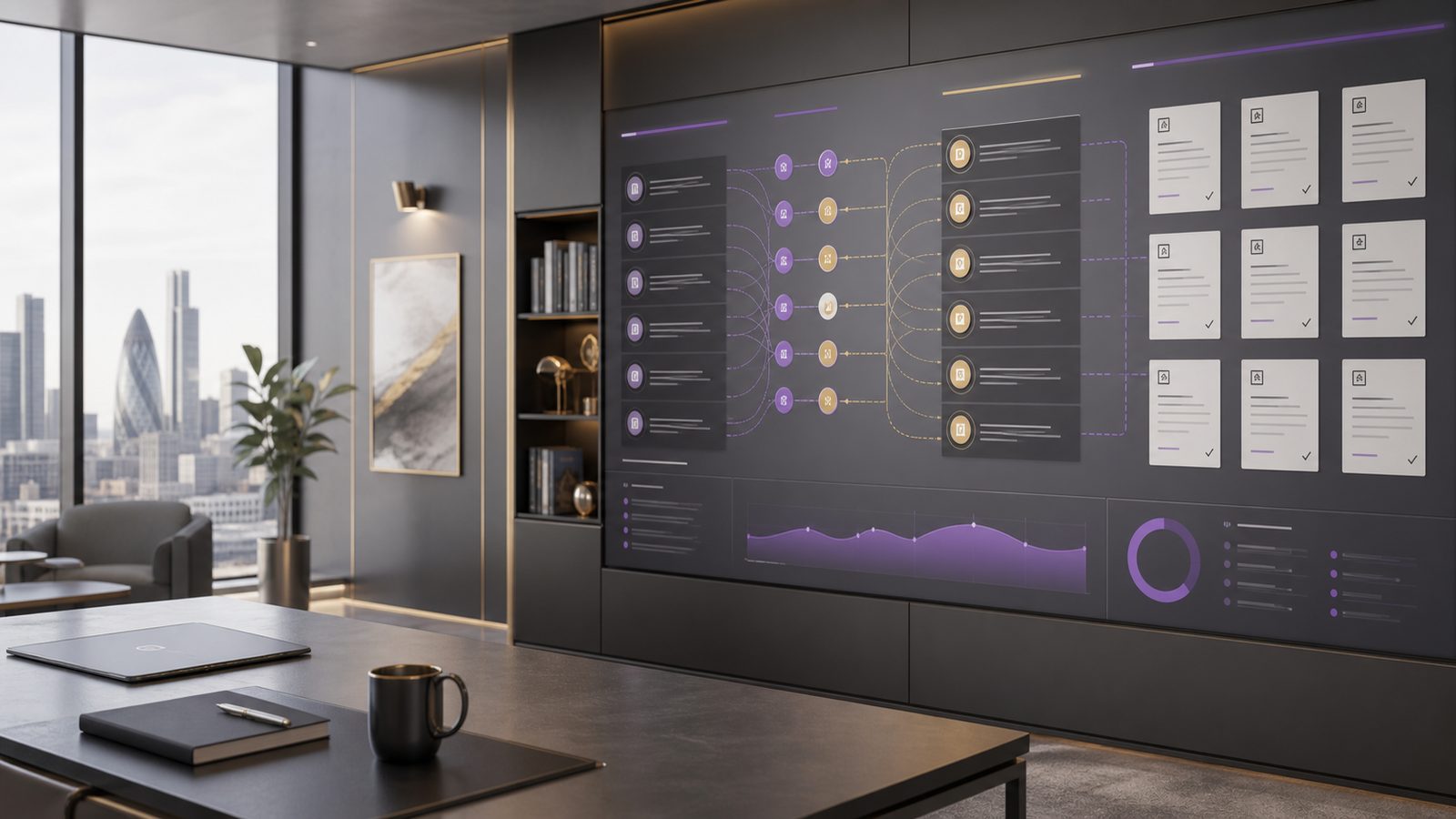
Mapping ISO 27001 Annex A controls to NIST 800-53
For many UK SMEs, ISO/IEC 27001 and NIST 800-53 appear in the same conversation for different reasons. One may be driven by customer assurance, another by a public sector requirement, a supplier questionnaire, or an internal security architecture review. The result is often the same: teams end up maintaining two sets of control language for broadly similar security outcomes.
A crosswalk between ISO 27001 Annex A controls and NIST 800-53 can reduce duplication, improve consistency, and make it easier to explain your security posture to different stakeholders. The key is to treat the mapping as a translation aid, not as a shortcut to compliance or a claim that the frameworks are interchangeable.
Why this crosswalk is useful for UK SMEs
When ISO 27001 and NIST 800-53 are being used for different stakeholders
ISO 27001 is commonly used to structure an information security management system, or ISMS, around risk, governance, and continual improvement. NIST 800-53 is a more detailed control catalogue, often used in US federal and enterprise environments, but increasingly referenced in technical assurance work because it is specific and operationally useful.
In practice, SMEs may see both frameworks in different places:
- Customer security questionnaires asking for evidence of access control, logging, or incident response.
- Internal governance teams wanting an ISMS structure and a Statement of Applicability.
- Technical teams needing a more granular control baseline for cloud, endpoint, or application security.
- Supplier assurance exercises where a single control set needs to satisfy multiple parties.
A crosswalk helps you avoid rewriting the same control intent in different ways. It also helps when you need to show that one control implementation supports multiple obligations, such as MFA, central logging, or backup testing.
Where the mapping helps and where it does not
The mapping is useful for:
- Identifying overlap between control families.
- Spotting gaps where one framework is more detailed than the other.
- Reducing duplicate evidence requests.
- Aligning engineering work with governance language.
It is not useful if you expect a neat one-to-one relationship. ISO 27001 Annex A controls are higher level and more outcome-focused. NIST 800-53 often breaks those outcomes into multiple control statements, enhancements, and implementation details. A single Annex A control may map to several NIST controls, and some NIST controls may support more than one Annex A control.
How to approach the mapping without forcing a one-to-one match
Control families versus control objectives
The most common mistake is to compare the wording directly and assume that similar language means identical scope. That usually leads to poor mappings and weak evidence trails.
Instead, compare:
- Control objective: what security outcome is being achieved?
- Control mechanism: what technical or procedural measure delivers it?
- Scope: which systems, identities, data sets, or suppliers are covered?
- Assurance level: is the control designed, operating, monitored, and tested?
For example, an ISO control about access restriction may align with several NIST 800-53 access control and identification controls. The ISO control is the business-facing statement. The NIST controls are the implementation detail that can be used to define how access is enforced, reviewed, and logged.
Handling partial overlaps and compensating controls
Not every mapping will be exact. In some cases, one framework will cover the core intent while the other adds detail around review frequency, privileged access, or technical enforcement.
Where the overlap is partial, record it explicitly. Use labels such as:
- Equivalent
- Partial overlap
- Supporting control
- Gap
- Compensating control
This is particularly important when a control is implemented through a combination of measures. For example, if a legacy application cannot support modern authentication directly, the effective control may rely on network restriction, jump host access, and enhanced monitoring. That should be recorded as a compensating arrangement rather than a direct equivalent.
A practical method for building your control crosswalk
Start from business risk and control intent
Begin with the risks your organisation actually needs to manage. For most SMEs, that means protecting customer data, maintaining service availability, reducing the likelihood of account compromise, and being able to detect and respond to suspicious activity.
From there, define the control intent in plain language. For example:
- Only authorised users can access production systems.
- Security events are logged centrally and reviewed.
- Incidents are triaged, contained, and recorded.
- Backups are protected and recoveries are tested.
Once the intent is clear, map each statement to the relevant Annex A control and then to one or more NIST 800-53 controls. This keeps the mapping anchored in operational reality rather than framework vocabulary.
Use a spreadsheet or GRC tool to record equivalence, overlap, and gaps
For many SMEs, a spreadsheet is enough. A GRC tool becomes useful when you need workflow, evidence links, ownership tracking, and reporting across multiple frameworks. The important thing is consistency, not tool complexity.
A workable crosswalk record might include:
- Control ID from ISO 27001 Annex A
- Control title and short intent
- Mapped NIST 800-53 control ID or IDs
- Relationship type: equivalent, partial, supporting, gap
- Implementation owner
- Evidence location
- Review date
- Notes on scope or exceptions
If you use a GRC platform, keep the mapping linked to actual evidence such as policy documents, configuration exports, ticket records, log samples, or test results. A mapping without evidence is just a taxonomy exercise.
Common Annex A areas and their NIST 800-53 counterparts
Access control, identity, and authentication
Access control is one of the clearest areas for crosswalking because both frameworks cover it extensively. In practical terms, you are usually looking at:
- User provisioning and deprovisioning
- Role-based access control, or RBAC
- Privileged access management
- Multi-factor authentication, or MFA
- Session control and account review
In NIST 800-53, these themes are typically spread across access control, identification and authentication, account management, and least privilege-related controls. The exact control set depends on the system and the assurance depth you need.
For an SME, the useful question is not “which framework has the better wording?” but “what evidence proves the control is working?” That might include:
- Identity provider configuration showing MFA enforcement
- Joiner, mover, leaver records
- Quarterly access review tickets
- Privileged account inventory
- Conditional access policies
If you are using Microsoft Entra ID, Okta, or another identity platform, the mapping should reflect the actual control implementation. For example, MFA enforced for all remote access, admin roles separated from standard user roles, and stale accounts disabled within a defined period after departure.
Logging, monitoring, and incident response
Logging and monitoring also map well, but only if you distinguish between log generation, log retention, alerting, and response. Many organisations say they “have logging” when they really mean that some systems produce logs that nobody reviews.
For a meaningful crosswalk, separate the control intent into layers:
- Event sources are identified and onboarded.
- Logs are centralised in a SIEM or log platform.
- Retention meets business and investigative needs.
- Alerts are tuned to relevant use cases.
- Incidents are triaged and escalated through a defined process.
In NIST 800-53, this area typically spans audit logging, continuous monitoring, incident handling, and related operational controls. In ISO 27001 Annex A, the equivalent intent is usually expressed more broadly, so your crosswalk should note the implementation detail separately.
A good SME pattern is to define a minimum logging baseline for identity, endpoint, cloud control plane, and critical business applications. Then record which NIST controls each source supports, and which ISO controls the baseline satisfies. This is especially useful if you are building detections in Microsoft Sentinel, Splunk, or another SIEM.
Where the mapping is strongest and where it becomes approximate
Technical controls with clear alignment
The strongest mappings are usually found in technical controls where the security outcome is measurable. Examples include:
- Access restriction and authentication
- Cryptographic protection of data in transit and at rest
- Logging and monitoring
- Vulnerability management
- Backup and recovery
- Secure configuration and change control
These areas are easier to map because both frameworks are trying to achieve the same operational result, even if the wording differs. You can usually point to a concrete implementation, such as TLS configuration, endpoint hardening, patch cadence, or recovery testing.
Organisational controls that need interpretation
Some Annex A controls are more organisational or governance-oriented, and the mapping becomes less precise. That includes areas such as policy management, supplier relationships, awareness, and broader security governance.
Here, NIST 800-53 may provide more granular supporting controls, but the relationship is often indirect. You may need to map one ISO control to a cluster of NIST controls covering policy, roles and responsibilities, training, oversight, and review.
That is not a weakness. It simply means the crosswalk should reflect intent rather than force a false equivalence. If the control is about governance, the evidence may be meeting minutes, policy approval records, training completion, or supplier review outcomes rather than a technical configuration.
How to use the mapping in an ISMS
Evidence collection and control ownership
An effective crosswalk becomes part of your ISMS operating model. Each mapped control should have a named owner, a review cadence, and a clear evidence source. Without ownership, the mapping will drift as systems change.
For example:
- Identity controls owned by the infrastructure or cloud team
- Logging controls owned by the security operations function or managed service provider
- Backup controls owned by infrastructure or platform operations
- Supplier controls owned by procurement or vendor management
This also helps with evidence collection. If a control maps to both ISO and NIST, you should collect evidence once and reuse it where appropriate. A single access review record may support multiple assurance requests if the scope and timing are clear.
Statement of Applicability and implementation notes
The Statement of Applicability should remain your ISO 27001 anchor. The crosswalk can sit alongside it as a technical reference layer. In practice, that means the Statement of Applicability explains which Annex A controls are applicable and why, while the crosswalk shows how those controls are implemented and how they relate to NIST 800-53.
Implementation notes are valuable here. They should capture:
- What is in scope
- What is excluded
- Any legacy constraints
- Any compensating controls
- Any dependencies on third parties or managed services
This makes the mapping more resilient during audits, customer reviews, and internal change management.
Using the crosswalk for supplier assurance and customer questionnaires
Reducing duplication across assurance requests
Supplier assurance exercises often ask the same question in different language. A crosswalk lets you answer once and reuse the response. For example, if a customer asks about access control under their own framework and another asks for NIST-aligned evidence, you can point both to the same underlying control set.
That does not mean sending the same document everywhere without review. It means maintaining a controlled mapping so that your answers stay consistent, current, and tied to evidence. This is particularly useful when you support multiple customers with different assurance expectations.
Explaining control coverage to non-specialists
Not every stakeholder wants framework detail. Procurement teams, account managers, and senior leaders usually want to know whether the control exists, whether it is operating, and whether there are any known exceptions.
A concise crosswalk summary can help you explain:
- Which controls are fully implemented
- Which are partially implemented
- Which depend on third-party services
- Which are scheduled for improvement
That makes the conversation more practical and less bureaucratic, while still preserving technical accuracy.
Pitfalls to avoid when translating between frameworks
Treating framework language as interchangeable
Do not assume that similar wording means the same thing. One framework may require a broader governance response, while the other expects a specific technical safeguard. If you collapse those differences, you can end up with a control that sounds complete but is not actually implemented in enough depth.
Ignoring scope, system context, and control maturity
A control may exist in one environment and not another. For example, MFA may be enforced for cloud services but not for a legacy on-premises application. Logging may be centralised for production but not for development. Backup testing may be documented but not regularly exercised.
Your crosswalk should therefore include scope and maturity notes. A mature control is not just present. It is consistently applied, monitored, and reviewed. If the control is still emerging, record that honestly and track it as an improvement item.
A lightweight template for SMEs to maintain the mapping
Suggested columns for the crosswalk
A simple spreadsheet can work well if it is maintained properly. Suggested columns:
- ISO Annex A reference
- ISO control intent
- NIST 800-53 reference
- Relationship type
- Implementation summary
- Control owner
- Evidence link
- Review date
- Exceptions or notes
If you prefer a GRC tool, keep the same structure. The tool should support the process, not define it.
Review cadence and ownership
Review the crosswalk whenever there is a material change to your environment, such as a cloud migration, identity platform change, major supplier change, or incident that exposes a control weakness. At minimum, review it on a scheduled basis, alongside ISMS management review and internal control testing.
For SMEs, quarterly or biannual review is often enough, provided the environment is stable. The important point is that the mapping remains a living artefact rather than a one-off project document.
Used well, a control crosswalk gives you a clearer view of how your security controls fit together. It can reduce duplicated work, improve evidence quality, and make your ISMS easier to operate across different assurance demands. Used badly, it becomes another spreadsheet with impressive labels and little practical value. The difference is whether you anchor it in risk, ownership, and evidence.
If you are building or refining an ISO 27001-aligned ISMS and need help turning framework language into something your team can actually run, a consultant can help you shape the mapping, evidence model, and operating rhythm around your environment.
Frequently asked questions
Is there a direct one-to-one mapping between ISO 27001 Annex A and NIST 800-53?
No. There is usually overlap, but not a clean one-to-one relationship. ISO 27001 Annex A is higher level, while NIST 800-53 is more granular. A single ISO control may map to several NIST controls, and some NIST controls may support multiple ISO controls.
Should SMEs use a crosswalk to reduce duplicate control documentation across customer and internal assurance requests?
Yes, provided the crosswalk is maintained as a controlled reference and backed by evidence. It is a practical way to reuse control descriptions, avoid inconsistent answers, and show how one implementation supports multiple assurance needs.
How detailed should the mapping be for a small organisation?
Detailed enough to support ownership, evidence, and review, but not so detailed that it becomes unmanageable. For many SMEs, a spreadsheet with relationship type, owner, evidence link, and review date is sufficient.
What is the best starting point?
Start with your highest-risk controls first, usually identity, access, logging, backups, and incident response. Map those end to end before expanding into lower-risk or more governance-heavy areas.
Can a GRC tool replace the need to think about the mapping?
No. A GRC tool can store and track the crosswalk, but the quality of the mapping still depends on control intent, scope, and evidence. The tool is only as useful as the structure you put into it.
When should the mapping be reviewed?
Review it after significant changes to systems, suppliers, or operating model, and also on a regular cycle as part of ISMS review. That keeps the crosswalk aligned with reality rather than historical assumptions.
If you would like support building a practical ISO 27001 control model or crosswalk for your environment, speak to a consultant.
Comments are closed