
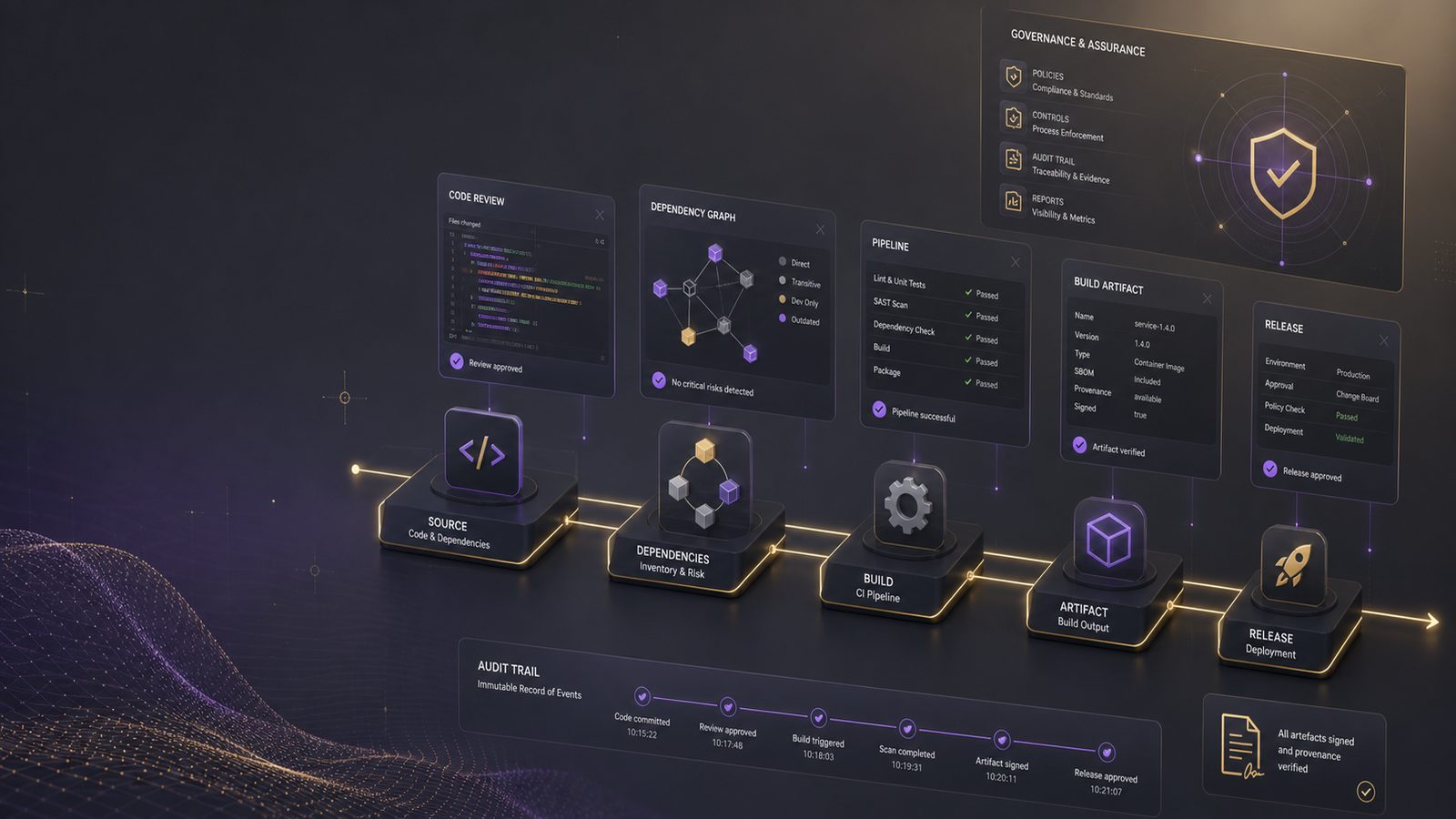
Implementing software supply chain assurance controls for technical teams
Software supply chain assurance is about proving that the software you build, buy, and release is what you think it is. For technical teams, that means controlling trust across source code, build systems, dependencies, artefacts, and deployment paths. It is not a single product or a one-off audit task. It is a set of layered controls that reduce the chance of tampering, make compromise easier to detect, and improve your ability to trace what changed, when, and by whom.
For UK SMEs, the practical challenge is usually not a lack of awareness. It is deciding where to start, which controls matter most, and how to implement them without creating so much friction that teams work around them. The right approach is risk-based. Focus first on the repositories, pipelines, and suppliers that can affect customer data, production systems, or release integrity.
What software supply chain assurance controls are trying to achieve
Define the trust boundaries across source code, build systems, dependencies, artefacts, and deployment paths
The first step is to define where trust begins and ends. In a modern delivery pipeline, source code is only one part of the picture. A release can also be influenced by package registries, build runners, container images, infrastructure-as-code templates, signing services, and deployment automation. Each of these is a potential trust boundary.
Assurance controls should answer a few basic questions:
- Can an attacker alter source code without detection?
- Can build jobs be modified or intercepted?
- Can a dependency change unexpectedly and affect production?
- Can a release artefact be replaced after it has been built?
- Can you prove which inputs were used to create a release?
Explain the main assurance outcomes: provenance, integrity, traceability, and controlled change
Four outcomes matter most. Provenance tells you where software came from. Integrity tells you it has not been altered. Traceability lets you follow the path from commit to build to release. Controlled change means only approved changes can move through the pipeline.
These outcomes are the basis for practical controls such as signed commits, protected branches, build attestations, SBOMs, and release approvals. If a control does not improve one of those outcomes, it may still be useful, but it should not be treated as core supply chain assurance.
Map the control scope before choosing tools
Identify the assets and trust anchors that matter most in your delivery pipeline
Before buying tools, map the assets that would matter most if they were compromised. For most SMEs, the highest-value trust anchors are the source control platform, the CI/CD system, the package manager or private registry, the signing key store, and the production deployment mechanism.
A simple way to scope the problem is to list:
- Repositories that can change production behaviour
- Build systems that compile, package, or containerise software
- External dependencies pulled during builds
- Artefact repositories and container registries
- Secrets stores, signing services, and release automation
- Deployment targets and infrastructure definitions
That inventory helps you decide where controls need to be strictest. A customer-facing SaaS platform will usually need stronger controls than an internal utility script. Likewise, a repository that feeds production should not have the same access model as a low-risk prototype.
Separate first-party code, third-party packages, build infrastructure, and release artefacts
One common mistake is treating the whole pipeline as a single trust domain. It is better to separate it into layers. First-party code is what your team writes. Third-party packages are what you import. Build infrastructure is where code is transformed into artefacts. Release artefacts are the outputs that reach users or production systems.
Each layer needs different controls. Source code needs review and branch protection. Dependencies need pinning and scanning. Build infrastructure needs isolation and short-lived credentials. Artefacts need signing and verification. Supplier assurance needs evidence that the upstream party applies comparable controls.
Establish source control and code integrity controls
Use branch protection, signed commits, mandatory reviews, and protected tags
Source control is the first practical control point. Start with branch protection on main or release branches. Require pull requests, at least one reviewer, and status checks before merge. If your team is large enough, separate code owners for sensitive paths such as authentication, payment logic, infrastructure definitions, and pipeline configuration.
Signed commits can add value where your team is ready to manage the operational overhead. They are most useful when combined with protected branches and a clear policy for trusted signing identities. Protected tags are also important, especially if tags drive releases. A release tag should not be editable by everyone with repository access.
For GitHub, GitLab, or Azure DevOps, the pattern is similar: restrict who can push directly to protected branches, require reviews, and block force-pushes. If you use release tags, protect them as well. If your platform supports it, require signed commits or signed tags for release branches.
Apply least privilege to repository access and automate policy checks on pull requests
Repository access should follow least privilege. Developers do not need admin rights to every repository, and service accounts should not be shared between teams. Use role-based access control, separate write access from administrative access, and review membership regularly.
Automated policy checks on pull requests help reduce human error. Typical checks include:
- Linting and unit tests
- Secret scanning
- Static application security testing, or SAST
- Infrastructure-as-code policy checks
- Dependency policy checks
The aim is not to block every change. It is to make risky changes visible before they reach the main branch. For SMEs, a small number of high-signal checks is usually better than a large number of noisy ones.
Harden build and CI/CD environments
Reduce runner trust, isolate build jobs, and minimise long-lived credentials
Build systems are a high-value target because they can turn trusted source into trusted artefacts. If an attacker gains control of a runner or pipeline definition, they may be able to alter outputs without changing the source repository in an obvious way.
Reduce runner trust wherever possible. Use ephemeral runners rather than long-lived machines. Isolate build jobs so that one pipeline cannot easily inspect another pipeline’s workspace or credentials. Avoid running builds with broad network access unless there is a clear reason. If a build only needs package registries and source control, do not give it unrestricted access to internal systems.
Long-lived credentials are a common weakness. Prefer short-lived tokens issued at build time, workload identity, or federated authentication where your platform supports it. If a secret must exist, scope it tightly and rotate it regularly.
Use ephemeral runners, short-lived tokens, and environment-specific secrets handling
Ephemeral runners reduce persistence risk because each job starts from a clean state. That makes it harder for a malicious change to survive from one build to the next. Short-lived tokens reduce the value of credential theft. Environment-specific secrets handling prevents development credentials from being reused in production pipelines.
A practical pattern is to separate secrets by environment and by function. For example, build-time package credentials should not be the same as production deployment credentials. Signing keys should be isolated from general CI access. Where possible, use a dedicated signing service rather than storing private keys on a build runner.
Control dependency and package risk
Pin versions, verify package integrity where possible, and monitor for dependency drift
Most modern software depends on third-party packages. That creates direct and transitive risk. A direct dependency is one you include yourself. A transitive dependency is pulled in by something else. Both can change your risk profile.
Pin versions rather than allowing floating ranges where stability matters. Use lock files and commit them to source control. Where your ecosystem supports it, verify package integrity or checksums. This is not a complete defence, but it reduces the chance of silent drift.
Monitor for dependency drift, especially in packages that are updated frequently or have broad privileges in your application. Changes to authentication libraries, logging components, build plugins, and container base images deserve extra attention.
Use SCA tooling and policy gates to manage direct and transitive dependencies
Software composition analysis, or SCA, helps identify vulnerable or risky dependencies. In practice, SCA should be paired with policy gates. For example, you might block new dependencies that are unmaintained, have known critical vulnerabilities, or are not approved for production use.
For SMEs, the key is to avoid turning SCA into a flood of alerts. Set thresholds that reflect business risk. A critical vulnerability in a production-facing package may require immediate action. A low-risk issue in a test-only library may be tracked for later remediation. The same logic applies to transitive dependencies. Not every finding needs a release stop, but every finding should have an owner and a decision.
Generate and enforce SBOM and provenance artefacts
Produce SBOMs with tools such as Syft and validate them in the pipeline
A software bill of materials, or SBOM, is a structured list of components in a software product. It helps you understand what is inside a build and supports downstream vulnerability analysis. For technical teams, SBOMs are most useful when they are generated automatically during the build.
Tools such as Syft can generate SBOMs from source directories, container images, or artefacts. The important point is not the tool itself, but the control pattern. Generate the SBOM in CI, store it with the build artefact, and validate that it matches the release you are about to publish. If the artefact changes, the SBOM should change too.
Where possible, treat the SBOM as a release artefact, not a separate document created after the fact. That makes it more reliable and easier to automate.
Attach provenance metadata and verify artefact integrity before release
Provenance metadata records how an artefact was built, from which source, and under what conditions. This can include the commit hash, build environment, builder identity, and timestamps. The more you can attest to the build process, the easier it becomes to detect tampering.
Artefact integrity should be checked before release and again at deployment if your platform allows it. Common patterns include checksum verification, signature verification, and admission controls that only accept signed artefacts. If you use containers, verify image signatures before deployment. If you publish packages, sign them and verify signatures in downstream systems.
Add security testing and policy enforcement into the pipeline
Combine SAST, DAST, secret scanning, and IaC checks with release criteria
Security testing is part of assurance, but it should be targeted. SAST looks for insecure code patterns in source. DAST, or dynamic application security testing, exercises a running application. Secret scanning checks for credentials in source history or current changes. Infrastructure-as-code checks look for insecure cloud or platform configurations.
These controls work best when they are tied to release criteria. For example:
- Block secrets in source control immediately
- Block critical SAST findings in production code
- Require review for high-risk infrastructure changes
- Run DAST on release candidates or scheduled builds
Do not rely on a single test type. Each one covers a different part of the risk picture. The goal is to create enough friction to catch meaningful issues without making the pipeline unusable.
Use risk-based thresholds so failures are actionable rather than noisy
Thresholds should reflect the maturity of your team and the criticality of the system. If every build fails for low-value reasons, developers will stop trusting the pipeline. A better approach is to classify findings by severity, exploitability, and business impact.
For example, a critical secret leak, a vulnerable build plugin, or an unsigned production artefact should be treated as a release blocker. A medium-severity issue in a non-production component may be tracked with a due date. This keeps the control set credible and sustainable.
Protect secrets, signing keys, and release credentials
Store sensitive material in key vaults or HSM-backed services
Secrets should not live in source code, build logs, or shared configuration files. Use a dedicated secrets manager, key vault, or hardware security module, depending on your environment and budget. The main aim is to centralise access, log usage, and reduce the chance of accidental exposure.
Signing keys deserve special treatment. If you sign artefacts, the private key should be protected more tightly than ordinary application secrets. HSM-backed services or managed signing services are preferable where available. If that is not realistic, at minimum isolate the key, restrict access, and monitor every use.
Separate signing duties from general build access and rotate credentials regularly
Separation of duties matters here. The person or process that builds software should not automatically be able to sign and release it. A compromise in the build stage should not immediately grant release authority.
Rotate credentials regularly, especially for deployment tokens, registry access, and signing-related secrets. Rotation is more effective when credentials are short-lived and scoped narrowly. Also review who can approve releases, who can modify pipeline definitions, and who can change secret stores. Those are high-impact permissions.
Monitor for supply chain compromise and tampering
Log build events, package changes, and release approvals for traceability
Assurance controls are only useful if you can see what happened. Log build starts and finishes, pipeline definition changes, dependency updates, release approvals, artefact signing events, and deployment actions. Keep logs in a central system where they can be searched and retained according to your policy.
Traceability is especially important when you need to answer questions such as which commit produced a release, who approved it, and whether the artefact was rebuilt or replaced. Without that evidence, it is hard to distinguish a genuine software defect from a tampering event.
Create detections for unusual dependency updates, pipeline changes, and unsigned artefacts
Monitoring should include simple detections for unusual behaviour. Examples include:
- Pipeline definition changes outside normal change windows
- New dependencies added to production branches without review
- Builds that publish unsigned or unverified artefacts
- Unexpected changes to package registries or mirrors
- Release approvals from unusual accounts or locations
If you already use a SIEM, feed these events into it. Even basic alerting can be useful if it is tuned to the few events that matter most. The objective is not perfect detection. It is early warning and traceability.
Build supplier assurance into procurement and operations
Ask suppliers for evidence of secure build practices, SBOM support, and vulnerability handling
Supply chain assurance does not stop at your own codebase. If you buy software or rely on hosted services, you need to understand how suppliers build, sign, and maintain what they deliver. Ask for evidence of secure build practices, SBOM support where relevant, vulnerability handling processes, and release integrity controls.
For technical teams, useful questions include:
- Do they sign releases or provide provenance data?
- Can they provide an SBOM for the product or service?
- How do they handle dependency vulnerabilities?
- How quickly are security fixes released?
- How are build and release credentials protected?
Evidence matters more than assurances. A supplier saying they take security seriously is not the same as showing how they control their pipeline.
Define minimum assurance requirements for hosted services and embedded software
Set minimum requirements for suppliers based on the risk of the service or component. A hosted service that processes customer data may need stronger requirements than a low-risk utility. Embedded software in operational systems may need stronger release integrity than a desktop add-on.
Minimum requirements might include signed releases, vulnerability notification commitments, change notification for major updates, and a clear process for reporting security issues. Keep the requirements proportionate, but make them explicit.
Prioritise implementation for SMEs with limited resources
Start with the highest-risk repositories, pipelines, and external dependencies
Most SMEs cannot implement every control at once. Start where the risk is highest. That usually means production repositories, internet-facing services, customer data systems, and pipelines that can deploy directly to live environments.
A sensible first phase is:
- Protect the main branch and release tags
- Remove shared credentials from CI/CD
- Introduce secret scanning and dependency scanning
- Generate SBOMs for production builds
- Sign release artefacts
- Log pipeline and release events centrally
That set gives you immediate value without requiring a complete redesign of your delivery process.
Phase controls by maturity so the programme is usable and sustainable
Do not try to force a high-maturity model on a small team overnight. Mature supply chain assurance usually develops in phases. First, make the pipeline visible. Then make it harder to tamper with. Then make it easier to verify. Finally, make it measurable.
As the team matures, you can add stronger provenance, tighter policy gates, more granular approvals, and more advanced monitoring. The right pace is the one your team can sustain.
Measure whether the controls are working
Track coverage for SBOMs, signed artefacts, protected branches, and dependency review
Measure the controls you have actually implemented, not the controls you intended to implement. Useful metrics include the percentage of production repositories with branch protection, the percentage of release artefacts that are signed, the percentage of builds that generate SBOMs, and the percentage of dependency changes that receive review.
These measures help you spot gaps and show whether the programme is improving over time. They also support management reporting without needing to overcomplicate the story.
Review exceptions, failed builds, and remediation lead times to tune the control set
Exceptions are part of reality. What matters is whether they are reviewed, time-bound, and justified. Track failed builds, false positives, and remediation lead times so you can tune the controls. If a rule is blocking too much, adjust it. If a high-risk issue keeps recurring, treat that as a process problem rather than a tooling problem.
Software supply chain assurance is most effective when it is treated as an operating discipline. The controls should make compromise harder, detection faster, and recovery more reliable.
If you want help turning these patterns into a practical roadmap for your environment, speak to a consultant.
Further reading
OWASP Software Assurance Maturity Model (SAMM) can help you structure secure development maturity improvements across governance, design, implementation, verification, and operations. It is useful when you want a broader maturity view alongside supply chain controls.
Microsoft Secure Development Lifecycle guidance is relevant if your teams want a structured set of secure development practices that can be adapted to modern CI/CD environments and release governance.
UK Government guidance on software security and supply chain expectations is useful when you need to align internal controls with public-sector style assurance language and supplier expectations.
Frequently asked questions
What are software supply chain assurance controls trying to achieve?
They are there to help you prove where software came from, that it has not been altered, and that you can trace it from commit through to build and release. They also help ensure only approved changes move through the pipeline. In practice, that means reducing the chance of tampering and making it easier to spot when something has changed unexpectedly.
Where should a UK SME start with supply chain assurance controls?
Start by mapping the parts of your delivery pipeline that matter most if they were compromised, such as source control, CI/CD, package registries, signing services, and production deployment mechanisms. The article recommends a risk-based approach, so focus first on repositories, pipelines, and suppliers that could affect customer data, production systems, or release integrity. That usually gives you a clearer view of where stricter controls are needed.
Do I need different controls for source code, dependencies, build systems, and release artefacts?
Yes, the article treats these as separate layers rather than one trust domain. Source code needs review and branch protection, dependencies need pinning and scanning, build infrastructure needs isolation and short-lived credentials, and artefacts need signing and verification. Keeping those layers distinct helps you apply the right control to the right part of the pipeline.
What source control controls are most useful for release integrity?
The article highlights branch protection, mandatory pull request reviews, status checks before merge, and protected tags. Signed commits can also help, especially when combined with protected branches and trusted signing identities. Repository access should follow least privilege, with separate write and administrative access where possible.
What automated checks should be part of pull request policy?
The article mentions linting, unit tests, secret scanning, static application security testing, infrastructure-as-code policy checks, and dependency policy checks. These checks help catch issues before changes are merged, but they should support human review rather than replace it. The aim is to reduce error and improve control, not to block every change.
Comments are closed