
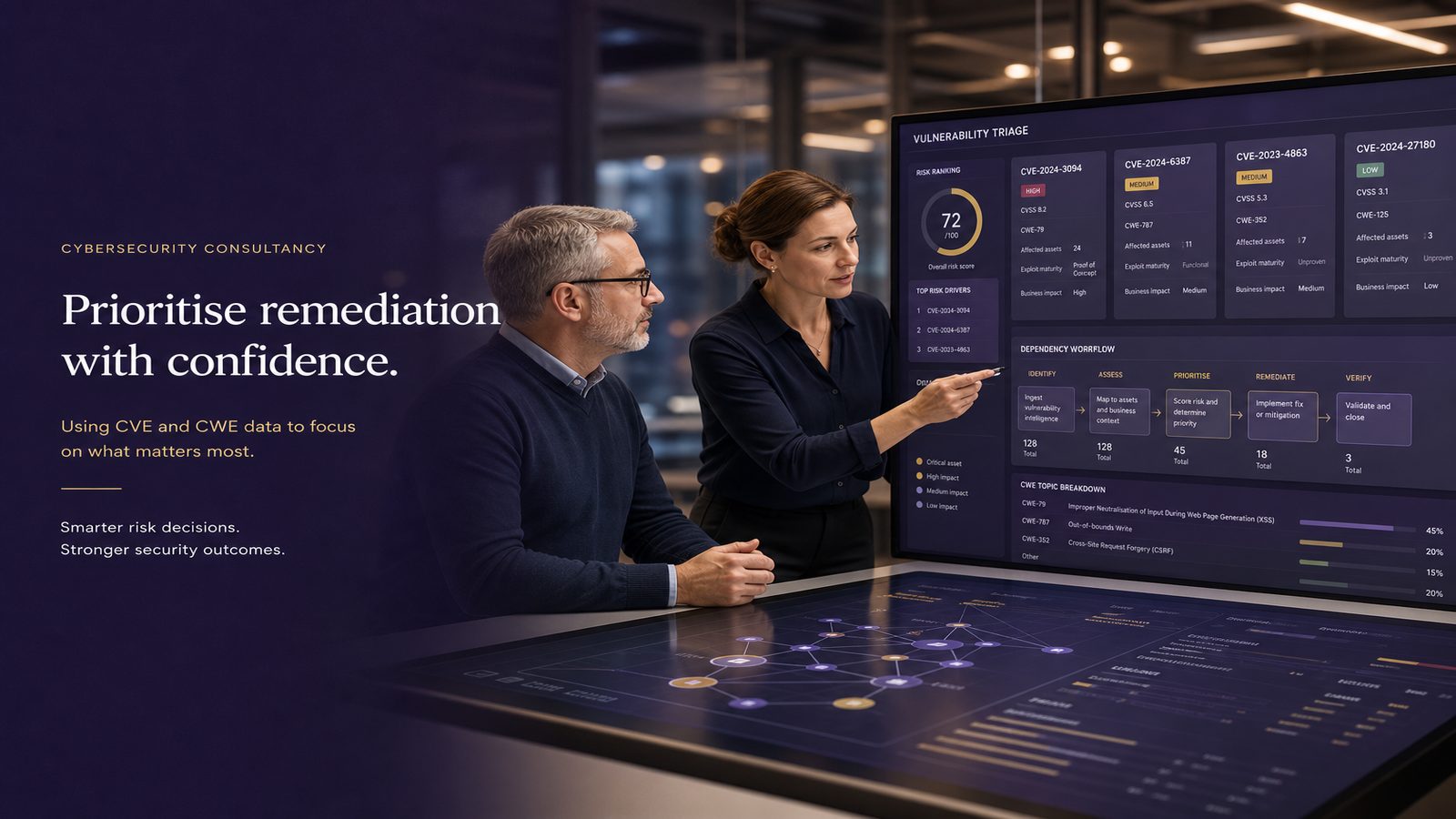
Using CVE and CWE data to prioritise remediation
For many UK SMEs, vulnerability management can become a long list of issues, scanner results, supplier notices, and patch requests. It is easy to end up fixing whatever looks most urgent on the day, rather than what reduces risk most effectively.
That is where CVE and CWE data can help. Used together, they give you two useful views of the same problem. CVE tells you about a specific known vulnerability in a product or component. CWE helps you understand the underlying weakness type, such as weak input handling, poor authentication logic, or insecure configuration. One is about the named issue. The other is about the pattern behind it.
For a small team, the aim is not to build a complex security function. It is to make better decisions with the information you already have. If you can combine vulnerability data with asset importance, exposure, and business context, you can prioritise remediation in a way that is more practical and more defensible.
What CVE and CWE mean in practice
CVE as a record of known vulnerabilities
CVE stands for Common Vulnerabilities and Exposures. In simple terms, it is a reference number for a publicly known vulnerability. If a scanner, supplier bulletin, or security advisory mentions a CVE, it is pointing to a specific issue that has been identified and tracked.
For example, a CVE may relate to a flaw in a web server, a library, or a framework your application uses. The value of the CVE is that it gives your team a common reference point. It helps you confirm whether you are affected, whether a fix exists, and whether the issue is already being exploited in the wild.
CWE as a way to describe the underlying weakness
CWE stands for Common Weakness Enumeration. Rather than describing one specific vulnerability, it describes a class of weakness. That might be something like missing input validation, use of hard-coded credentials, or improper access control.
This matters because the same weakness can appear in many different products and codebases. If you only focus on the CVE, you may fix the immediate issue but miss the wider pattern. If you also understand the CWE, you can reduce the chance of the same type of problem appearing again in future releases.
Why SMEs should use both views together
Balancing immediate fixes with longer-term weakness reduction
Most SMEs need to balance short-term remediation with longer-term improvement. CVE data is useful for the immediate response. It tells you what is known, what is affected, and what may need patching or mitigation now. CWE data is useful for the longer view. It shows whether the same kind of weakness keeps appearing in your applications, supplier products, or internal tooling.
Used together, they help you avoid a narrow patch-only mindset. Patching is important, but patching alone does not always reduce the underlying risk. If the same weakness keeps recurring, your team may spend time chasing symptoms rather than improving the way software is built and changed.
Avoiding a patch-only approach that misses root causes
A patch-only approach can create a false sense of progress. You may clear scanner findings for one release, only to see similar issues return in the next one. That is often a sign that the remediation process is not feeding back into secure development, code review, or design decisions.
CWE data helps you spot those repeat issues. If several findings map to the same weakness type, that is a clue that the root cause may sit in a shared library, a common coding pattern, or a gap in engineering standards. In that case, the best remediation may be a combination of patching, code changes, and process improvement.
How to decide what to fix first
Considering exposure, exploitability, and business impact
Severity scores are useful, but they should not be the only factor. A high-severity CVE in a system that is not exposed and is tightly controlled may be less urgent than a medium-severity issue in a customer-facing service that handles sensitive data.
A practical prioritisation approach should consider three things:
- Exposure: Is the affected system internet-facing, internally accessible, or isolated?
- Exploitability: Is there evidence that the issue is easy to exploit, or already being used by attackers?
- Business impact: What happens if the system is compromised, unavailable, or manipulated?
For SMEs, business impact often matters more than technical severity alone. A vulnerability in a low-value test system is not the same as the same vulnerability in a payment workflow, a customer portal, or a system that stores personal data.
Using asset criticality and internet-facing status to refine priority
Asset criticality is a simple way of saying how important a system is to the business. You do not need a perfect classification scheme to make use of it. Even a basic split between critical, important, and non-critical systems can improve decision-making.
Internet-facing systems deserve special attention because they are easier to reach and often easier to attack. If a CVE affects a public service, a remote access tool, or a component used in a web application, it will usually sit higher in the queue than the same issue on an internal development machine.
When you combine CVE data with CWE context, you can also ask whether the weakness affects a high-risk part of the system. For example, a weakness linked to authentication, session handling, or input validation in a public application is usually more important than the same weakness in a low-risk internal utility.
Turning vulnerability data into a practical triage process
Grouping findings by severity, affected systems, and owner
Small teams often struggle because vulnerability data arrives in fragments. One tool reports CVEs, another reports code issues, and a supplier sends a separate advisory. The first step is to bring those findings into one triage view.
A simple triage process can group findings by:
- Severity or risk rating
- Affected system or application
- Business owner or technical owner
- Exposure level
- Whether a fix is available now
This makes it easier to see which issues belong together. It also helps avoid duplicated effort, where several teams are working on related problems without realising it.
Separating urgent remediation from planned engineering work
Not every issue needs the same response. Some findings should be treated as urgent remediation because they affect exposed systems, have a clear fix, and carry a meaningful risk of exploitation. Others are better handled as planned engineering work, especially where the issue is lower risk, harder to reach, or needs a code change that should be scheduled properly.
A useful rule of thumb is to separate:
- Immediate action: patch, isolate, disable, or mitigate quickly
- Planned work: code changes, refactoring, dependency updates, or design improvements
This distinction matters because it helps you avoid disrupting the business for issues that can wait, while still moving quickly on the ones that should not.
Using CWE patterns to reduce repeat issues
Spotting recurring weakness types across releases
Once you start tagging findings by CWE, patterns become easier to see. You may notice repeated issues around input validation, access control, insecure deserialisation, or secret handling. That is valuable because it shows where your development process is creating avoidable risk.
Recurring CWE patterns are especially useful for SMEs with small engineering teams. You may not have the volume of findings that a large enterprise sees, but even a handful of repeated weakness types can point to a meaningful gap in standards, training, or review practice.
Feeding lessons into secure coding and design reviews
The point of identifying a weakness pattern is to change future behaviour. If a CWE keeps appearing, feed that lesson into secure coding guidance, pull request reviews, and design checkpoints. For example, if access control issues keep recurring, make sure engineers know what good access checks look like and where they should be tested.
Design reviews are also a good place to use CWE trends. If a new feature introduces a pattern that has caused problems before, you can address it earlier, before the code reaches production. That is usually cheaper and less disruptive than fixing the same class of issue after release.
Common mistakes when prioritising remediation
Treating severity scores as the only factor
Severity scores are a starting point, not the full answer. They are useful for sorting, but they do not know your business. A medium-severity issue on a critical system may matter more than a high-severity issue on a low-value asset.
It is also worth remembering that severity does not always reflect context. A vulnerability may be rated highly because it is theoretically serious, but if it is not reachable in your environment, the practical risk may be lower. That does not mean you ignore it. It means you prioritise it sensibly.
Ignoring business context and compensating controls
Compensating controls are the safeguards already in place that reduce risk. Examples include network segmentation, strong authentication, restricted access, monitoring, or temporary isolation. If you ignore these controls, you may over-prioritise some issues and under-prioritise others.
Business context matters too. If a system supports a key customer service, payroll, or regulated process, the impact of disruption may be higher than the technical issue alone suggests. Good prioritisation takes that into account without becoming overly complicated.
A simple operating model for UK SMEs
Assigning ownership, deadlines, and escalation paths
For a small organisation, the most effective remediation process is usually the one people can actually follow. Start by assigning each finding to a named owner. That owner should know whether they are responsible for fixing it, coordinating a fix, or deciding that a mitigation is more appropriate.
Each item should also have a target date and an escalation path. If the deadline is missed, someone should know what happens next. That might mean raising it to a manager, moving it into a risk register, or agreeing a temporary control until the issue is resolved.
This does not need to be bureaucratic. It just needs to be clear enough that important issues do not disappear into a spreadsheet.
Reviewing trends to improve remediation decisions over time
Remediation should improve over time. A monthly or quarterly review can show whether the same CVEs keep appearing, whether certain CWEs are recurring, and whether fixes are being delivered within a reasonable time. That review can also highlight where process changes are needed.
For example, if most urgent issues come from a particular supplier, you may need better procurement checks. If the same weakness appears in your own code repeatedly, you may need stronger secure coding standards or more focused training. If fixes are delayed because ownership is unclear, the answer may be simpler governance rather than more tooling.
The aim is not to create a perfect vulnerability management function. It is to make better decisions, reduce repeat work, and focus effort where it will reduce risk most.
For many UK SMEs, that is a realistic and worthwhile improvement.
Practical next steps
If you want to start using CVE and CWE data more effectively, begin with a small set of systems and a simple triage model. Record the CVE, the affected asset, the business owner, the exposure level, and the likely weakness type if you can identify it. Then review whether the issue needs immediate remediation, planned engineering work, or a temporary mitigation.
Over time, look for patterns. The more consistently you connect vulnerability data to business context and weakness trends, the easier it becomes to prioritise work that genuinely reduces risk.
If you would like help shaping a practical vulnerability management approach for your organisation, speak to a consultant.
Further reading
MITRE CVE and CWE entries can be useful reference points when you are mapping specific vulnerabilities to underlying weakness types. For teams that want to go a step further, the MITRE CWE catalogue helps explain why the same class of issue keeps reappearing across different systems.
OWASP guidance on secure coding and vulnerability management can also support internal discussions about recurring weakness patterns and how to reduce them during development.
Microsoft Security Development Lifecycle materials are helpful if you want to connect remediation trends back to design reviews, code review, and release processes.
UK NCSC guidance on vulnerability management is a useful reference when building a lightweight process that fits a small organisation.
UK Government secure software guidance can help suppliers and product teams align remediation priorities with broader secure development expectations.
For teams that want a structured way to improve secure development maturity, OWASP SAMM can provide a useful framework for discussion and planning.
Frequently asked questions
What is the difference between CVE and CWE? CVE identifies a specific known vulnerability, while CWE describes the underlying weakness type. CVE helps you fix the immediate issue. CWE helps you understand and reduce the broader pattern.
How can a small team use vulnerability data without creating too much process? Keep it simple. Track the affected asset, owner, exposure, business impact, and whether the issue maps to a recurring weakness type. A short, consistent triage process is usually more useful than a large workflow that nobody follows.
Should we always fix the highest CVSS score first? Not necessarily. CVSS or similar severity scores are useful, but they should be balanced with exposure, exploitability, business impact, and compensating controls. The most urgent issue is often the one that creates the greatest practical risk in your environment.
How does CWE data help with prevention? If the same weakness type keeps appearing, it suggests a repeatable cause. That can feed into secure coding standards, design reviews, testing, and developer training, which helps reduce future findings rather than just clearing current ones.
Comments are closed