
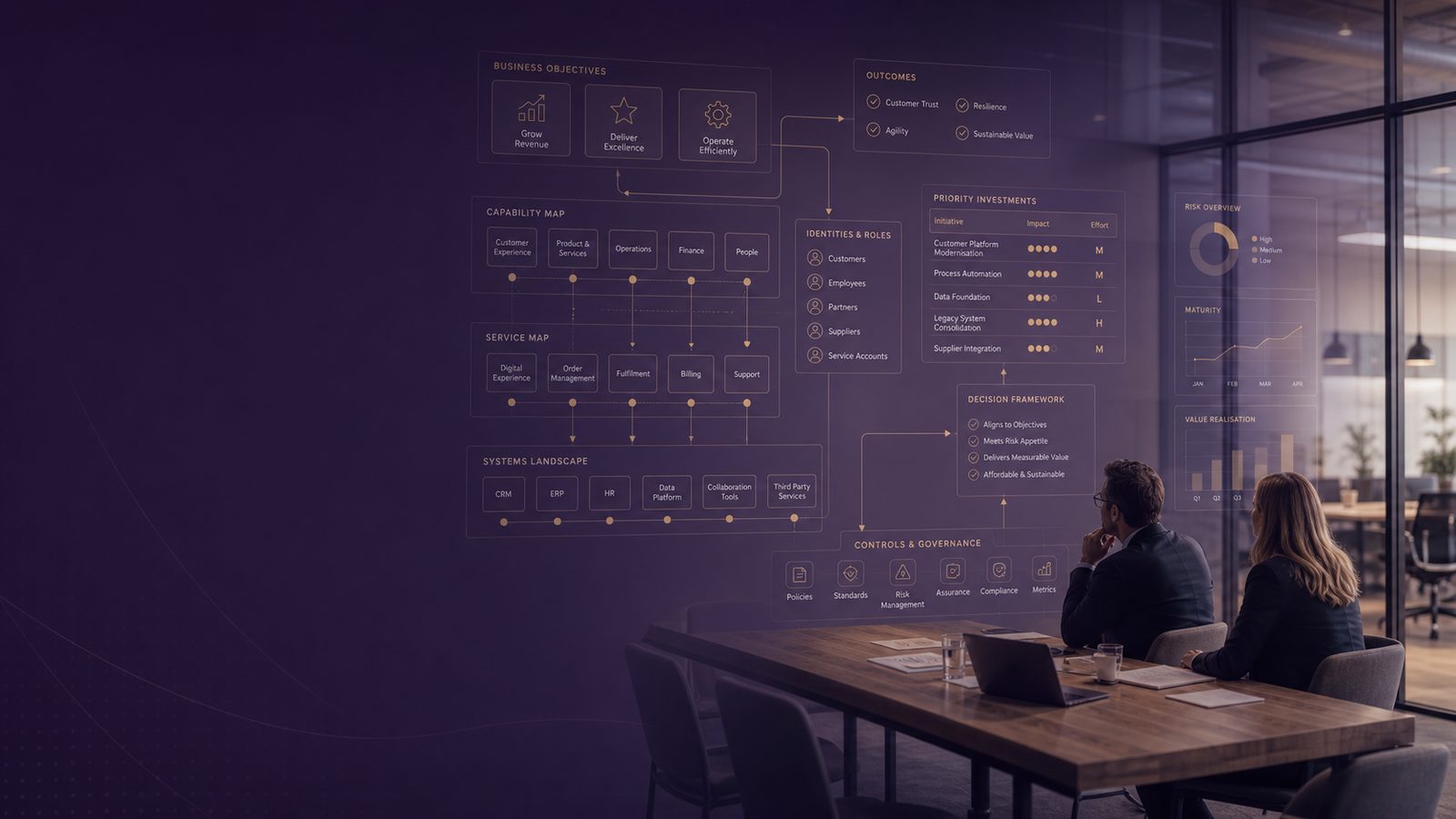
Aligning security architecture to business objectives for UK SMEs
For many UK SMEs, security architecture starts as a set of sensible controls: multi-factor authentication, backups, logging, access restrictions, and secure configuration. Those controls matter. But they only work well when they are designed around what the business is trying to achieve.
That is the real test of good security architecture. It should help the organisation stay open, serve customers, protect data, and grow without creating unnecessary friction. If security becomes disconnected from business priorities, it can end up slowing delivery, increasing cost, or leaving important risks untreated.
For smaller organisations, this balance is especially important. Most SMEs do not have unlimited budget, large security teams, or time to manage complex controls. The aim is not to build the most elaborate architecture. The aim is to build one that is proportionate, understandable, and aligned to the way the business actually operates.
Why security architecture should start with business goals
Security architecture is the way your systems, data, identities, and controls are designed to work together. In plain English, it is the structure behind how you protect the business.
If that structure is built without reference to business goals, it is easy to optimise for the wrong thing. A control that looks strong on paper may not help the organisation if it makes day-to-day work harder, delays sales, or creates too much administration for a small team.
What business objectives usually matter for SMEs
Most SMEs care about a similar set of outcomes, even if the details differ by sector. These often include keeping services available, protecting customer trust, avoiding avoidable disruption, supporting growth, and keeping operating costs under control.
Some businesses also have specific priorities such as meeting customer security requirements, protecting intellectual property, supporting remote work, or maintaining service levels during busy periods. Security architecture should reflect those priorities rather than applying a one-size-fits-all model.
How security decisions can support growth, resilience, and efficiency
Well-designed security can help the business move faster, not slower. For example, clear identity controls can make onboarding more consistent. Good segmentation can limit the impact of a technical issue. Reliable backups can reduce the business impact of an outage. Centralised logging can make investigations quicker and less disruptive.
When security is aligned to business objectives, it becomes part of operational resilience. That means the organisation is better able to continue working through incidents, change, and growth.
Turning business priorities into security requirements
The practical challenge is translating broad business goals into security requirements. That means moving from statements such as “we need to protect customer trust” to more concrete design choices.
A useful starting point is to ask what would hurt the business most if it were lost, exposed, altered, or unavailable. That may be customer records, finance systems, email, production systems, supplier portals, or the ability for staff to authenticate securely.
Identifying what needs protecting most
Not everything needs the same level of protection. An SME should identify its most important assets and services, then decide what level of control is proportionate for each one.
For example, a customer-facing system may need stronger availability and monitoring than an internal reference site. Finance systems may need tighter access control than general collaboration tools. A development environment may need separation from live data. These are architecture decisions, not just policy decisions.
It also helps to consider dependencies. A business service may look simple from the outside, but depend on identity systems, cloud platforms, third-party software, backups, and network connectivity. If one of those supporting layers fails, the business service may fail too.
Linking risk, value, and operational impact
Security requirements should reflect three things together: the value of what is being protected, the likelihood of something going wrong, and the impact if it does. That impact is not only financial. It can include lost time, missed orders, damaged reputation, staff disruption, or manual workarounds.
This is where business language matters. A technical control should be justified in terms the leadership team can understand. For example, “this reduces the chance of unauthorised access to payroll data” is more useful than “this improves identity assurance”.
That does not mean every decision needs a detailed business case. It does mean the business should be able to explain why a control exists, what risk it addresses, and what would happen if it were not there.
Common ways security architecture drifts away from business needs
Even well-intentioned security programmes can drift. This usually happens gradually, especially when controls are added in response to isolated incidents, customer pressure, or general concern rather than a clear design approach.
Overengineering controls that slow delivery
One common problem is overengineering. This can happen when controls are designed as if the organisation were much larger or more heavily regulated than it really is. The result may be too many approval steps, too much manual checking, or complex tooling that only a few people understand.
Overengineering often creates hidden costs. Staff find workarounds, projects take longer, and the security team spends more time maintaining controls than improving them. In some cases, the business becomes less secure because people start bypassing inconvenient processes.
For SMEs, simplicity is often a strength. A smaller number of well-understood controls, applied consistently, is usually better than a large control set that nobody can operate properly.
Underinvesting in areas that create avoidable business disruption
The opposite problem is underinvestment. Some organisations focus heavily on visible controls, such as endpoint protection or password rules, while underinvesting in areas that reduce business disruption, such as backups, recovery planning, logging, or identity governance.
This can leave the business exposed to avoidable operational pain. If a key system fails, if access is misconfigured, or if an incident needs investigation, the lack of supporting architecture can make recovery slower and more expensive.
Good architecture takes the whole operating model into account. It should support prevention, detection, response, and recovery, not just one of those areas.
A practical approach to balancing protection and usability
There is no perfect security architecture. Every SME has to make trade-offs based on budget, maturity, risk appetite, and operational needs. The goal is to make those trade-offs deliberate rather than accidental.
Choosing controls that fit the organisation’s size and maturity
Controls should be proportionate. A small business with a lean IT function may need different design choices from a larger organisation with dedicated security staff. That does not mean weaker security. It means controls that can realistically be run, monitored, and improved.
When choosing controls, consider how they will be operated in practice. Who will administer them? How often will they need review? What happens when someone is on leave? Can the business still function if the control fails? These questions matter as much as the control itself.
It is also worth thinking about maturity. An SME may not be ready for complex automation or advanced segmentation straight away. In that case, a phased approach is often better: establish the basics first, then improve the design as the business becomes ready.
Making trade-offs explicit for leadership
Security decisions should not sit only with technical teams. Leadership needs to understand the trade-offs, because those trade-offs affect cost, speed, resilience, and customer experience.
For example, stronger access controls may reduce the risk of unauthorised access, but they may also add friction for staff. More detailed logging may improve visibility, but it may also increase storage and management overhead. Tighter network restrictions may improve containment, but they may also complicate remote support or integrations.
The point is not to avoid these trade-offs. The point is to make them visible, discuss them openly, and choose the option that best supports the business objective.
How to review whether your architecture is still aligned
Alignment is not a one-time exercise. Businesses change, systems change, and risks change. A security architecture that made sense last year may no longer fit the organisation today.
Using change, incidents, and business growth as review triggers
There are several moments when a review is especially useful. These include major system changes, new supplier relationships, mergers or acquisitions, office moves, new regulations from customers, significant incidents, and periods of rapid growth.
Growth is a common trigger. A control that worked for a team of 20 may not work for a team of 80. Likewise, a business that has moved from local operations to remote or hybrid working may need a different identity, access, and monitoring approach.
Incidents are also valuable learning points. Even a small issue can reveal where the architecture is too fragile, too manual, or too dependent on one person’s knowledge.
Keeping architecture decisions under regular governance
Regular governance does not need to be heavy. For many SMEs, a simple quarterly or biannual review is enough to keep decisions current. The review should ask whether the controls still match the business, whether any major risks have changed, and whether any controls have become burdensome or ineffective.
It helps to keep a short record of key architecture decisions. That record should explain what was decided, why it was decided, and what assumptions were made. When the business changes, those assumptions can be revisited quickly.
This kind of governance is useful because it prevents security from becoming a collection of disconnected tools. Instead, it remains a managed part of the business operating model.
A simple checklist for SME decision-makers
If you are responsible for approving security changes, you do not need to become a technical architect. You do, however, need enough structure to ask the right questions.
Questions to ask before approving new controls
Before approving a new control, ask: what business problem does this solve, what risk does it reduce, who will operate it, how much effort will it add, and what happens if it is unavailable?
Also ask whether the control fits the way the business works. If it creates too much friction, staff may avoid it. If it depends on specialist knowledge that the business does not have, it may be difficult to sustain.
Finally, ask whether there is a simpler way to achieve the same outcome. In SME environments, the simplest workable design is often the most resilient.
Signs that architecture needs a reset
There are a few warning signs that your architecture may no longer be aligned. These include repeated workarounds, controls that nobody can clearly explain, frequent exceptions, slow onboarding, inconsistent access management, and recurring incidents in the same area.
Another sign is when security and business teams are talking past each other. If technical controls are being added without a clear business reason, or business teams are frustrated by controls they do not understand, the architecture probably needs a review.
A reset does not always mean starting again. Often it means simplifying, removing duplication, clarifying ownership, and redesigning around the business priorities that matter most now.
Bringing it all together
For UK SMEs, aligning security architecture to business objectives is about making security useful, sustainable, and proportionate. It means protecting what matters most, supporting continuity, and avoiding unnecessary complexity.
The best security architecture is not the most impressive on paper. It is the one that helps the business operate with confidence, recover when things go wrong, and adapt as it grows.
If you want a practical view of where your current architecture supports the business, and where it may be creating friction or blind spots, a structured review can help. Speak to a consultant if you would like support shaping a risk-based approach that fits your organisation.
Key points: Security architecture works best when it supports business priorities such as continuity, customer trust, and manageable operating cost. For SMEs, the aim is not maximum control, but the right level of protection for the organisation’s risks and resources.
Optional next step: If you are reviewing your current controls, it can help to map them against your most important services, owners, and business impacts before making changes.
Frequently asked questions
How do I align security architecture with business objectives in an SME?
Start by identifying what the business is trying to protect and enable, such as customer trust, service availability, growth, and cost control. Then translate those priorities into practical security requirements for the systems and data that matter most. The article suggests using business language so leadership can understand why a control exists and what risk it addresses.
What should I protect first when designing security controls?
Focus first on the assets and services that would hurt the business most if they were lost, exposed, altered, or unavailable. That may include customer records, finance systems, email, production systems, or the ability for staff to authenticate securely. It also helps to look at the dependencies behind those services, such as identity systems, cloud platforms, backups, and network connectivity.
How can security help rather than slow down the business?
When security is designed well, it can support onboarding, limit the impact of incidents, and make investigations quicker. The article gives examples such as clear identity controls, good segmentation, reliable backups, and centralised logging. The aim is to make security part of operational resilience, not a separate layer that creates unnecessary friction.
What does overengineering security look like for a small business?
Overengineering usually means adding too many approval steps, too much manual checking, or tools that only a few people understand. This can slow delivery, increase hidden costs, and encourage staff to work around the controls. For SMEs, the article recommends a smaller number of well-understood controls that can be operated consistently.
How do I decide whether a security control is proportionate?
A proportionate control should reflect the value of what it protects, the likelihood of something going wrong, and the impact if it does. The article suggests thinking about both financial and operational impact, such as lost time, missed orders, reputation damage, and staff disruption. If a control cannot be explained in business terms, it may be worth revisiting its purpose and fit.
Comments are closed