
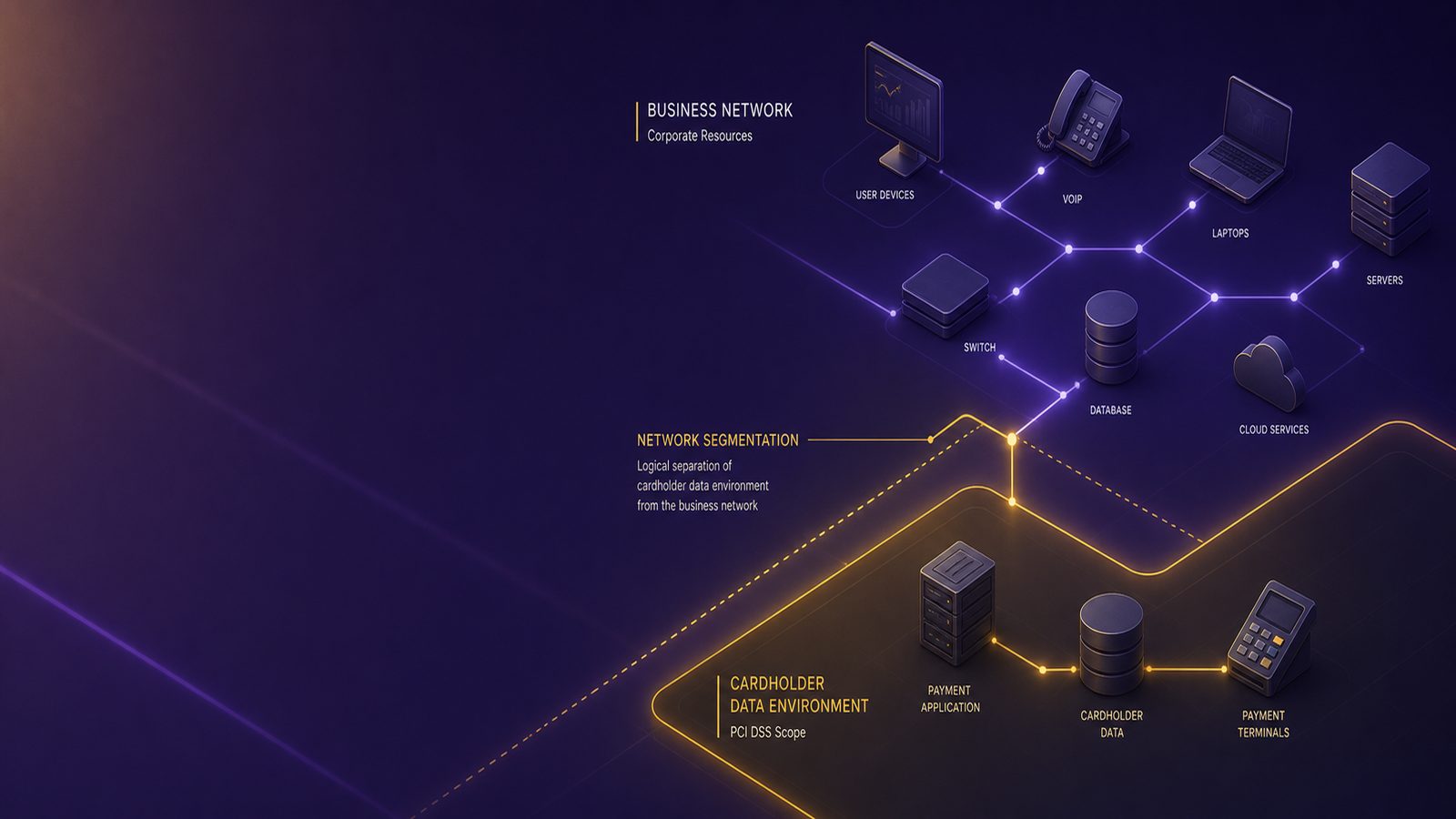
Implementing network segmentation for PCI DSS: a practical guide for UK SMEs
For many UK SMEs, PCI DSS can feel like a technical standard that belongs in larger organisations with dedicated network teams. In practice, one of the most useful ways to make the requirement more manageable is to think carefully about network segmentation. Done well, segmentation helps separate cardholder data from the rest of the business, reduces the number of systems in scope, and makes day-to-day control more practical.
This article is not a full explanation of PCI DSS. It focuses on the practical side of implementing network segmentation for PCI DSS in a small or mid-sized business. The aim is to help you make sensible design choices, avoid common mistakes, and build something that your team can actually operate.
What network segmentation means in a PCI DSS context
Network segmentation means dividing your environment into separate parts so that not every system can talk to every other system. In a PCI DSS context, the most important separation is between the cardholder data environment, often shortened to CDE, and the rest of the business network.
The CDE is the part of the environment that stores, processes, or transmits cardholder data. If you can keep that area tightly separated, you reduce the chance that a problem elsewhere in the business spreads into the systems handling payment data.
Why segmentation matters for cardholder data environments
Without segmentation, the cardholder data environment can become much larger than it needs to be. That usually means more servers, more user devices, more remote access paths, and more administration overhead. It also means more systems need to be considered when you are reviewing access, monitoring, patching, and change control.
Segmentation does not remove the need for good security controls. It does, however, make those controls easier to focus. If only a small set of systems can reach the CDE, then you have fewer places to secure and fewer places to investigate if something looks wrong.
How segmentation can reduce exposure without overcomplicating the network
For SMEs, the goal should not be to build a complicated network architecture for its own sake. The goal is to create clear boundaries that match how the business actually uses payment data. A simple, well-documented design is usually better than a clever design that nobody understands six months later.
In many cases, the right approach is to keep the CDE small, restrict traffic into and out of it, and make sure only approved systems and people can reach it. That can often be achieved with a combination of network separation, firewall rules, and access control rather than a complete redesign.
Where segmentation fits in a small business environment
SME networks are often built for convenience first. That is understandable. A typical environment may include office laptops, shared file services, cloud applications, a point-of-sale system, remote support tools, and perhaps a small number of on-premises servers. Payment-related systems may sit alongside general business systems unless someone has deliberately separated them.
That mixed setup is where segmentation becomes useful. You do not need to isolate everything from everything else. You do need to identify which systems genuinely belong near cardholder data and which do not.
Typical SME network layouts and common card data flows
Common card data flows in SMEs often involve a payment terminal, a payment application, a back-office system, and sometimes a support or reporting platform. In some cases, card data never needs to be stored locally at all, which can simplify the design considerably. In other cases, a business may have legacy systems that still touch payment data in some way.
The first step is to map those flows clearly. Ask where card data enters the environment, where it goes, which systems handle it, and whether any system stores it. You should also identify any management tools, remote access services, logging platforms, or backups that can reach those systems.
Identifying systems that should be separated from the cardholder data environment
Once you understand the flows, separate the systems that do not need direct access to the CDE. That usually includes general office devices, guest Wi-Fi, development systems, test environments, and most third-party support tools. If a system does not need to touch cardholder data, it should not be able to reach the CDE by default.
This is a useful principle for SMEs because it keeps the design grounded in business need. Every connection into the CDE should have a clear reason. If you cannot explain why a system needs access, it probably should not have it.
Start with scope, not technology
It is tempting to start by asking whether you need VLANs, firewalls, or a new network appliance. That is the wrong starting point. The better question is: what is in scope, and what really needs to connect to it?
When you begin with scope, you can make better decisions about the controls you need. You may find that the environment can be simplified before any technical change is made.
Mapping cardholder data flows and connected systems
Build a simple map of the systems involved in payment processing. Include endpoints, servers, network devices, cloud services, remote support tools, and any third-party connections. For each one, note whether it stores, processes, transmits, or can access cardholder data.
Also record the direction of traffic. A system that only sends logs out of the CDE is different from one that can log in and administer a payment server. The more clearly you understand the direction and purpose of each connection, the easier it is to design sensible controls.
Using scope reduction to focus effort on the right assets
Scope reduction is about removing unnecessary systems from the cardholder data environment. Segmentation is one of the main ways to do that. If you can prove that a system cannot reach the CDE, it may no longer need to be treated as part of that environment.
That can save time and effort, but only if the boundary is real and maintained. A diagram on its own is not enough. The controls must match the design, and the design must match how the business operates.
Practical segmentation patterns for SMEs
Most SMEs do not need an elaborate architecture. A practical design usually uses a few well-understood building blocks: separate network segments, restrictive firewall rules, controlled administration paths, and limited remote access.
VLANs, firewalls, and access controls in plain English
A VLAN, or virtual LAN, is a way of separating devices on the same physical network into different logical groups. It is useful for keeping traffic apart, but by itself it is not enough. You still need firewall rules or equivalent controls to decide what traffic is allowed between segments.
A firewall is the control point that decides which connections are permitted. In a PCI DSS context, that usually means allowing only the minimum traffic needed for the business process, and blocking everything else by default.
Access controls are the rules that decide who or what can connect. These should cover both users and systems. For example, an administrator may need access to a payment server, but only from a managed device, through a controlled jump point, and only using approved credentials.
When logical separation is enough and when stronger isolation is sensible
Logical separation is often enough for smaller environments where the payment systems are limited and the network is well managed. That might mean separate VLANs, strict firewalling, and tightly controlled administration.
Stronger isolation becomes more sensible when the environment is more complex, when there are legacy systems that are difficult to trust, or when the business has multiple teams and suppliers touching the same infrastructure. In those cases, a more rigid boundary can reduce the chance of accidental exposure.
The right answer depends on the risk, not on a generic template. A small retailer with a simple payment setup will usually need a different design from an SME operating several sites with shared services and remote support.
Designing controls that are workable day to day
A segmentation design only works if people can operate it without finding workarounds. If staff regularly need exceptions to do their jobs, the design is probably too loose, too rigid, or too poorly understood.
The most effective designs are the ones that fit normal business activity while still keeping the CDE tightly controlled.
Admin access, remote access, and third-party support paths
Administrative access deserves special attention because it often provides the shortest route into sensitive systems. Admin accounts should be limited, monitored, and separated from normal user accounts. Where possible, administration should happen from dedicated management devices or controlled admin workstations rather than from everyday office laptops.
Remote access should also be tightly managed. If staff or suppliers need to connect from outside the office, use a controlled remote access method with strong authentication and clear logging. Avoid leaving broad remote access paths open into the CDE.
Third-party support is another common weak point. Suppliers may need access for maintenance or troubleshooting, but that access should be time-limited, approved, and restricted to the systems they genuinely need. If a supplier only needs to support a payment application, they should not automatically be able to reach the rest of the network.
Logging, monitoring, and change control for segmented networks
Segmentation is easier to trust when you can see what is happening. Log connections into and out of the CDE, especially administrative activity, failed access attempts, and changes to firewall rules or network configuration. You do not need a huge monitoring platform to start with, but you do need enough visibility to spot unexpected access.
Change control matters because segmentation often fails gradually. A temporary rule becomes permanent. A new supplier needs access. A new server is added to the wrong segment. Each small change can weaken the boundary if it is not reviewed properly.
Keep a simple approval process for changes that affect the CDE or the rules protecting it. That process should include a check that the change is still necessary and that it does not widen access more than intended.
Testing whether segmentation is actually effective
It is not enough to assume segmentation works because the network diagram looks sensible. You need to test the boundary in a practical way. The aim is to confirm that traffic is restricted as intended and that systems outside the CDE cannot reach it without an approved path.
Validating that traffic is restricted as intended
Validation can be straightforward. Check whether systems in one segment can reach systems in another segment when they should not. Review firewall rules against the documented data flows. Confirm that administrative access only works from approved locations and devices. Make sure test and development systems cannot talk to production payment systems unless there is a clear, controlled reason.
It is also worth checking indirect paths. A system may not have direct access to the CDE, but it might still be able to reach a management server that does. Those chained connections can undermine the boundary if they are not considered carefully.
Common weaknesses that undermine segmentation
Several issues come up repeatedly in SME environments. Flat networks are one of the most common, where too many systems sit on the same segment. Overly broad firewall rules are another, especially where rules were added quickly to solve a business problem and never tightened afterwards.
Shared admin credentials, unmanaged remote access tools, and supplier accounts with too much privilege can also weaken segmentation. So can forgotten test systems, old VPN profiles, and network devices that were installed during a project and never reviewed again.
Another common problem is relying on documentation that no longer matches reality. If the diagram says one thing but the live network does another, the segmentation boundary is not dependable.
Maintaining segmentation over time
Segmentation is not a one-off project. It needs to be maintained as the business changes. New locations, new payment systems, cloud services, supplier relationships, and staff changes can all affect the boundary.
Keeping diagrams, rules, and inventories aligned
Keep network diagrams, firewall rules, asset inventories, and access lists in step with each other. If a payment server is added, it should appear in the inventory and the diagram, and the firewall rules should reflect how it is actually used. If a supplier account is removed, that should be reflected everywhere too.
This does not need to be complicated. A small business can maintain useful records with a disciplined spreadsheet, a clear diagram, and a regular review cycle. The important thing is consistency.
Reviewing segmentation after business or infrastructure changes
Review segmentation whenever there is a meaningful change. That could include a new payment provider, a network refresh, a move to a new office, a merger, a new managed service provider, or a change in how staff work remotely.
These changes often create hidden dependencies. A system that used to be isolated may now share services with something else. A temporary exception may no longer be temporary. Regular review helps you catch those shifts before they become a problem.
When to seek specialist help
Some SME environments are straightforward enough to manage internally. Others become difficult because the payment environment is mixed with legacy systems, multiple suppliers, or older network design decisions that are hard to unwind.
Signs the environment is becoming difficult to manage
If you are struggling to explain which systems are in scope, if firewall rules have grown over time without a clear pattern, or if remote access is handled in several different ways, it may be time to step back and simplify. The same applies if you cannot confidently test the boundary or if the team is unsure which changes affect the CDE.
These are usually signs of complexity rather than failure. They simply mean the environment would benefit from a more structured review.
How advisory support can help prioritise practical improvements
External advisory support can help you map the environment, identify unnecessary connections, and decide where segmentation will give the best return for effort. For UK SMEs, that often means focusing on the highest-risk paths first rather than trying to redesign everything at once.
A good consultant should help you make the design workable, not just technically neat. That includes considering how the business operates, how suppliers support the environment, and how the controls will be maintained after the initial project ends.
If you would like help thinking through your PCI DSS segmentation approach, we can discuss practical options and help you prioritise the changes that matter most for your environment.
Conclusion
Implementing network segmentation for PCI DSS is best approached as a scoping and risk-reduction exercise. For UK SMEs, the aim is to keep the cardholder data environment small, separate it from the rest of the business, and make sure the boundary is clear enough to operate and test.
Start with the data flows, not the technology. Keep the design simple where you can. Restrict access by default. Test the boundary properly. Then review it whenever the business changes. That approach will not guarantee compliance, but it will give you a much stronger and more manageable foundation for PCI DSS work.
If you want a second pair of eyes on your segmentation design, speak to a consultant and we can help you assess the practical next steps.
Frequently asked questions
What is network segmentation in PCI DSS terms?
Network segmentation means dividing your environment so that not every system can talk to every other system. In a PCI DSS context, the key separation is between the cardholder data environment, or CDE, and the rest of the business network. The aim is to keep systems that store, process or transmit cardholder data tightly controlled and easier to manage.
Why does segmentation help reduce PCI DSS scope?
If the CDE is kept small and well separated, fewer systems need to be considered when you review access, monitoring, patching and change control. That can make the security work more focused and practical for an SME. Segmentation does not remove the need for controls, but it can help you apply them to a smaller set of assets.
What should I map before designing segmentation for cardholder data?
Start by mapping where card data enters the environment, where it goes, which systems handle it, and whether any system stores it. It is also sensible to note any management tools, remote access services, logging platforms or backups that can reach those systems. A simple map of data flows and connected systems is usually the best place to begin.
Which systems should usually be kept away from the cardholder data environment?
Systems that do not need direct access to cardholder data should not be able to reach the CDE by default. That often includes general office devices, guest Wi-Fi, development systems, test environments and most third-party support tools. The basic test is whether you can explain a clear business reason for the connection.
Do I need a complex network design to segment PCI DSS systems?
Not usually. For many SMEs, a simple and well-documented design is better than a complicated one that is hard to operate. The article suggests keeping the CDE small, restricting traffic in and out of it, and using a mix of network separation, firewall rules and access control where that fits the business.
Comments are closed