
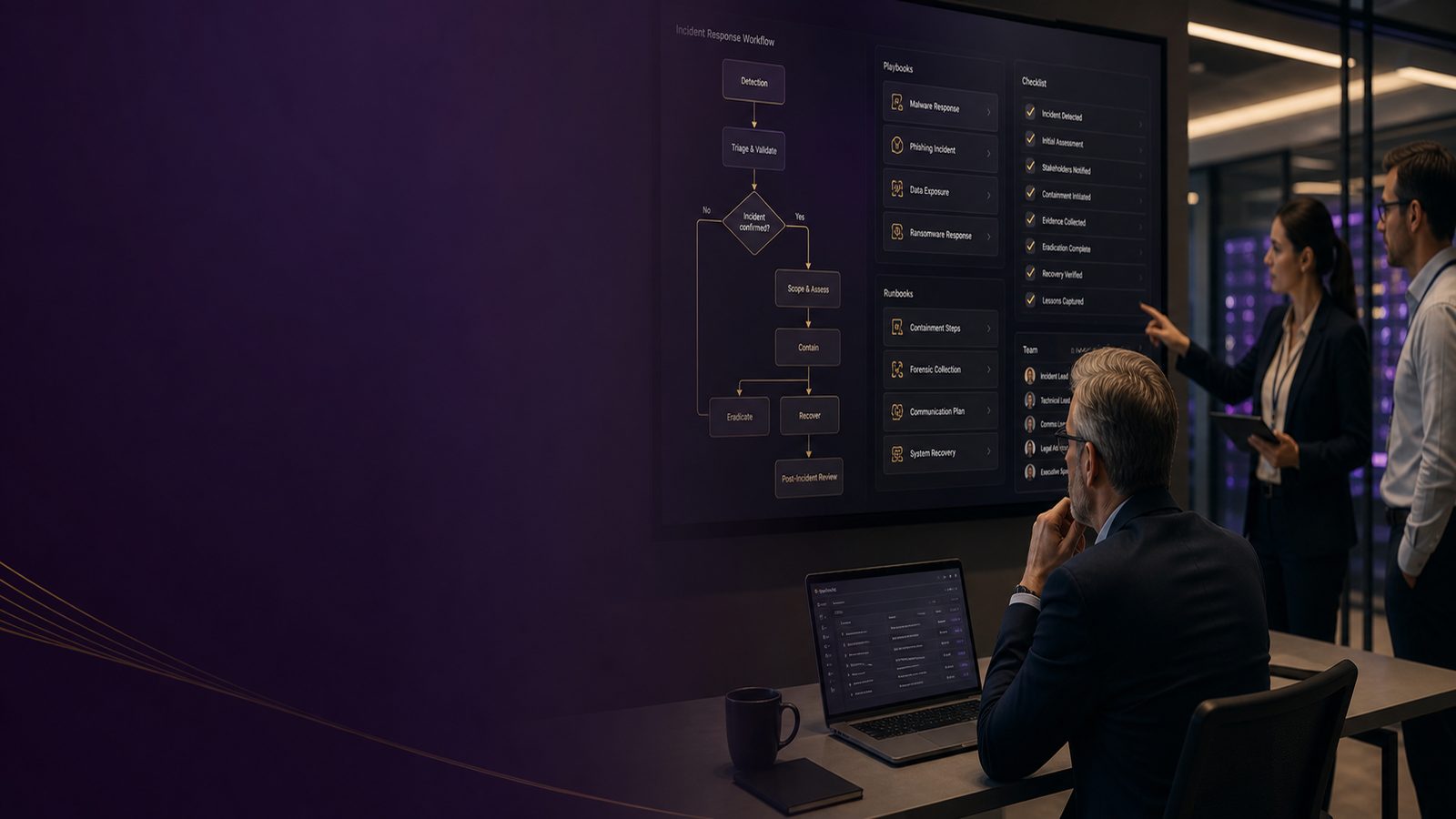
Incident response works best when the team is not trying to invent the process during a live event. For UK SMEs, the difference between a controlled response and a messy one is often whether the organisation has clear playbooks and runbooks that people can actually use under pressure.
A playbook sets out the response approach for a scenario such as account compromise, ransomware, or suspicious email activity. A runbook is the step-by-step technical procedure that supports a repeatable task inside that response, such as disabling an account, isolating an endpoint, or preserving logs. If you already have a broader response process in place, as covered in incident response fundamentals for SMEs, this article focuses on the operational design work that turns policy into action.
Key takeaways
- Start with a small number of high-value incident scenarios and write playbooks around decision-making, ownership, and escalation.
- Use runbooks for repeatable technical actions such as account disablement, endpoint isolation, mailbox containment, and evidence preservation.
- Link playbooks to your alert sources, triage criteria, and MITRE ATT&CK mapping so responders can move from detection to containment faster.
- Test every playbook with tabletop exercises and technical walk-throughs, then update it after incidents, drills, and tooling changes.
What incident response playbooks and runbooks are
In practice, a playbook is the decision framework. It tells responders what kind of incident they are dealing with, what the objective is, who owns the response, and when escalation is required. It should be scenario-based and outcome-focused. A runbook is narrower and more mechanical. It describes the exact actions to take, in order, with enough detail that a competent engineer or analyst can execute them consistently.
The distinction matters because not every incident needs the same level of detail. A playbook for suspected business email compromise might reference several runbooks: one for mailbox containment, one for identity reset, one for message trace review, and one for evidence capture. That structure keeps the playbook readable while still giving the team enough technical depth to act quickly.
Playbooks sit at the point where triage becomes response. They are the bridge between alert handling and containment, recovery, and post-incident review. If your team already uses a SOC-style workflow, the playbook should align with your triage and escalation model rather than sit alongside it. That is especially important if you have outsourced monitoring or a managed service provider, because the handover points need to be explicit.
Why SMEs need both documents
SMEs often assume that a small team can rely on memory and informal knowledge. That works until the person who knows the process is on leave, the incident happens out of hours, or a supplier needs to take action and is waiting for instructions. A good playbook reduces decision-making time, and a good runbook reduces execution errors.
The business value is straightforward. Clear response documents reduce time to contain, reduce confusion between teams, and make it easier to coordinate with external parties. They also help with consistency. If the same incident is handled differently each time, you will struggle to compare outcomes, improve controls, or show that lessons learned are being applied. That is one reason playbooks are a useful companion to incident triage and escalation workflows in SOC operations for UK SMEs.
For smaller organisations, the aim is not to create a large library of documents. It is to create a small set of reliable, well-maintained assets that cover the incidents most likely to disrupt operations or expose sensitive data. A concise, well-tested playbook is more useful than a long one that nobody trusts.
Start with scope and incident categories
Before writing anything, decide what the playbooks are for. Start with the incidents that matter most to your environment, your data, and your operating model. For many UK SMEs, the highest-value categories are identity compromise, endpoint compromise, email compromise, cloud account abuse, and ransomware.
Identity incidents deserve priority because they often provide the attacker with access to email, SaaS platforms, file storage, and admin portals. Endpoint incidents matter because they can be the entry point for credential theft, persistence, or lateral movement. Email incidents are common because they are easy to trigger and can be used for phishing, invoice fraud, and internal impersonation. Cloud incidents need their own handling because the evidence, logs, and containment actions are often different from on-premises systems. Ransomware deserves a dedicated playbook because it combines containment, recovery, evidence preservation, and business continuity decisions.
Do not try to cover every possible scenario on day one. A small set of strong playbooks will deliver more value than a large catalogue of weak ones. If you need a starting point for defensive control design around the systems that feed these incidents, the article on reducing attack surface using system hardening techniques for UK SMEs is a useful companion.
Define ownership, escalation, and decision points
Every playbook should name an owner. In a small organisation, that may be the IT lead, security lead, or service desk manager, but the role matters more than the job title. The owner is responsible for making sure the playbook is current, usable, and exercised. During an incident, the owner may also coordinate actions across internal staff and suppliers.
Escalation needs to be defined in practical terms. For example, a single suspicious login may remain a monitoring event, but multiple failed logins followed by a successful sign-in from an unusual location may trigger account containment and leadership notification. A workstation with malware alerts may require isolation, but a server hosting business-critical services may need a more cautious containment approach. The playbook should state who can approve disruptive actions, such as disabling a privileged account, taking a system offline, or blocking a business application.
It is also worth defining handover points. If your managed service provider performs first-line monitoring, when do they escalate to your internal team? When does the internal team involve leadership? When should legal advisers, insurers, or external incident responders be contacted? These decisions should be written down before anyone is under pressure.
Design the playbook structure
A practical playbook should be easy to scan. Use a consistent structure so responders know where to look. A good pattern is: trigger, objective, scope, roles, containment, investigation, recovery, communications, and closure criteria.
The trigger section should describe the conditions that open the playbook. This might be a high-confidence alert, a user report, a threat intelligence indicator, or a manual escalation from another team. The objective should state what success looks like. For example, the objective for an account compromise playbook might be to stop unauthorised access, preserve evidence, and restore trusted access without reintroducing risk.
Containment should explain the immediate actions that reduce harm. Investigation should list the evidence sources to check, such as identity logs, endpoint telemetry, email audit logs, or cloud activity logs. Recovery should describe how to return systems or accounts to service safely. Communications should cover who needs to know, what they need to know, and when. Closure criteria should define when the incident can be marked contained, recovered, and ready for post-incident review.
If you are designing response around automation, make sure the playbook distinguishes between manual and automated steps. The article on automated response and SOAR design patterns for security teams is relevant here, because automation should support the playbook rather than replace judgement in high-impact decisions.
Write runbooks for repeatable technical actions
Runbooks are where the technical detail lives. They should be specific enough to avoid ambiguity, but not so brittle that they break every time a tool changes. A good runbook includes prerequisites, exact steps, expected outcomes, rollback considerations, and notes on evidence preservation.
For identity containment, a runbook might include steps to disable the account in Entra ID or Active Directory, revoke active sessions, reset passwords, review recent sign-ins, and check for privilege changes or consent grants. For endpoint containment, it might cover isolating the device in your EDR platform, collecting volatile evidence if required, and confirming whether the host is still communicating with suspicious infrastructure. For mailbox containment, it might include disabling forwarding rules, checking inbox rules, reviewing sent items, and preserving audit logs.
Evidence handling belongs in the runbook, not as an afterthought. If you need to preserve logs, note where they are collected from, how long they are retained, and whether any action might overwrite or destroy useful data. Include change control notes where relevant, especially if the action affects production systems or shared services. If you want a deeper view of the evidence side, see why digital forensics matters after an incident.
Keep runbooks versioned and tied to the tools you actually use. A runbook for Microsoft Defender for Endpoint will look different from one for CrowdStrike, SentinelOne, or a native EDR capability. If the tooling changes, the runbook should change with it.
Build in detection and triage inputs
A playbook is more effective when it is linked to the signals that trigger it. Define the alert sources, enrichment data, and severity criteria that should feed each scenario. For example, an identity compromise playbook may use impossible travel, unfamiliar device, risky sign-in, or token abuse indicators. An endpoint playbook may use suspicious PowerShell, credential dumping behaviour, or unusual parent-child process chains.
Where useful, map the playbook to MITRE ATT&CK techniques. That helps analysts understand what the incident might represent in attacker terms and makes it easier to connect detection logic to response actions. For example, if a playbook is triggered by suspicious remote service creation or scheduled task persistence, the containment and investigation steps can be aligned to the likely technique rather than the raw alert name.
This mapping is not just for mature SOCs. Even a small team can benefit from a simple table that says: alert type, likely scenario, immediate action, evidence to collect, and escalation threshold. That makes triage faster and reduces the chance of treating every alert as a one-off.
Include communications and business coordination
Technical response fails when communication is improvised. Every playbook should say who needs to be told, what they need to know, and who is allowed to speak externally. Internal updates should be concise and factual. They should cover impact, current status, actions taken, and next decision point.
Customer messaging, supplier coordination, and insurer notification all need careful handling. The playbook should not draft legal statements, but it should identify when those parties need to be involved. For example, if a third-party platform is implicated, the supplier may need to confirm logs, reset credentials, or support containment. If the incident may affect service availability or data handling, leadership may need to decide on customer communication timing.
For organisations that rely on external support, the playbook should include the contact method, service window, and expected response time for each supplier. That avoids delays when the incident happens outside normal hours. If your response model includes cloud services or managed security tooling, it is worth aligning the playbook with your monitoring and containment architecture, as discussed in incident response fundamentals for SMEs and automating incident response to reduce impact for UK SMEs.
Make the documents usable during pressure
Usability is often the difference between a document that helps and one that gets ignored. Use short sections, clear headings, numbered steps, and plain language. Avoid burying the critical actions in long paragraphs. If a responder needs to isolate a host, they should not have to read three pages to find the command or portal path.
Store the documents where the response team can reach them even if primary systems are unavailable. That may mean a secure document repository with offline export, a read-only copy in a separate platform, or a printed emergency pack for critical scenarios. Access control matters too. The people who need to execute the runbooks should be able to reach them quickly, but the content should still be protected from unauthorised changes.
Version control is essential. Each playbook and runbook should have an owner, a review date, and a change history. If you use a ticketing or knowledge management platform, make sure the current version is obvious and old versions are archived. During an incident, nobody should be guessing which copy is current.
Test, validate, and improve the content
A playbook that has never been exercised is a theory, not an operational asset. Test it with tabletop exercises and technical walk-throughs. A tabletop exercise checks decision-making, escalation, and communication. A technical walk-through checks whether the runbook steps are accurate in the live tools and whether the team can complete them without confusion.
After each exercise, record what slowed the team down. Common issues include missing permissions, unclear ownership, outdated screenshots, and steps that assume access to a tool the responder does not have. Fix those issues quickly. If the exercise reveals that a containment action is too disruptive, adjust the playbook so the decision point is explicit and the approval path is clear.
Real incidents should also feed improvement. Update the playbooks after a genuine event, after a supplier change, and after major tooling changes. If you add a new EDR platform, change identity provider, or move logging to a new SIEM, the runbooks need to be reviewed immediately. This is where a continuous improvement mindset matters, and it is closely related to the approach described in using incidents and alerts to improve defence.
Common mistakes to avoid
The most common mistake is writing generic steps that do not match the environment. A runbook that says “check the logs” is not useful unless it identifies which logs, where they are, and what the responder should look for. Another common issue is unclear ownership. If nobody knows who can approve containment, the incident will stall.
Another trap is treating the documents as static. Response content should evolve with the environment. If the team changes, the supplier changes, or the tooling changes, the playbooks need to be reviewed. A stale runbook can be worse than none at all because it creates false confidence.
Finally, do not overcomplicate the first version. The goal is operational clarity, not completeness for its own sake. Start with the incidents you are most likely to face, write the minimum useful detail, and improve from there.
Practical starter set for UK SMEs
If you are building from scratch, start with four playbooks: suspected account compromise, suspicious email or phishing, endpoint malware or ransomware, and cloud service compromise. These cover a large share of the incidents that affect SMEs and they create reusable patterns for escalation, evidence capture, and recovery.
For each playbook, create a small set of runbooks. At minimum, include account disablement and session revocation, endpoint isolation and evidence capture, mailbox containment and message trace review, and log preservation. If you have a Microsoft-heavy environment, you may also want a runbook for Entra ID sign-in review, Exchange mailbox rule inspection, and Defender for Endpoint isolation actions.
As the library grows, keep the same structure across all documents. That consistency is what makes them usable under pressure. It also makes it easier to train new staff and bring in external responders without starting from zero.
If you want help turning your response process into a practical operating model, ClearPath Security can support design and implementation through our ISO 27001 Consultancy service. The aim is to help you build response content that fits your environment, your team, and your risk profile, without turning it into unnecessary bureaucracy.
For organisations that want a structured review of their current response documentation, Speak to a consultant.
Frequently asked questions
How do you create an incident response playbook?
Choose a specific incident scenario, define the trigger, objective, owners, escalation points, containment steps, investigation inputs, recovery actions, and closure criteria, then test it with the team and refine it after exercises or real incidents.
What is the difference between a runbook and a playbook?
A playbook describes the overall response approach for a scenario, while a runbook is the detailed step-by-step technical procedure for a repeatable task within that response.
Comments are closed