
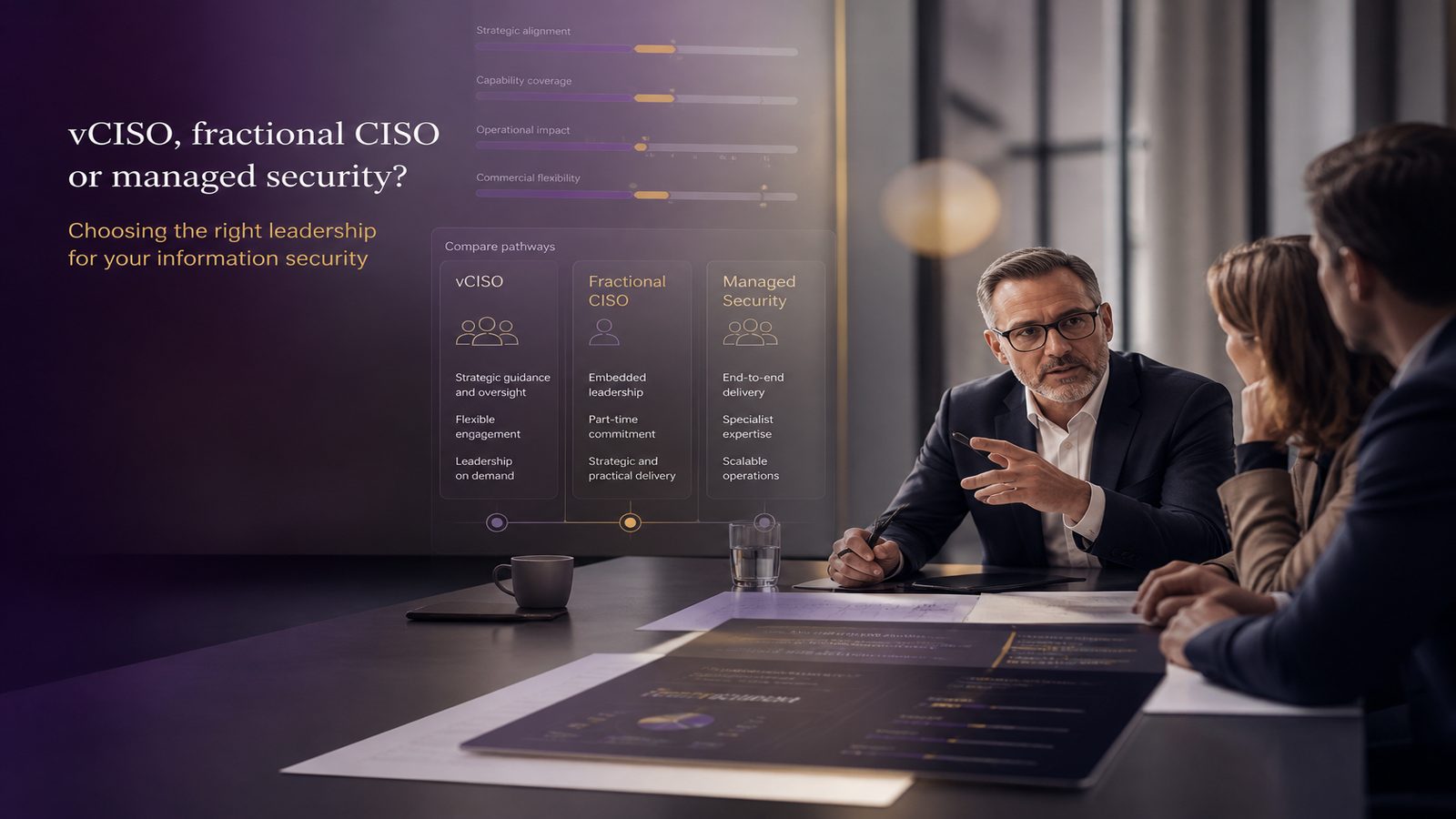
Key takeaways
- Choose a virtual CISO if you need senior advice and a clear security roadmap, but not regular hands-on delivery.
- Choose a fractional CISO if you need ongoing leadership input each month and want someone to help steer decisions over time.
- Choose managed information security if your main need is practical, recurring work that turns plans into action.
- The best model for an SME is usually the one that matches internal capacity, risk level, and budget, not the most impressive title.
What each option means in plain English
If you are trying to improve security without hiring a full-time senior security leader, the choice can feel confusing. The titles sound similar, but they usually mean different levels of support, different time commitments, and different outcomes for your business.
The simplest way to think about it is this: one model gives you advice, one gives you regular leadership, and one gives you more hands-on delivery. The right choice depends on whether your main problem is strategy, decision-making, or getting work done.
What a virtual CISO does
A virtual CISO is an external security leader who helps guide your organisation at a senior level without joining as a permanent employee. The role is usually focused on direction, priorities, risk decisions, and helping leadership understand what matters most.
For an SME, this can be useful when you know security needs attention but do not have the time or expertise to shape the overall plan. A virtual CISO may help define the security roadmap, support governance, review risks, and advise on what should happen next. They are often best used as a trusted adviser to the business rather than someone doing all the operational work.
What a fractional CISO does
A fractional CISO is similar, but the emphasis is usually on a more regular, ongoing commitment. Instead of occasional advice, you are buying a portion of a senior person’s time each month. That means more continuity, more involvement in decisions, and more opportunity to track progress over time.
In practice, a fractional CISO often sits between a pure adviser and a part-time internal leader. They may attend regular meetings, help steer priorities, support management decisions, and keep security work moving. For businesses that need stability but cannot justify a full-time hire, this can be a practical middle ground.
What managed information security usually includes
Managed information security is usually more operational. Rather than mainly advising, the provider helps carry out security tasks on an ongoing basis. That can include monitoring, reviewing alerts, managing security tasks, maintaining evidence, supporting policies, or helping with recurring security activities.
This model is often chosen when the business needs help turning plans into action. It can be especially useful if your internal team is small, your IT function is already stretched, or you need a service that produces clear, regular outputs. If you are still building the basics, it may sit alongside broader support such as why information security and data protection are not just big business problems.
How the three models differ in practice
These services can overlap, which is why buyers sometimes struggle to compare them. The easiest way to separate them is by looking at time, responsibility, and the type of work being done.
Time commitment and availability
A virtual CISO is often used on an as-needed basis. You may bring them in for planning, reviews, or specific decisions. A fractional CISO is normally more embedded, with a set number of days or hours each month. Managed information security is usually more continuous, with recurring tasks and service delivery built into the arrangement.
That difference matters because security work does not only happen in meetings. If you need someone available to keep things moving week by week, a light-touch advisory model may not be enough. If you only need senior direction a few times a quarter, paying for a more operational service may be unnecessary.
Strategic leadership versus hands-on delivery
A virtual CISO is strongest when you need judgement, prioritisation, and executive-level advice. A fractional CISO adds more regular leadership and accountability. Managed information security goes further into delivery, helping with the practical work that keeps your programme alive.
For example, if your business needs to decide which risks to tackle first, a virtual or fractional CISO may be the right fit. If you already know the priorities but need help implementing them, managed information security is often more suitable.
Internal ownership and external support
None of these models should replace internal ownership. Someone inside the business still needs to make decisions, approve actions, and keep track of business priorities. External support works best when it strengthens your internal capability rather than creating dependency.
This is especially important for SMEs, where the same person may already be responsible for IT, operations, and supplier management. A good provider should make responsibilities clearer, not blur them. If you are also thinking about how to handle sensitive data more safely, our guide on handling sensitive information without breaking the law or the bank may help frame the wider picture.
Which model suits different types of organisation
There is no universal best option. The right fit depends on the size of your business, how much internal capability you already have, and how quickly you need to improve.
Owner-managed SMEs that need direction
If you are a smaller business and security has grown in an unplanned way, a virtual CISO is often a sensible starting point. You may not need a large service. What you need is clarity: what matters, what to fix first, and what can wait.
This model works well when the leadership team wants informed advice but does not want to commit to a long-term operational service before understanding the problem properly. It can also help if you are preparing for a customer review, supplier questionnaire, or a broader improvement programme.
Growing businesses that need steady security leadership
If your organisation is growing, taking on more customers, or handling more sensitive information, a fractional CISO can provide the continuity you need. Growth often creates security gaps because systems, people, and suppliers change faster than governance does.
In this situation, regular senior input is valuable. A fractional CISO can help keep security aligned with business change, rather than letting it become a one-off project. This is often the right choice when the business has enough activity to justify ongoing leadership, but not enough to support a full-time senior hire.
Organisations that need ongoing operational support
If your main challenge is not deciding what to do, but finding the time and people to do it, managed information security is usually the better fit. This is common where internal IT is small, security tasks are being done informally, or there is no dedicated security resource at all.
Managed support can be particularly helpful if you need repeatable tasks completed every month, such as reviewing controls, maintaining evidence, or supporting day-to-day security administration. It can also reduce the risk of important work being delayed because everyone is busy with other priorities.
When a virtual CISO is the better fit
A virtual CISO is usually the best option when you need senior advice without a full-time hire. It is a good fit if your main issue is uncertainty rather than execution.
You need senior advice without a full-time hire
Many SMEs know they need better security leadership, but they do not have the budget or workload for a permanent senior role. A virtual CISO gives you access to experience without the overhead of recruitment, salary, and employment costs.
This can be especially useful if you are at an early stage of improving security and want to understand the shape of the problem before committing to a larger programme.
You have gaps in planning, prioritisation, or governance
If your business has controls in place but no clear plan, a virtual CISO can help organise the work. They can bring structure to risk discussions, help define priorities, and make sure security decisions are tied to business impact rather than guesswork.
That matters because many SMEs spend money on tools before they have agreed what problem they are trying to solve. A virtual CISO can help avoid that mistake by focusing attention on the highest-value actions first.
You want help setting a realistic security roadmap
A good roadmap should be realistic, not theoretical. It should reflect your budget, your people, and the level of risk your business can tolerate. A virtual CISO can help build that roadmap and make it understandable for directors and managers.
If you are trying to improve your overall resilience, it may also be useful to think about incident readiness. Our article on preparing your organisation for security incidents covers the practical side of being ready when something goes wrong.
When a fractional CISO is the better fit
A fractional CISO is usually the better fit when you need regular leadership input each month. It is a stronger choice than a purely advisory model when security decisions need follow-through.
You need regular leadership input each month
If your business needs someone to stay involved, attend recurring meetings, and keep the programme moving, a fractional CISO provides that continuity. The value is not just in advice, but in the rhythm of ongoing leadership.
This can help prevent security from slipping down the agenda when operational pressures increase. It also gives the business a consistent point of contact for security decisions.
You already have some internal security or IT capability
A fractional CISO works well when you already have people who can carry out some of the work, but need senior oversight to coordinate it. In other words, the business has capability, but not enough leadership.
That is a common situation in growing SMEs. You may have an IT manager, an external support provider, or a small internal team, but no one with the time or experience to own the security direction end to end.
You want someone to help steer decisions over time
Some security decisions are not one-off choices. They need review, adjustment, and trade-offs over time. A fractional CISO is useful when you want someone to stay close to those decisions and help the business adapt as it changes.
This is often the right model when you are building maturity gradually and want a steady hand rather than a series of disconnected recommendations.
When managed information security makes more sense
Managed information security makes more sense when you need help turning plans into day-to-day action. It is the most operational of the three models.
You need help turning plans into day-to-day action
If you already know what should happen but struggle to make it happen consistently, managed support can close that gap. It is useful when the business needs practical delivery, not just advice.
That might include recurring reviews, control maintenance, evidence gathering, or support with routine security tasks that otherwise get delayed.
You have limited internal capacity
Many SMEs do not have spare time to manage security properly. Even when people care about it, it is easy for security tasks to be pushed aside by sales, operations, customer work, or day-to-day support issues.
Managed information security can relieve that pressure by taking ownership of defined tasks. This can be a better use of budget than buying advice you do not have time to act on.
You want a more operational service with clear deliverables
If you want to see regular outputs, managed information security is often the clearest model. You should expect defined activities, agreed reporting, and visible progress. That makes it easier to judge whether the service is working.
It can also be easier to justify internally because the deliverables are concrete. Instead of paying for broad guidance, you are paying for work that can be tracked and reviewed.
How to think about cost and value
Price matters, but it should not be the only factor. The cheapest option is not always the best value if it leaves your business with gaps, confusion, or unfinished work.
What drives the price up or down
Cost is usually affected by the amount of time involved, the complexity of your environment, how much documentation is needed, and whether the provider is mainly advising or doing operational work. A more hands-on service will usually cost more than a light advisory arrangement.
The scope also matters. Supporting one business unit is different from supporting multiple sites, complex suppliers, or a large amount of sensitive data. Be clear about what you need before comparing quotes.
How to compare cost against business risk
The right question is not just, “What does it cost?” It is also, “What business problem does this solve?” If a service reduces the chance of poor decisions, missed priorities, or delayed action, it may save more than it costs.
Think about the cost of inaction as well. That might include wasted staff time, customer concern, delayed deals, or extra work after an incident. A sensible security service should reduce those risks in a way that fits your business.
Why cheaper is not always better
A low-cost offer can look attractive, but it may not include enough time, depth, or follow-through to make a difference. If the service is too thin, you may end up paying again later to fill the gaps.
It is usually better to choose the model that matches your actual need than to buy the cheapest title. A smaller, well-scoped engagement that solves the right problem is often better value than a broad service that does not fit.
Questions to ask before you choose a provider
Before you sign anything, ask practical questions. The answers will tell you more than the job title on the proposal.
What will they actually do each month
Ask for a clear description of the work. Will they attend meetings, review risks, update plans, support delivery, or produce reports? If the answer is vague, the service may be vague too.
Who will own decisions and actions internally
Make sure you know who inside your business will approve priorities and follow up on actions. External support works best when internal ownership is clear.
How progress will be measured
Agree how you will know whether the service is helping. That might include completed actions, clearer priorities, better reporting, or improved readiness for customer and supplier discussions.
If you are also reviewing wider procurement or supplier risk, our article on procuring AI systems securely as an organisation shows the kind of structured questions that help buyers make better decisions.
A simple decision checklist for SMEs
If you want a quick way to choose, use this simple rule of thumb.
If you need strategy, choose this
Choose a virtual CISO if you need senior advice, clearer priorities, and a realistic roadmap, but do not need someone deeply involved every week.
If you need regular leadership, choose this
Choose a fractional CISO if you want ongoing senior input, regular involvement, and someone to help steer decisions over time.
If you need ongoing delivery, choose this
Choose managed information security if your main need is practical, recurring work that turns plans into action and helps keep the programme moving.
For many UK SMEs, the best answer is not the most impressive title. It is the model that fits your current stage, your internal capacity, and the level of risk you are carrying.
If you would like help working out which approach is most suitable for your organisation, speak to a consultant.
Frequently asked questions
What is vCISO vs CISO?
A virtual CISO is an external senior security adviser, while a CISO is usually a permanent internal senior security leader. The virtual model gives you access to experience without hiring a full-time employee.
What does fractional CISO mean?
A fractional CISO is a senior security leader who works with your business for a set portion of their time each month. It is usually a more regular and embedded arrangement than a purely virtual advisory role.
How much does a fractional CISO cost?
Cost depends on the amount of time involved, the complexity of your environment, and the scope of work. The most useful comparison is not just price, but whether the service matches the level of support your business actually needs.
Comments are closed