
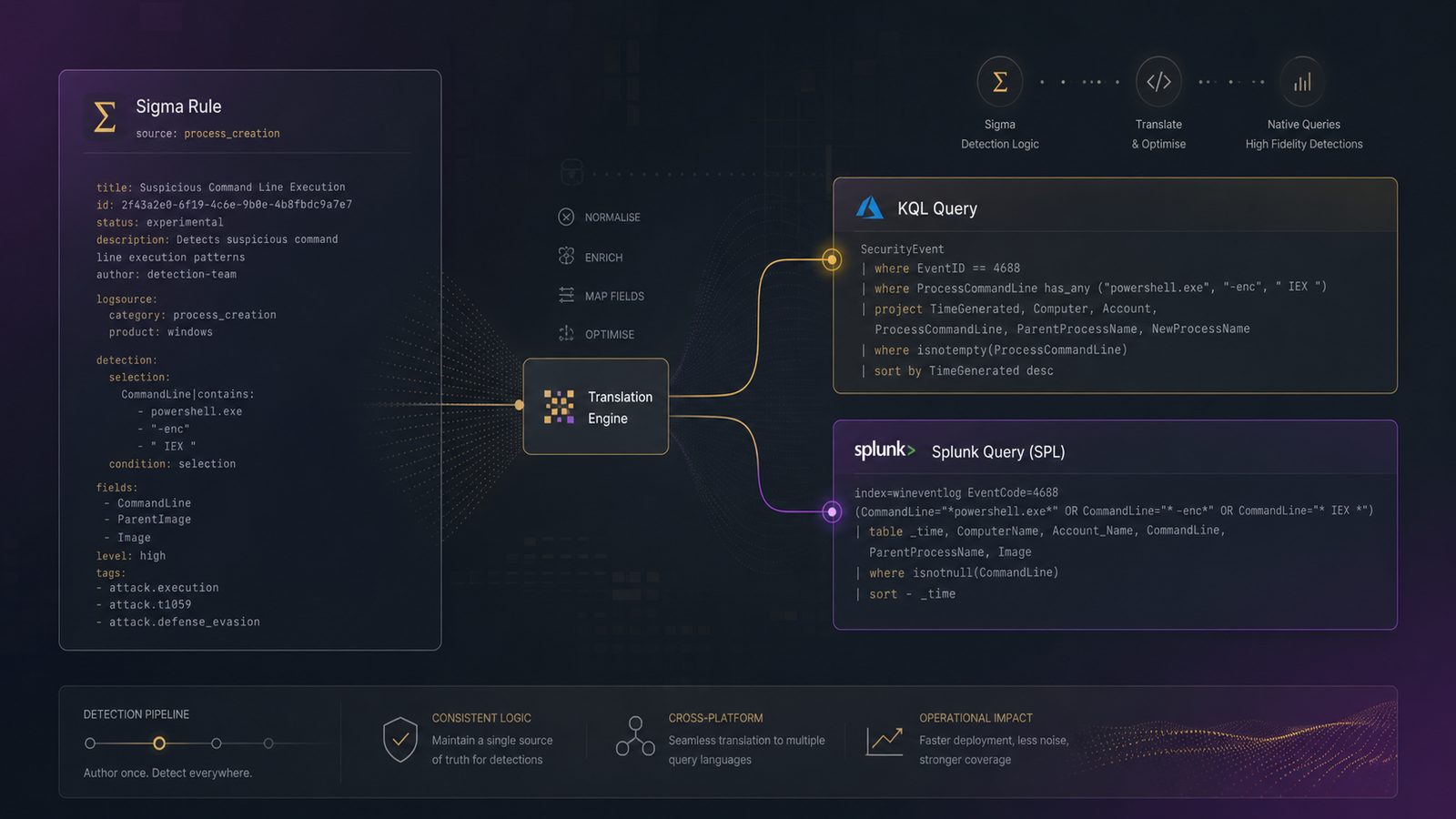
Sigma has become a useful way to describe detections once and translate them into the query language of the platform you actually run. For teams working across Microsoft Sentinel, Splunk, or a mix of tools, that portability can save time and reduce duplication. It is not a magic converter, though. A Sigma rule is only as good as the telemetry behind it, the quality of the field mapping, and the care taken during validation.
If you already have a detection programme, Sigma sits neatly between hypothesis and implementation. It gives you a common authoring format for describing suspicious behaviour, then lets you generate platform-specific queries from that description. That makes it easier to share detections across teams, compare coverage, and keep logic consistent. It also helps when you are building a detection-as-code workflow, as discussed in our article on building a detection-as-code pipeline with Sigma and CI/CD.
Key takeaways
- Sigma is a portable detection format, not a replacement for platform-specific SIEM logic.
- Conversion to KQL or Splunk works best when the underlying telemetry and field mappings are well understood.
- Every converted rule should be validated against real data and tuned for local noise before production use.
What Sigma rules are and where they fit in detection engineering
Sigma is a generic rule format for describing log-based detections. Think of it as a portable intermediate representation rather than a SIEM query language. You define what you want to detect in a structured YAML document, and then convert that rule into KQL, SPL, or another backend-specific query.
That makes Sigma especially useful in environments where the same detection idea needs to be expressed in more than one tool. A security engineer might prototype a rule in Sigma, convert it to KQL for Microsoft Sentinel, and also generate SPL for Splunk Enterprise Security. The detection logic remains conceptually the same, even if the syntax changes.
The practical value is consistency. Without a shared format, teams often rewrite the same detection several times, each version drifting slightly. One analyst writes a Sentinel query, another writes a Splunk search, and the two no longer mean exactly the same thing. Sigma reduces that drift by giving you a single source of truth for the detection intent.
It is also helpful for collaboration. A threat hunter can write a rule in Sigma, a detection engineer can review the logic, and a platform specialist can check whether the converted query behaves correctly in the target SIEM. That division of labour is often more efficient than asking every engineer to be fluent in every query language.
Why Sigma is useful as a portable detection format
Portability is the main reason Sigma matters. It allows you to express a detection once and reuse it across different backends. For organisations with a mixed estate, or those migrating from one SIEM to another, that can be a significant operational advantage.
It also supports reuse at the rule logic level. For example, a detection for suspicious PowerShell, unusual service creation, or anomalous authentication patterns can be written once and then adapted to the available telemetry in each platform. That is particularly useful for UK SMEs that do not have the luxury of maintaining separate detection libraries for every tool in use.
There is a second benefit: portability makes review easier. A rule written in Sigma is often easier to inspect than a long, platform-specific query. The logic is separated from the implementation details, so reviewers can focus on the behaviour being detected rather than the syntax of a particular SIEM.
How Sigma differs from platform-native SIEM queries
Platform-native queries are still necessary. KQL and SPL can do things Sigma cannot express cleanly, especially where you need joins, advanced aggregation, time-window correlation, or platform-specific enrichment. Sigma is not intended to replace those capabilities. It is a common format for the detection idea, not the final operational query in every case.
In practice, Sigma is best for atomic detections and many straightforward behavioural rules. Native queries become more important when you need to exploit a platform’s richer features, such as Sentinel watchlists, Splunk lookups, or custom parsing logic. If you need advanced correlation, you may still start in Sigma for consistency, but expect to refine the generated output manually.
How Sigma rules are structured
A Sigma rule is usually a YAML document with a small set of standard sections. The important ones are metadata, logsource, detection, and condition. The structure is simple enough to read quickly, but expressive enough to capture useful detection logic.
Core fields, logsource, detection, condition, and metadata
Metadata describes the rule itself. This typically includes the title, id, status, description, references, tags, and author. In a mature detection programme, metadata matters because it supports governance, review, and traceability. It also helps when you are mapping detections to frameworks such as MITRE ATT&CK, which is useful for understanding coverage and gaps.
The logsource section tells the converter what kind of telemetry the rule expects. For example, you might specify Windows process creation logs, PowerShell logs, or authentication events. This is one of the most important parts of the rule because it determines whether the target platform can actually support the detection.
The detection section contains the matching logic. It is usually built from one or more named selections, each of which defines fields and values to look for. The condition then combines those selections using logic such as selection and not filter, or more complex expressions where needed.
Here is a simple example of the shape, not a production-ready rule:
title: Suspicious PowerShell download cradle
logsource:
  product: windows
  category: process_creation
detection:
  selection:
    Image|endswith: '\powershell.exe'
    CommandLine|contains:
      - 'DownloadString'
      - 'WebClient'
  condition: selection
That rule says, in effect, “look for PowerShell process creation events where the command line contains common download cradle indicators”. The exact field names and operators vary by backend, but the detection intent is clear.
Common rule patterns and what they mean in practice
Most Sigma rules use a few recurring patterns. Equality matches are the simplest. Wildcards and suffix matches are common for process paths, file names, and domain names. Lists are used when several values should trigger the same detection. Filters are used to suppress known benign activity, such as admin scripts, software deployment tools, or monitoring agents.
In practice, the quality of a Sigma rule often depends on how well it balances signal and noise. A broad pattern may catch more activity, but it can also generate too many false positives. A narrow pattern may be precise, but miss variants used by an attacker. That trade-off is not unique to Sigma, but the format makes it easier to see and discuss.
When to use Sigma instead of writing KQL or Splunk first
There are times when Sigma is the right starting point, and times when it is not. If your team needs a portable rule that may be deployed to more than one platform, Sigma is usually the better authoring format. If you are building a detection that depends heavily on one platform’s native features, it may be better to write directly in KQL or SPL.
Portability across tools and teams
Use Sigma when you want a shared detection definition that can be reviewed independently of the backend. This is especially useful if one team owns the detection logic and another team operates the SIEM. It also helps when you are standardising detections across business units or subsidiaries that do not all use the same platform.
For SMEs, portability can also reduce lock-in. You may not know whether your SIEM choice will stay the same in two years, but you can still preserve your detection logic in a platform-neutral format. That makes migration less painful and reduces the risk of losing hard-won detection work during a tooling change.
Trade-offs in fidelity, tuning, and platform-specific features
The main trade-off is fidelity. A Sigma rule can describe the intent, but the generated KQL or SPL may not perfectly reproduce the original behaviour. Field names may differ, data types may not line up, and some operators will translate imperfectly. A rule that looks elegant in Sigma can become awkward once it is mapped to a real dataset.
There is also a tuning cost. A portable rule often needs environment-specific filters after conversion. For example, a generic process-creation rule may need exclusions for software deployment tools in one organisation and endpoint management agents in another. That tuning is not a weakness of Sigma. It is a reminder that detections are always contextual.
Converting Sigma rules to KQL
Microsoft Sentinel uses KQL, so Sigma-to-KQL conversion is common in Microsoft-heavy environments. The conversion is usually straightforward for simple field matches, but it becomes more nuanced when the Sigma rule relies on operators or log fields that do not map cleanly to the Sentinel schema.
How Sigma maps to Microsoft Sentinel query logic
At a basic level, Sigma selections become KQL where clauses. A field equality match becomes a comparison, a wildcard becomes a string operator, and a list becomes a set of alternative conditions. If the Sigma rule says “Image ends with powershell.exe and CommandLine contains DownloadString”, the KQL should express the same logic against the relevant table and columns.
A practical KQL pattern might look like this:
DeviceProcessEvents
| where FileName =~ "powershell.exe"
| where ProcessCommandLine has_any ("DownloadString", "WebClient")
That is not a direct Sigma output, but it shows the translation style. The important part is that the query uses the correct Sentinel table and the correct field names for the telemetry source you have enabled.
In Microsoft environments, you may need to choose between tables such as DeviceProcessEvents, SecurityEvent, or WindowsEvent, depending on whether you are using Defender for Endpoint, Windows event forwarding, or another ingestion path. The Sigma rule itself does not decide that for you. The logsource gives the converter a clue, but the final query still depends on your data model.
Typical translation issues in KQL, including field names and data types
The most common issue is field mapping. Sigma may refer to Image, CommandLine, ParentImage, or User, while your Sentinel table uses FileName, ProcessCommandLine, InitiatingProcessFileName, or AccountName. If the mapping is wrong, the query may return nothing or, worse, return misleading results.
Data types can also cause trouble. Sigma often treats values as strings, but KQL may expect datetime, dynamic, or numeric types in certain contexts. If the conversion introduces a type mismatch, the query may fail or behave unexpectedly. This is why converted rules should always be tested against real sample data, not just syntactic validation.
Another issue is case sensitivity and operator choice. KQL offers different matching operators, and the wrong one can materially change the result set. A query that uses contains may be too broad, while has may be too narrow if the tokenisation does not match your expectation. These details matter when you are trying to keep false positives under control.
If you are building Sentinel detections from Sigma, it is worth pairing the conversion with a review of your existing KQL hunting content, such as KQL threat hunting with Microsoft Sentinel and building Microsoft Sentinel analytics rules from MITRE ATT&CK techniques. Those patterns help you understand how the converted query will behave in a real Sentinel workspace.
Converting Sigma rules to Splunk SPL
Splunk uses SPL, which is flexible but also highly dependent on how data is indexed and extracted. Sigma-to-Splunk conversion can work well, but the output often needs more environment-specific adjustment than people expect.
How Sigma maps to Splunk search syntax
In Splunk, a Sigma selection usually becomes a search expression over indexed events. Simple equality checks translate cleanly, and field filters can often be expressed using field=value style syntax. More complex logic may require search, where, or eval clauses.
A rough SPL equivalent of the earlier PowerShell example might look like this:
index=endpoint sourcetype=WinEventLog:Process
| search Image="*\\powershell.exe" CommandLine="*DownloadString*" OR CommandLine="*WebClient*"
Again, the exact output depends on your field extractions and sourcetype conventions. Splunk is very sensitive to how data is normalised. If the Sigma rule assumes a field that is not extracted in your environment, the converted search will not work as intended.
Common SPL translation considerations for indexes, sourcetypes, and field extraction
The biggest practical difference with Splunk is that the query is only part of the story. You also need the right index, sourcetype, and field extraction rules. A Sigma rule may be logically correct, but if the relevant logs are not indexed or the fields are not extracted, the detection will be incomplete.
That means conversion should be followed by a data validation step. Check whether the expected events are present, whether the fields exist, and whether the values are normalised consistently. It is common for a rule to work in a lab dataset and fail in production because the source logs are slightly different.
Splunk also encourages a different style of tuning. You may need to add lookups, macros, or saved search constraints to make the detection operationally useful. That is not a flaw in Sigma. It simply reflects the fact that SPL deployments often carry more local assumptions than a portable rule format can capture.
Validation, testing, and tuning after conversion
Conversion is only the first step. A rule is not ready for production until you have checked that the translated query still matches the original intent, produces sensible results, and behaves well in your environment.
Checking that the converted query matches the original intent
Start by comparing the Sigma rule and the generated query side by side. Ask whether every selection was preserved, whether any filters were dropped, and whether the condition logic still means the same thing. If the target platform does not support a Sigma operator directly, confirm how the converter handled it.
Then test the query against known-good and known-bad data. You want to see the detection trigger on representative malicious or suspicious examples, and stay quiet on routine administrative activity. If the environment does not have labelled test data, use a small number of carefully chosen samples from your own logs and document the expected outcome.
For teams that already run detection engineering exercises, this is where purple-team validation becomes useful. You can simulate the behaviour safely, observe the logs, and verify whether the converted rule fires as expected. That approach is often more reliable than relying on syntax checks alone.
Reducing false positives and handling environment-specific noise
False positives are usually the main reason a converted rule is not operationally useful. Common causes include admin tooling, software deployment systems, scheduled tasks, and legitimate scripts that resemble attacker behaviour. The answer is not to suppress everything aggressively, but to tune carefully and document the rationale for each exclusion.
Good tuning often involves adding allow-lists for known management hosts, service accounts, or software distribution paths. In Microsoft environments, that may mean filtering on device groups or trusted process parents. In Splunk, it may mean using lookups or saved search constraints. The key is to keep the rule precise enough to be actionable without hiding real risk.
It is also worth measuring alert quality over time. A rule that looks good on day one may become noisy as the environment changes. That is why detection content should be reviewed periodically, just like any other operational control.
Practical workflow for using Sigma in a detection-as-code pipeline
For technical teams, Sigma works best when it is treated as code. That means version control, peer review, automated checks, and a clear promotion path from draft to production. It also means accepting that some rules will remain hunts rather than alerts.
Version control, review, and promotion into production
Store Sigma rules in a repository alongside documentation and test artefacts. Use pull requests for review, and make sure reviewers check both the detection intent and the expected backend translation. A rule should not be promoted simply because it parses successfully.
In a sensible workflow, the Sigma file is the source of truth. Generated KQL or SPL can be committed as build artefacts or regenerated during deployment, depending on your operating model. Either way, the review process should capture why the rule exists, what telemetry it depends on, and what exclusions were added during tuning.
This is also where framework mapping helps. If you tag rules to MITRE ATT&CK techniques, you can track coverage and identify gaps. That makes it easier to prioritise new detections and explain why a rule matters in the wider defence programme.
Where converters, linters, and CI checks fit
Automated tooling is useful, but it should support review rather than replace it. A linter can catch formatting errors and some schema issues. A converter can generate KQL or SPL. A CI job can ensure the rule still parses after a change. None of those checks can tell you whether the detection is actually good.
A practical pipeline might include schema validation, rule linting, conversion to the target backend, unit-style tests against sample logs, and a manual approval step before deployment. That gives you a repeatable process without pretending that detection engineering can be fully automated.
Common pitfalls when working with Sigma, KQL, and Splunk
The first pitfall is assuming that conversion is lossless. It is not. Some Sigma features map neatly to KQL or SPL, but others need approximation or manual adjustment. If you treat the generated query as final, you risk deploying a detection that does not behave as intended.
The second pitfall is incomplete telemetry. If the source logs do not contain the fields you need, no amount of query tuning will fix that. This is why log source design matters as much as rule writing. A detection programme built on poor telemetry will always struggle.
The third pitfall is over-reliance on one-to-one translation. A good Sigma rule may need to be adapted differently for Sentinel and Splunk because the platforms model data differently. That does not mean the rule has failed. It means the implementation needs to respect the backend.
The fourth pitfall is ignoring operational context. A detection that is technically correct but too noisy to triage is not useful. Likewise, a highly precise rule that only covers a tiny subset of the environment may not justify the effort to maintain it. Production readiness is about fit, not just syntax.
How to decide whether a Sigma rule is production-ready
A production-ready rule should have a clear purpose, a known telemetry source, a tested conversion path, and an agreed response process. If any of those pieces are missing, the rule is probably still a hunt or a draft.
Coverage, precision, and operational fit
Ask three questions. Does the rule cover a behaviour you care about? Does it do so with acceptable precision? Can your team respond to the alert within a reasonable time? If the answer to any of those is no, the rule may need more work before it becomes an alert.
Coverage is about whether the rule actually addresses a meaningful technique or pattern. Precision is about whether it avoids excessive noise. Operational fit is about whether the team has the time, context, and runbook support to handle the output. These are practical questions, not theoretical ones.
When to keep a rule as a hunt versus promoting it to an alert
Some Sigma rules are better kept as hunts. That is often the case when the signal is weak, the environment is noisy, or the behaviour is rare and needs analyst interpretation. Other rules are suitable for alerting because they are high-confidence and map to a clear response path.
A good rule of thumb is to promote only when you know what action the alert should trigger. If the team cannot explain how they would triage it, the rule probably belongs in a hunting queue first. That approach keeps the alert volume manageable and gives you time to improve the logic before formalising it.
For organisations building out detection maturity, Sigma can be a strong foundation. It helps you standardise logic, compare coverage, and move more quickly between platforms. But the real value comes from disciplined validation, careful tuning, and a realistic view of what the underlying telemetry can support.
If you want help turning Sigma content into a practical detection workflow, or you are trying to align detection engineering with a broader control framework, speak to a consultant.
Frequently asked questions
Can Sigma rules be converted automatically to KQL and Splunk?
Yes, many Sigma rules can be converted automatically, but the output usually needs review because field names, data types, and backend capabilities differ between platforms.
Do converted Sigma rules behave exactly the same in every SIEM?
No, they rarely behave identically because each SIEM stores and queries data differently, so the converted rule should be tested and tuned in the target environment.
What are the main limitations of converting Sigma rules into platform-specific queries?
The main limitations are imperfect field mapping, differences in log schemas, unsupported operators, and environment-specific noise that the original Sigma rule cannot fully predict.
Comments are closed