
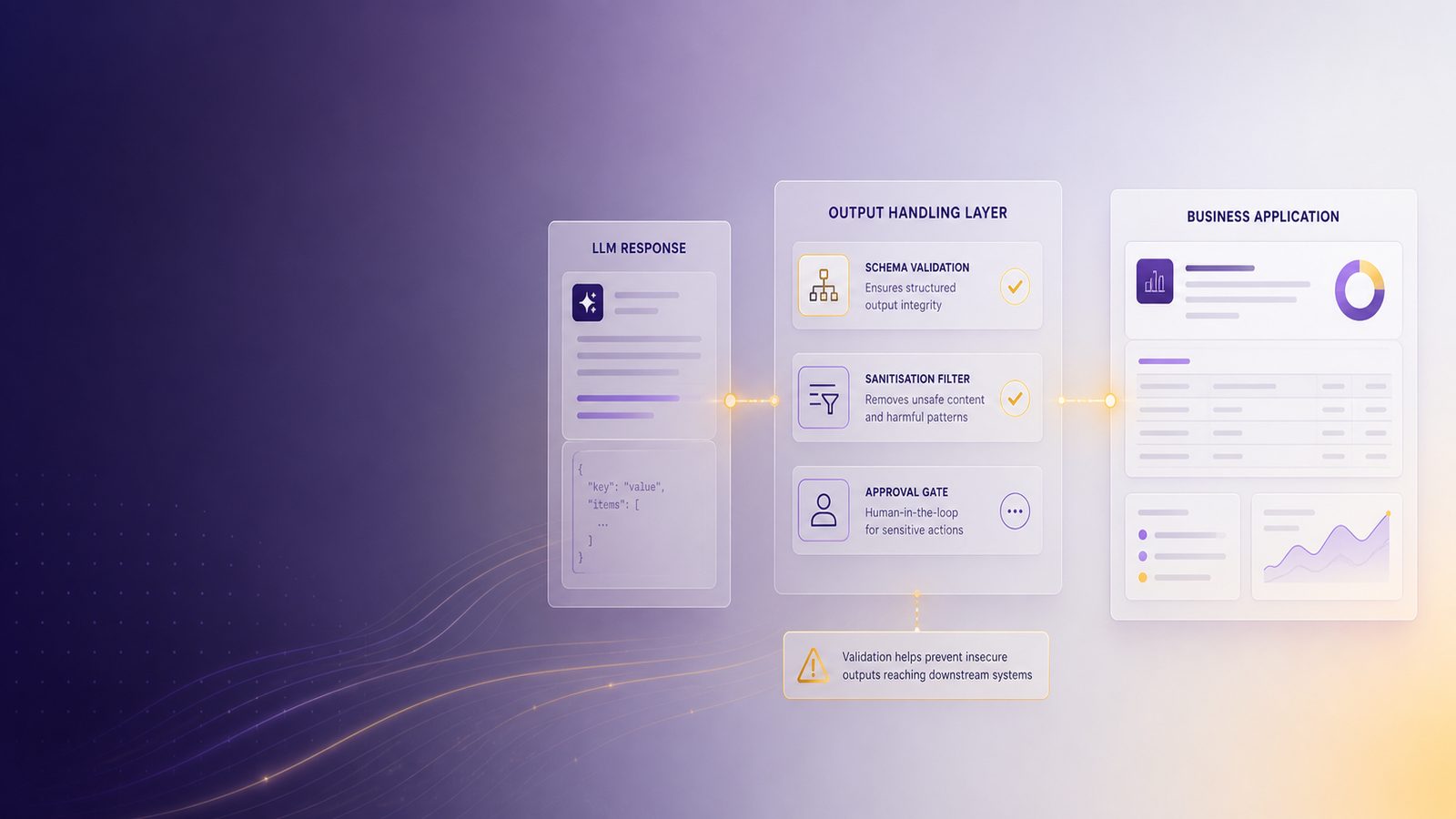
Large language models are often treated as if they are a trusted component in an application stack. That is a mistake. From a security engineering perspective, model output is just another external input, and it should be handled with the same care you would apply to user-supplied data, third-party API responses, or content pulled from an untrusted source.
For UK SMEs building customer-facing assistants, internal copilots, or workflow automation, the risk is not only that a model says something wrong. The more important issue is what the application does with that output. If the output is rendered into a web page without encoding, forwarded into a ticketing system without validation, or passed to an automation step that assumes the content is safe, you can end up with insecure output handling vulnerabilities that affect confidentiality, integrity, and availability.
This article looks at the practical side of LLM output handling and insecure output vulnerabilities. It focuses on what can go wrong, where the control failures usually appear, and how to design safer handling patterns without making the system unusable.
Key takeaways
- Treat LLM output as untrusted data until it has been validated, encoded, and routed through the correct control point.
- Use strict schema validation and allow-lists for any output that feeds automation, APIs, or downstream business workflows.
- Escape or sanitise model output before rendering it in web pages, emails, tickets, or other rich text channels.
- Log prompts, outputs, validation results, and downstream actions so you can detect regressions and investigate misuse.
What insecure output handling means in an LLM application
Insecure output handling happens when an application trusts model output too early, or in the wrong place. The model may generate plain text, markdown, JSON, HTML, code, or instructions for another system. Each of those formats creates a different trust problem. The application has to decide whether the output is only for display, whether it can be stored, whether it can be parsed, and whether it can trigger any downstream action.
Why model output should be treated as untrusted data
LLMs are probabilistic systems. They do not guarantee truth, consistency, or safe formatting. They can produce malformed JSON, unexpected markup, fabricated references, or instructions that look authoritative but are not suitable for execution. That means the output should be treated as untrusted until it has passed through explicit validation and control points.
This is the same design principle that underpins secure handling of other external data. If you already use input validation, encoding, and output sanitisation in your application stack, the same mindset applies here. The difference is that LLM output often looks more natural and therefore more trustworthy to developers and business users, which makes mistakes easier to miss. The practical controls are similar to those described in our article on input validation, encoding, and output sanitisation techniques.
How this differs from prompt injection and input validation
Prompt injection is about influencing the model’s behaviour through malicious or misleading instructions. Input validation is about checking what comes into the system. Insecure output handling is about what happens after the model has already responded. The three issues are related, but they are not the same.
A prompt injection may cause the model to produce unsafe content. Poor output handling then turns that content into a real security issue by rendering it unsafely, storing it in a sensitive system, or using it to drive automation. In other words, prompt injection is often the cause, while insecure output handling is the amplification path.
Where output handling failures create risk
The highest-risk cases are the ones where model output crosses a trust boundary. That usually means a boundary between the model and a user interface, a database, a ticketing platform, a workflow engine, or another service that assumes the content is valid.
Customer-facing chatbots and support assistants
Customer-facing assistants are a common place to see output handling mistakes. A chatbot may produce markdown that is rendered directly into HTML, or it may generate a support response that is copied into a CRM record without checking for embedded links, scripts, or malformed formatting. Even if the model is not directly exposed to the browser, the application can still create an unsafe rendering path if it assumes the response is harmless text.
For example, a support assistant might summarise a customer’s issue and include a link or a code snippet. If the front end allows rich text rendering without strict sanitisation, the content can become a cross-site scripting risk. If the assistant writes directly into a ticketing system, the issue may move from a display problem to a workflow integrity problem.
RAG workflows, agents, and tool-using systems
Retrieval augmented generation, or RAG, adds another layer of complexity because model output is often combined with retrieved content and then used to answer a question or trigger a tool. If the output is later parsed by another component, the application must be strict about structure and type. A model that is asked to return JSON for a downstream workflow should not be allowed to return free text and still be treated as valid.
Agentic systems raise the stakes further. If the model can call tools, open tickets, update records, or send messages, then output handling becomes part of the control plane. A weak assumption about output format can turn into an unintended action. That is why the design of MCP tool integrations and other tool-using patterns should include strict parsing, allow-listed actions, and explicit confirmation for sensitive operations.
Content generation, summarisation, and code assistance
Content generation tools often move output into publishing systems, document stores, or collaboration platforms. Summarisation tools may feed meeting notes into task trackers or compliance records. Code assistants may generate snippets that are copied into repositories or CI pipelines. In each case, the output is not just text. It is an artefact that may be consumed by another system or person who assumes it has already been checked.
That is why teams should distinguish between output that is for human reading only and output that is intended for machine consumption. The second category needs much tighter controls.
Common insecure output patterns to watch for
Most output handling weaknesses fall into a small number of patterns. If you know what to look for, they are easier to spot during design review and testing.
Unsafe rendering into web pages, emails, and tickets
The most obvious risk is rendering model output directly into HTML, email templates, or rich text fields. Even when the model does not produce malicious content, it may generate characters or formatting that break the page structure or create injection opportunities. Markdown is not automatically safe either, because many renderers support embedded HTML, links, tables, or other features that need careful handling.
Emails and tickets are especially important because they are often viewed by multiple users and may be exported, forwarded, or indexed. A single unsafe field can spread the issue across several systems.
Blindly executing or forwarding model output
Another common pattern is treating model output as if it were a command, query, or trusted instruction. This can happen when a model generates shell commands, SQL fragments, configuration snippets, or API payloads that are then executed automatically. It can also happen more subtly when one service forwards the output to another without checking whether the content matches the expected schema.
For technical teams, the rule should be simple: if the output can change state, it needs a stronger control than if it is only being displayed. In practice that means separating generation from execution, and inserting a validation step that can reject anything unexpected.
Broken assumptions about format, schema, or truthfulness
Many teams assume that if they ask the model for JSON, they will get valid JSON. In reality, models may add commentary, omit fields, change data types, or invent values. The same applies to summaries, classifications, and extracted entities. A model may sound confident while still being wrong.
This is why schema validation matters. If the application expects a specific structure, it should parse the output strictly and fail closed when the structure is not correct. If the output is used for decision-making, the system should also record confidence, provenance, and any fallback path used when the model response is incomplete.
How to design safer output handling controls
Safer output handling starts with a simple principle: the model should not be the component that decides whether its own output is safe. That decision belongs to the application.
Allow-listing, schema validation, and strict parsing
For machine-readable output, define a strict schema and reject anything that does not match it. In practice this means using JSON Schema, typed data models, or equivalent validation logic in the application layer. If the model is supposed to return a limited set of categories, use an allow-list rather than trying to infer intent from free text.
For example, if a workflow expects one of three actions, the model should return only those action names, not a paragraph explaining its reasoning. If the output is malformed, the application should either retry with a constrained prompt or route the request to a human reviewer.
Encoding and sanitisation before display or storage
When output is destined for a browser, email client, document store, or ticketing system, encode it for the target context. HTML encoding, attribute encoding, and URL encoding are not interchangeable. The correct choice depends on where the content will be rendered.
Do not rely on the model to produce safe markup. If rich text is genuinely needed, use a sanitiser that strips unsafe tags and attributes, and test it with hostile examples. If the content is only meant to be plain text, render it as plain text and avoid unnecessary formatting features.
Separation between model text and application logic
One of the most effective design choices is to keep model text separate from application logic. The model can suggest, summarise, or classify, but the application should decide what to do next. That means avoiding patterns where the model writes directly into a command interpreter, a database query, or a workflow engine without an intermediate control layer.
This separation is especially important in systems that combine LLMs with business rules. A model might be useful for drafting a response, but the final decision to send, store, or execute should be made by deterministic code, not by free-form text.
Implementation approaches by output channel
The right control depends on where the output is going. A single control pattern will not fit every channel.
Web UI and API responses
For web applications, return structured data where possible and render it in a controlled component. If the output is plain text, escape it before inserting it into the DOM. If the output is JSON for an API, validate it before returning it to the client and before any downstream consumer processes it.
In API-driven systems, consider using a response envelope that separates the model’s answer from metadata such as confidence, source references, and validation status. That makes it easier for downstream services to make safe decisions.
Markdown, HTML, and rich text rendering
Markdown is convenient, but it is not a security boundary. If your product allows markdown, define exactly which features are supported, and test the renderer with links, images, tables, code blocks, and embedded HTML. Disable features you do not need. If the output is converted to HTML, sanitise it after conversion and before rendering.
For email and document workflows, be careful about auto-linking, inline images, and embedded attachments. These features can create unexpected behaviour even when the text itself looks harmless.
JSON, CSV, and downstream automation
JSON is the most common format for machine-to-machine output, but it still needs strict parsing. Use a parser that rejects trailing text, duplicate keys, and type mismatches. If the model is generating CSV for import into another system, validate the delimiter, quoting, and row structure before the file is accepted.
For automation, it is often safer to have the model produce a recommendation and then have deterministic code translate that recommendation into a command or API call. That gives you a clear point where policy checks, allow-lists, and approvals can be applied.
Detection and monitoring for output abuse
Good design reduces risk, but it does not remove the need for monitoring. You need enough telemetry to understand when output handling is failing or being abused.
Logging prompts, outputs, and downstream actions
Log the prompt, the model output, the validation result, and the downstream action taken. This gives you a traceable path from request to effect. For privacy reasons, you may need to redact sensitive content or store only hashes and metadata, but the principle remains the same: if the output can influence a business process, you need evidence of what happened.
Where possible, correlate model events with application events in your SIEM. That makes it easier to spot repeated malformed responses, unusual retry patterns, or suspicious sequences of actions following a specific output.
Alerting on malformed, unexpected, or policy-breaking output
Set alerts for validation failures, schema mismatches, and outputs that contain disallowed patterns. For example, you might alert when a model returns HTML in a field that should only contain plain text, or when an assistant tries to produce a command in a channel that should never execute commands.
These alerts are not just for security teams. Product and engineering teams should also see them, because repeated failures often indicate a prompt design issue, a parser problem, or a regression introduced in a release.
Using test cases to spot regressions in guardrails
Regression testing is essential because output handling can break when prompts, models, templates, or tools change. Build a small but representative set of hostile and malformed test cases and run them as part of release validation. Include examples that test formatting, schema violations, unexpected language, and attempts to smuggle instructions into output.
This is closely related to the broader testing approach used for LLM abuse cases and guardrails. If you already run structured tests for prompt injection or jailbreak behaviour, extend those tests to cover output handling as well.
How insecure output handling fits into OWASP LLM guidance
Insecure output handling is not a niche issue. It sits naturally within the broader set of risks covered by the OWASP Top 10 for LLM Applications, particularly where output is used to drive rendering, automation, or downstream processing. The practical lesson is that LLM security is not only about what goes into the model. It is also about what comes out and how the application consumes it.
If you are already using threat modelling, this is a useful place to map trust boundaries. Identify where model output crosses from the LLM into a browser, a database, a queue, a workflow engine, or a human approval step. Then decide what validation, encoding, or approval is needed at each boundary. Our article on threat modelling LLM systems for prompt injection is a useful companion when you are mapping those boundaries.
For teams building a more complete control set, it is also worth aligning output handling with broader secure development practice. The same discipline that supports secure software delivery applies here, including review gates, test automation, and clear ownership of risk.
Practical testing approach for technical teams
If you are responsible for a live system, testing should focus on abuse cases rather than theoretical edge cases. The aim is to prove that the application fails safely when the model output is unexpected.
Abuse cases for malformed output and instruction leakage
Test the system with outputs that are deliberately malformed, oversized, or formatted in a way that should be rejected. Include cases where the model returns extra text around JSON, nested markup, or content that tries to influence the next step in the workflow. You are not trying to break the model. You are checking whether the application correctly refuses unsafe output.
Also test for instruction leakage, where the model includes internal prompts, hidden instructions, or chain-of-thought style content in a response that should only contain a concise answer. If the application exposes that content to users or downstream systems, it may reveal implementation details or create confusion in business processes.
Regression testing after model, prompt, or tool changes
Any change to the model version, system prompt, retrieval source, or tool integration can alter output shape and content. Treat those changes like code changes. Re-run your output handling tests after each significant update, and keep a baseline of expected behaviour for the most important workflows.
Where possible, automate the checks in CI/CD. A simple set of tests that validates schema conformance, sanitisation, and rejection behaviour is often enough to catch the most common regressions before release.
What to include in a security review checklist
A practical review checklist should ask whether the output is ever rendered as HTML, whether it is ever parsed as structured data, whether it can trigger automation, whether validation fails closed, and whether logs capture the validation result. It should also ask who owns the sanitiser, who owns the schema, and who approves changes to either of them.
For teams already working with secure development controls, this is a natural extension of the same review discipline used for other application risks. If you need a broader development baseline, our article on secure development practices for AI systems is a useful reference point.
Priority actions for UK SMEs
If you are trying to improve this area without overengineering it, start with the controls that reduce the most risk for the least effort.
Quick wins for small teams
First, identify every place where LLM output is rendered, stored, or forwarded. Second, make sure plain text is escaped before display. Third, validate any machine-readable output against a strict schema. Fourth, stop any workflow that executes model output directly without a deterministic control layer. Fifth, add logging for validation failures and downstream actions.
These steps are usually enough to remove the most obvious failure modes. They also create a clearer picture of where the remaining risk sits.
Controls to plan for in the next release cycle
In the next release cycle, consider adding a dedicated output policy for each channel, stronger sanitisation for rich text, automated regression tests, and clearer separation between model suggestions and business actions. If the system is customer-facing, review the user interface as well as the backend, because unsafe rendering often happens at the presentation layer rather than in the model itself.
If you are procuring or integrating third-party AI services, make sure the supplier’s output handling assumptions are documented. That includes format guarantees, logging options, and any restrictions on how their output may be used in your environment.
For organisations that want a structured way to improve these controls, an ISO 27001-aligned ISMS can help you assign ownership, track risk treatment, and keep the controls under review. If you would like advisory support on how to apply that in practice, you can Speak to a consultant.
Frequently asked questions
Is insecure output handling the same as prompt injection?
No. Prompt injection is an attack on the model’s behaviour, while insecure output handling is a failure in how the application consumes the model’s response. They often work together, but they are different control problems.
What is the safest way to handle LLM output in production?
Treat the output as untrusted, validate it against a strict schema where possible, encode or sanitise it for the target channel, and keep model text separate from application logic. If the output can trigger an action, add a deterministic approval or policy check before execution.
Comments are closed