
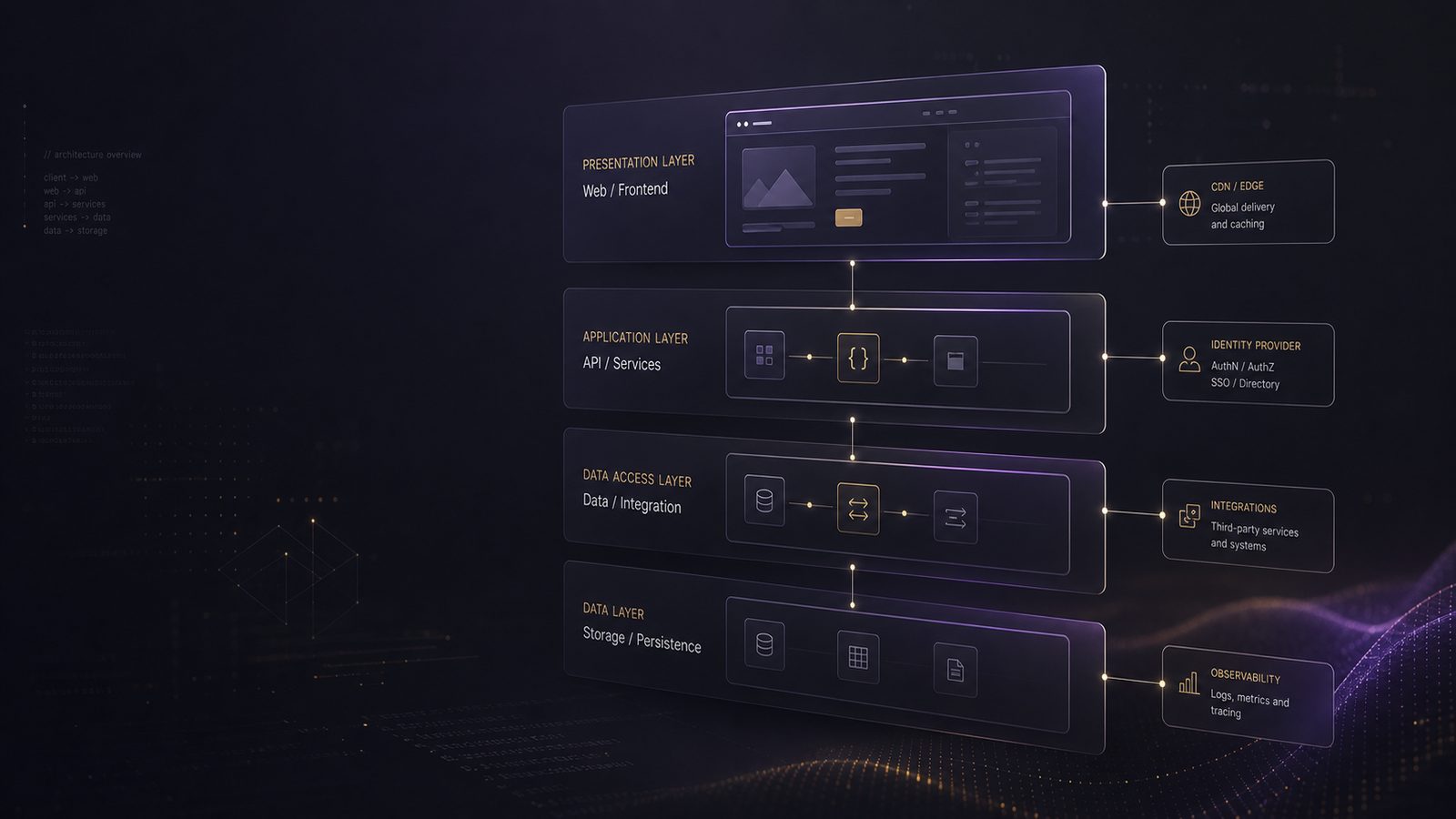
Implementing OWASP ASVS controls across application tiers
OWASP ASVS (Application Security Verification Standard) is a list of security requirements grouped into chapters and three levels. Implementing it well means deciding which tier of your application owns each control: the browser, the API, or the backend. This guide maps the main ASVS chapters to tiers and shows how to verify each.
OWASP ASVS, the Application Security Verification Standard, is one of the most useful control catalogues for teams that want to build security into software in a structured way. For technical practitioners, its value is not that it replaces threat modelling, secure coding, or testing. Its value is that it gives you a practical baseline for what “good” looks like, then lets you scale that baseline according to risk.
That matters for UK SMEs because most organisations do not have the luxury of applying the same level of assurance to every service. A public customer portal, an internal admin console, and a low-risk reporting API do not deserve identical treatment. The right approach is to map ASVS controls to application tiers, trust boundaries, and data sensitivity, then turn those controls into engineering work that can be built, tested, and maintained.
Why ASVS is useful as an implementation baseline
ASVS sits well alongside OWASP Top 10, OWASP SAMM, and secure SDLC practices. The Top 10 is useful for awareness of common weakness classes. SAMM helps you measure maturity across the software lifecycle. ASVS is more operational. It gives you a verification-oriented checklist that can be translated into requirements, test cases, and release gates.
In practice, ASVS helps answer questions such as:
- What authentication assurance do we need for this application tier?
- Which controls are mandatory for public endpoints versus internal services?
- How do we prove that access control, input validation, and session handling are implemented consistently?
For a technical team, the main benefit is consistency. Without a baseline, teams often re-invent security decisions per service. That leads to uneven controls, duplicated effort, and gaps between the browser front end, API layer, and backend services.
Start by scoping ASVS to the application’s actual risk profile. A customer-facing SaaS platform that stores personal data and supports payments will usually need stronger controls than an internal reporting tool. The same is true for services that cross trust boundaries, expose privileged functions, or integrate with third parties.
Building a tiered control model for web, API, and backend services
A useful way to apply ASVS is to treat each application tier as a separate assurance target. That does not mean each tier gets a different security philosophy. It means the implementation details differ.
For example:
- Presentation tier: browser app, mobile front end, or server-rendered web UI
- Application tier: API gateway, monolith, or microservice layer
- Data tier: databases, object storage, queues, caches, and reporting stores
Each tier has different attack surfaces and different control priorities. The presentation tier is exposed to browser-based threats such as cross-site scripting, session theft, and CSRF. The application tier is where authorisation, business logic, and request validation often fail. The data tier is where secrets, sensitive records, and integrity controls become critical.
A practical pattern is to define assurance levels by service type:
- Public-facing services: highest baseline for authentication, session management, input validation, and logging
- Partner-facing services: strong identity assurance, API authentication, fine-grained authorisation, and rate limiting
- Internal services: still controlled, but with scope adjusted to the trust boundary and exposure
This is where ASVS becomes useful as a design tool. You can map required controls to each tier, then document exceptions where the business risk is genuinely lower. The aim is not to force every service into the same mould. The aim is to avoid accidental under-protection.
Identity and session controls across tiers
Identity is one of the first places where tier-specific design matters. Browser applications, APIs, and service-to-service traffic should not share the same authentication pattern unless there is a clear reason.
For browser-based applications, use modern session management patterns. That usually means short-lived sessions, secure cookies, HttpOnly and SameSite flags where appropriate, and re-authentication for sensitive actions such as changing payment details or administrative settings. If you use federated identity, make sure the session created by the application is still independently controlled and not treated as a passive extension of the identity provider.
For APIs, prefer token-based authentication with narrow scopes and short lifetimes. Bearer tokens should be treated as credentials, not as harmless transport artefacts. If a token is stolen, the attacker can often replay it until expiry unless you have additional binding or revocation controls in place. Where feasible, use mutual TLS for service-to-service communication, especially for high-trust internal calls or partner integrations.
For backend-to-backend traffic, avoid shared static secrets where possible. Use workload identity, managed identities, or short-lived certificates rather than long-lived API keys embedded in configuration. If you must use API keys, rotate them, scope them tightly, and monitor for anomalous use.
ASVS also pushes you to think about re-authentication and step-up authentication. A useful rule is to require stronger verification when the action changes risk, not just when the user logs in. That can include privilege elevation, exporting sensitive data, or approving financial transactions.
Input handling, output encoding, and request validation
Input handling should be consistent across tiers, not left to each service team to interpret differently. The core principle is simple: do not trust data just because it came from another internal component.
That matters in distributed systems. A request may pass through an API gateway, a web application, a queue, and a worker service. Each hop can alter the data shape, encoding, or trust assumptions. If one tier assumes another has already validated the payload, you can end up with a trust gap.
Good implementation patterns include:
- Canonicalise input before validation where encoding ambiguity is possible
- Use allow-list validation for expected formats, lengths, ranges, and enumerations
- Apply context-aware output encoding at the point of rendering or serialisation
- Reject unexpected fields rather than silently ignoring them where business logic is sensitive
For JSON APIs, validate both structure and semantics. A field may be syntactically valid but still inappropriate for the current state transition. For example, a user may be allowed to update their address but not their account status. That is an authorisation issue, but it often appears first as a request validation problem.
In microservice environments, be careful with message queues and asynchronous processing. A message that was valid at enqueue time may no longer be valid when consumed. Re-check business rules and authorisation context where it matters. Do not assume the queue is a security boundary.
Access control design for distributed applications
Broken access control remains one of the most common implementation failures because it is often spread across multiple layers. ASVS is helpful here because it forces you to think about both object-level authorisation and function-level authorisation.
Object-level authorisation answers the question: can this subject access this specific record or resource? Function-level authorisation answers: can this subject perform this action at all? In a distributed application, both need to be enforced consistently.
A common anti-pattern is to check access in the UI and assume the API will only receive legitimate requests. Another is to centralise authorisation in one service but forget to enforce it in downstream services that expose privileged operations. The result is a system that looks secure in the front end but can be bypassed through direct API calls or internal routes.
Practical controls include:
- Centralise policy decisions where possible, using a policy engine or shared authorisation service
- Pass subject identity and context explicitly between services
- Enforce object ownership checks at the data access layer, not only in controllers
- Use deny-by-default logic for privileged functions
Where business logic spans multiple services, document the trust model carefully. If one service can create a resource and another can approve it, define which service owns the state transition and which service merely presents it. This avoids hidden privilege paths.
Secrets, cryptography, and sensitive data handling
ASVS also drives better discipline around secrets and cryptography. For SMEs, the main risk is not usually weak algorithms. It is poor key handling, overexposed credentials, and unclear data boundaries.
Protect credentials, signing keys, and tokens in each tier using a dedicated secrets manager or key vault. Do not store secrets in source control, container images, or environment files that are widely accessible. If a secret is needed at runtime, inject it just in time and scope access to the smallest viable workload identity.
For cryptography, define the boundary first. Ask what needs to be protected in transit, at rest, and between services. TLS should be used for external traffic and, where appropriate, for internal service communication too. Sensitive data at rest should be encrypted using managed keys or a controlled key management process. For the most sensitive material, consider whether field-level encryption or tokenisation is more appropriate than full-database encryption alone.
Do not forget integrity. Signing tokens, webhooks, or configuration artefacts can be as important as encryption. If a downstream service trusts a signed payload, protect the signing key with the same care as any other privileged secret.
Secure configuration and deployment controls
Many ASVS controls are undermined by weak runtime configuration. A secure codebase can still be exposed by permissive headers, weak CORS settings, unsafe container defaults, or inconsistent environment configuration.
For web applications, review security headers such as Content Security Policy, X-Frame-Options or frame-ancestors, and cache controls where sensitive data is involved. For APIs, ensure CORS is restricted to known origins and that preflight behaviour does not accidentally widen exposure. For containers and orchestration platforms, remove unnecessary capabilities, run as non-root where possible, and keep filesystem and network permissions tight.
Infrastructure as code is useful here because it gives you a repeatable way to enforce baseline settings. Pair it with policy checks in the pipeline. For example, use static analysis on Terraform or Kubernetes manifests to detect public exposure, overly broad security groups, or missing resource limits. The point is not to make deployment slower. The point is to make insecure defaults harder to ship.
Verification strategy: how to test ASVS controls in practice
ASVS is most effective when it is treated as a verification standard, not just a design checklist. That means you need evidence that the controls work in the running system.
A sensible testing mix includes:
- SAST for code patterns such as unsafe deserialisation, injection risks, and insecure crypto usage
- DAST for runtime issues such as missing headers, weak session handling, and exposed endpoints
- Dependency scanning for vulnerable third-party libraries and transitive dependencies
- Manual testing for access control, business logic, and abuse cases that tools often miss
For technical teams, the most useful evidence is not a generic “scan passed” result. It is a set of test cases mapped to ASVS requirements, with clear pass or fail outcomes. If a control is intentionally not implemented, record the rationale and the compensating control. That makes review and maintenance much easier.
Regression testing matters as well. Security controls can fail quietly when a feature is refactored, an API is versioned, or an authentication flow changes. Add security regression checks to the same discipline you use for functional tests. If a bug once allowed unauthorised access, create a test that proves the issue stays fixed.
Operationalising ASVS in CI/CD and engineering workflows
To make ASVS sustainable, translate it into engineering artefacts. That means backlog items, pull request checks, pipeline gates, and release acceptance criteria.
A practical workflow looks like this:
- Use ASVS to define security requirements during design
- Convert those requirements into user stories or engineering tasks
- Attach test cases and abuse cases to the relevant work items
- Automate checks where possible in CI/CD
- Require manual sign-off only for higher-risk exceptions
In pull requests, reviewers should be able to see whether a change affects authentication, authorisation, input handling, secrets, or logging. If it does, the review checklist should reflect that. For example, a change to an admin API should trigger a review of object-level access control, audit logging, and token scope.
Track exceptions carefully. If a team cannot meet a control immediately, record the risk, the owner, the target date, and any compensating controls. This is especially important for SMEs, where delivery pressure can otherwise turn temporary exceptions into permanent weaknesses.
Common implementation pitfalls and how to avoid them
The biggest mistake is over-scoping. If every service is treated as mission-critical, teams will either ignore the standard or spend time on controls that do not materially reduce risk. Use tiering and trust boundaries to keep the standard proportionate.
The second mistake is treating ASVS as a one-off assessment. A point-in-time review may be useful, but it does not keep pace with code changes, new integrations, or infrastructure drift. ASVS needs to become part of the engineering operating model.
Other common issues include:
- Relying on front-end checks instead of enforcing controls in the API and data layers
- Using shared secrets across services because it is quicker than implementing workload identity
- Assuming internal traffic is trusted by default
- Leaving security testing until just before release, when fixes are more expensive
If you want ASVS to work in practice, keep it close to the teams building the software. The standard should inform design reviews, code review checklists, pipeline checks, and test planning. It should not sit in a document that nobody uses.
For UK SMEs, the best result is usually a pragmatic baseline: strong controls for exposed and sensitive services, lighter but still deliberate controls for lower-risk internal systems, and a repeatable way to prove that the controls are working. That gives you a security standard that supports delivery rather than competing with it.
If you are planning to adopt ASVS across a portfolio of web apps, APIs, and backend services, it is often worth starting with one representative system and building a reusable control pattern from there. That usually gives engineering teams a clearer path than trying to retrofit everything at once.
Speak to a consultant if you would like help translating ASVS into a practical control set for your application tiers, CI/CD pipeline, and security testing approach.
Comments are closed