
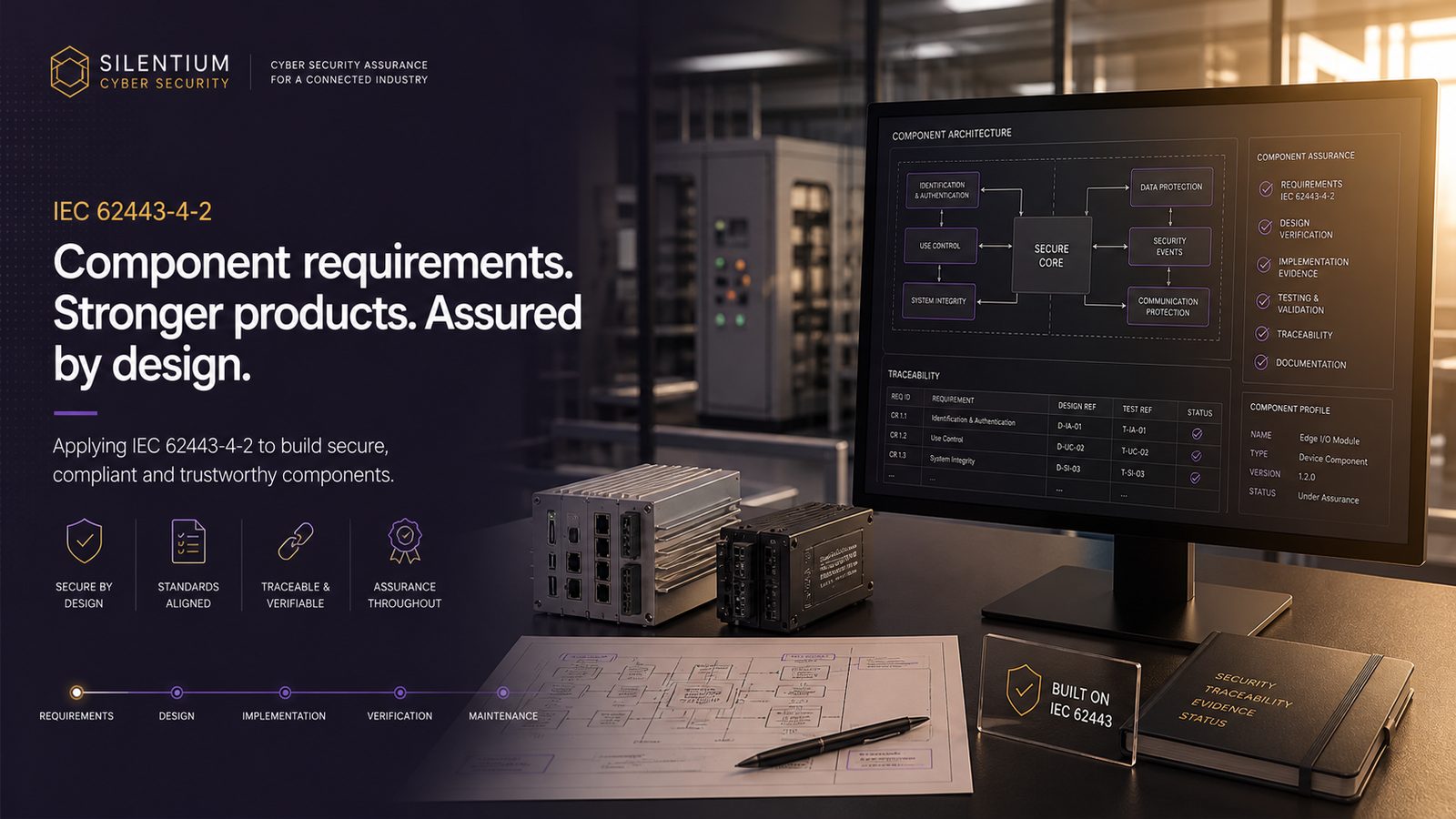
IEC 62443-4-2 is the part of the IEC 62443 series that product teams usually need when they are building or maintaining industrial components. If 4-1 is about the secure development process, 4-2 is about the technical security capabilities the component itself should provide. For engineers, that distinction matters: you are not just proving that you have a process, you are designing and testing specific behaviours into the product.
In practice, 4-2 is most useful when it is treated as an engineering input early in the lifecycle. Teams that leave it until the end often discover that authentication, logging, update handling, or interface hardening were never designed in, which creates rework and awkward trade-offs. That is especially true for smaller product teams that may be balancing legacy firmware, third-party libraries, and customer-specific deployment constraints.
Key takeaways
- IEC 62443-4-2 should be treated as a design input for product engineering, not a late-stage compliance checklist.
- Product teams should translate each requirement into specific component behaviour, test cases, and release evidence.
- Authentication, authorisation, secure update handling, logging, and interface hardening are usually the highest-value controls to implement first.
- A traceability matrix linking requirements, design decisions, and verification results makes it much easier to manage gaps and release risk.
What IEC 62443-4-2 is and where it fits in the standard
IEC 62443 is a family of standards for industrial automation and control systems. The 4-2 part focuses on component requirements, meaning the security properties expected from a product element such as a device, embedded controller, software module, gateway, or appliance. It sits alongside system-level requirements, which are covered elsewhere in the series and describe what the overall OT environment should do.
The simplest way to think about it is this: system requirements describe the security outcome for the whole environment, while component requirements describe what an individual product must be capable of to support that outcome. A component does not need to solve every security problem on its own, but it should provide the controls that a system integrator can rely on when building a secure design.
For product teams, that means 4-2 is not a policy document. It is a design and verification reference. If you are already working with IEC 62443-4-1 secure product development lifecycle practices, 4-2 is the technical counterpart that turns secure development into measurable product behaviour.
Component requirements versus system requirements
Component requirements are about the product’s own capabilities, such as how it authenticates users, protects communications, handles updates, logs events, or enters a safe state. System requirements are broader and may include network segmentation, access control architecture, monitoring, and operational procedures. A product team can influence the system, but it usually only owns the component.
This distinction is important when you are writing requirements. A vague statement such as “the device shall be secure” is not useful. A better requirement is specific, testable, and tied to a behaviour, for example: “the device shall require authenticated access for configuration changes” or “the component shall reject unauthorised firmware images before installation.”
Why product teams usually need this standard
Most product teams need 4-2 because customers, integrators, and procurement teams increasingly want evidence that industrial products have been designed with security in mind. Even where no formal certification route is being pursued, the standard gives teams a structured way to define and test security features.
It is also useful internally. Product managers can use it to prioritise security work, architects can use it to shape the trust model, and developers can use it to turn abstract security goals into implementation tasks. If you already use secure design reviews or threat modelling, 4-2 gives you a more concrete target for the component layer.
Which products and components this applies to
IEC 62443-4-2 is relevant to many industrial and OT-adjacent products, not just large PLCs or specialist control hardware. It can apply to embedded devices, industrial gateways, remote access appliances, protocol converters, HMI software, edge compute devices, and software components that are shipped as part of a broader OT product.
The key question is whether the item is part of an industrial automation or control environment and whether it has security-relevant behaviour. If the component stores credentials, accepts remote commands, processes control traffic, exposes an API, or can affect the integrity or availability of an OT process, it is likely in scope from a practical engineering perspective.
Embedded devices, controllers, gateways and software components
Embedded devices often need the widest range of design decisions because they may have limited CPU, memory, and storage, yet still need secure boot, authenticated updates, logging, and resilient communications. Gateways and protocol translators usually need strong interface control because they sit between trust zones and can become a high-value pivot point. Software components need the same discipline, even if they run on a general-purpose platform, because the component may still be the security boundary customers rely on.
For example, if you are building a gateway that bridges an IT network and an OT cell, the product may need to support mutual authentication, certificate lifecycle handling, interface restrictions, and clear logging of administrative actions. If you are building a controller, you may need secure configuration storage, role separation, and recovery behaviour that prevents unsafe operation after a fault or failed update.
When a component is in scope for an OT product
A component is in scope when its compromise could affect confidentiality, integrity, or availability in the industrial environment. That includes components that are not directly exposed to the internet but are reachable from engineering workstations, maintenance laptops, vendor support channels, or adjacent network segments. In OT, indirect exposure is often enough to create meaningful risk.
Product teams should therefore map the component’s trust boundaries carefully. If the product includes a local web interface, a serial management port, a remote support function, or a cloud-connected service, each of those interfaces may need separate requirements and test cases. This is where a simple zone and conduit view can help, especially if you are already using zone and conduit modelling under IEC 62443 to describe trust boundaries.
How to read the requirement families without the PDF
Even without the full document in front of you, the requirement families can be understood as a set of engineering questions. Can the component identify users and other systems? Can it control what they are allowed to do? Can it maintain integrity and recover safely? Can it protect data in transit and at rest? Can it limit exposure and remain available under stress?
That framing is useful because it helps teams translate the standard into backlog items, architecture decisions, and test cases. The exact wording of the standard matters for formal work, but product teams usually need the underlying intent first.
Identification and authentication
This family is about proving who or what is connecting to the component. For human users, that usually means usernames, passwords, certificates, tokens, or multi-factor authentication where appropriate. For machine-to-machine communication, it may mean mutual TLS, signed requests, or device certificates.
From an implementation perspective, avoid shared default credentials, hard-coded secrets, and weak bootstrap flows. If a device ships with a default password, make the first-login change mandatory and ensure the password policy is enforced locally, not just in documentation. If the component supports service accounts or API clients, use unique identities and rotate credentials in a controlled way.
Use control and privilege management
Use control is about limiting what authenticated users can do. In product terms, this often becomes role-based access control, command authorisation, or separate privilege levels for operators, engineers, and administrators. The goal is to prevent a low-privilege user from changing safety-critical settings or accessing functions they do not need.
Design this carefully. A common mistake is to authenticate everyone successfully and then rely on the user interface to hide dangerous options. That is not enough. The component should enforce authorisation server-side, and every sensitive action should be checked against the user’s role or policy context. If you already use least privilege access using IAM and RBAC in enterprise systems, the same principle applies here, even if the implementation is embedded or protocol-driven.
System integrity and secure state handling
This family covers the component’s ability to resist tampering and recover to a known good state. It includes secure boot, signed firmware, integrity checks, tamper detection where relevant, and safe handling of failed updates or corrupted configuration.
For product teams, the important question is what happens after something goes wrong. If an update fails halfway through, does the device brick, fall back to a vulnerable image, or recover to a safe version? If configuration data is corrupted, does the component fail closed, fail open, or enter a degraded but controlled mode? These are design decisions, not just test cases.
Data confidentiality and communication protection
Confidentiality is not always the primary concern in OT, but it still matters for credentials, configuration data, recipes, telemetry, and maintenance information. Communication protection usually means encryption in transit, integrity protection, and where appropriate mutual authentication between peers.
Do not assume that “internal network” means “trusted network”. Industrial environments often contain long-lived devices, flat segments, and vendor access paths that are difficult to monitor perfectly. If the component exchanges sensitive data, use TLS or an equivalent secure channel where the platform supports it, and document any constraints where it does not.
Restricted data flow and resource availability
Restricted data flow is about limiting where the component can send or receive information. In practice, that means interface allow-listing, protocol restrictions, port minimisation, and careful control of remote services. Resource availability covers resilience against overload, malformed input, and denial-of-service conditions.
This is often where product teams underestimate the work. A component may be functionally correct but still fragile under stress. If a malformed packet, repeated login attempt, or large request can exhaust memory or crash a service, the product may meet functional requirements but fail operationally. That is why availability testing should be part of the design, not an afterthought.
What product teams need to design in from the start
The strongest 4-2 outcomes come from early design decisions. Security requirements should be part of the product specification, not a separate document that appears after implementation is nearly complete. If the architecture cannot support a requirement, the team should know that before code is written or hardware is frozen.
Security requirements in product specifications
Write security requirements in a form that developers and testers can use. Each requirement should have a clear intent, an owner, and a verification method. For example, instead of saying “secure authentication is required”, specify the supported authentication methods, the credential storage approach, the lockout behaviour, and the expected logging.
A useful pattern is to maintain a requirements traceability matrix that links each 4-2 requirement to design decisions, implementation tasks, and test evidence. That makes it easier to show coverage and identify gaps before release.
Architecture decisions that affect compliance work later
Some decisions are expensive to change later. Examples include whether the product supports local accounts or only federated identities, whether updates are delta-based or full-image, whether logs are stored locally or forwarded, and whether the device can support certificate-based trust. These choices affect both security and maintainability.
Product teams should also decide how the component behaves when security services are unavailable. If certificate validation fails because of time drift, what is the fallback? If the logging destination is offline, does the component buffer, drop, or block? Each answer has security and operational consequences.
Dependencies on platform, firmware and cloud services
Modern OT products rarely stand alone. They depend on operating systems, bootloaders, third-party libraries, cloud APIs, remote support platforms, and sometimes containerised services. Those dependencies can make or break your ability to meet 4-2 expectations.
For example, if the platform does not support secure storage for keys, your authentication design may need hardware-backed protection or a different trust model. If the cloud service handles device registration, you need to define how identities are provisioned, revoked, and audited. If you rely on third-party components, you should track versions, vulnerabilities, and patch constraints as part of product security governance.
Practical implementation patterns for engineering teams
There is no single implementation pattern that fits every product, but there are a few recurring controls that tend to matter most. These are the areas where product teams usually get the best security return for the effort invested.
Authentication and credential handling
Use unique identities per device, user, or service wherever possible. Avoid shared credentials across fleets, because they make revocation and auditability difficult. Store secrets using platform mechanisms designed for that purpose, such as secure elements, TPM-backed storage, or encrypted key stores, depending on the device class.
For remote administration, prefer certificate-based authentication or strong token-based mechanisms over static passwords alone. If passwords are unavoidable, enforce minimum length, rate limiting, lockout or backoff controls, and secure reset flows. Make sure credentials are never logged in clear text and are not exposed in debug interfaces.
Secure update and patch mechanisms
Updates should be signed, verified before installation, and tied to a clear rollback strategy. The device should know what to do if an update is interrupted, invalid, or incomplete. If you support remote updates, protect the update channel and the update metadata, not just the payload.
It is also worth defining patch policy expectations for customers. Some OT environments cannot patch immediately, so product teams should document supported versions, end-of-support dates, and compensating controls. That documentation helps customers manage risk without guessing how long a version remains safe to operate.
Logging, auditability and event retention
Logs should record security-relevant events such as authentication attempts, privilege changes, configuration changes, firmware updates, and security setting modifications. Keep the logs structured where possible, so they can be forwarded into a SIEM or central log platform without heavy parsing.
Do not over-log to the point that the device becomes unstable, but do not under-log either. A practical approach is to define a minimum event set, a retention strategy, and a way to export logs securely. If the product cannot retain enough history locally, document the limitation and provide a forwarding option.
Hardening interfaces, services and exposed ports
Minimise the attack surface. Disable unused services, close unnecessary ports, and separate management interfaces from operational interfaces where possible. If the component exposes an API, define authentication, authorisation, input validation, and rate limiting as first-class requirements.
For network-facing products, test how the component behaves with malformed traffic, repeated requests, unexpected sequencing, and partial failures. That kind of validation is especially important for industrial protocols and gateway devices, where a small parsing weakness can have a disproportionate impact.
Evidence and documentation product teams should maintain
Good evidence is not just for external assurance. It helps engineering teams understand what has been designed, what has been tested, and what remains as an accepted limitation. For 4-2, the most useful evidence is usually technical and traceable rather than policy-heavy.
Security requirements traceability
Maintain a mapping from each requirement to the design element, implementation ticket, and verification activity that supports it. This can be a lightweight matrix in a product backlog tool or a more formal requirements repository. The goal is to show that the requirement was considered, implemented, and tested.
Design decisions, threat models and test evidence
Keep architecture notes, threat models, and design review outputs. If a requirement was not implemented in the most obvious way, record the reason. For example, if a device cannot support a certain authentication method because of hardware constraints, document the compensating control and the residual risk.
This is also where threat modelling helps. A simple STRIDE-style review can identify spoofing, tampering, repudiation, information disclosure, denial of service, and elevation of privilege risks that map neatly to 4-2 design work. If you already use threat modelling concepts in your product process, extend them to the component boundary and the OT context.
Release notes, known limitations and compensating controls
Release notes should not just list features and bug fixes. They should also call out security-relevant changes, supported configurations, and known limitations. If a control is partially implemented, say so clearly and describe the compensating control or deployment assumption.
That level of transparency helps integrators make better decisions and reduces the risk of accidental misuse. It also makes support conversations easier when a customer deploys the product in a way that was never intended.
How to test whether a component meets the intended controls
Testing for 4-2 is a mix of functional verification, negative testing, and abuse-case validation. The aim is not only to prove that the happy path works, but also to show that the component behaves safely when inputs are wrong, malicious, or simply unexpected.
Security testing approaches for firmware and software
For firmware, test secure boot, update verification, rollback behaviour, credential storage, and interface exposure. For software components, test authentication flows, session handling, API authorisation, logging, and dependency behaviour. Where possible, automate these checks so they run in CI or pre-release pipelines.
Static analysis, dependency scanning, and configuration review all have a place, but they should be complemented by runtime testing. A component can look fine in source code and still fail when deployed with real certificates, real network conditions, or real operator workflows.
Negative testing, abuse cases and interface validation
Negative testing should include invalid credentials, expired certificates, malformed requests, overlong inputs, replay attempts, and repeated access attempts. Abuse cases should reflect realistic misuse, such as an operator trying to access an admin function with a standard account or a maintenance tool sending commands out of sequence.
For network-exposed interfaces, validate that the component rejects unsupported protocols, unexpected ports, and unauthorised management access. For local interfaces, test what happens when a user attempts to bypass the intended workflow through debug menus, hidden endpoints, or direct file manipulation.
What to verify before release
Before release, product teams should confirm that the security requirements are traceable, the critical controls are implemented, the tests have been executed, and the known limitations are documented. If a control is not fully implemented, the release decision should be explicit and risk-based, not accidental.
A practical pre-release checklist usually includes authentication, authorisation, secure update, logging, hardening, recovery, and dependency review. If the product is part of a larger OT system, coordinate with the system team so the component assumptions match the deployment model.
Common gaps that cause avoidable rework
The most common mistake is treating 4-2 as a late-stage compliance checklist. By the time the team reaches that point, the architecture may already be fixed, the hardware may be frozen, and the release date may be close. That is when security requirements become expensive to retrofit.
Treating the standard as a late-stage checklist
When teams leave security until the end, they often discover that the product cannot support the required control without major redesign. The better approach is to use 4-2 as a design reference from the start, then verify incrementally as features are built.
Missing trust boundaries and weak default settings
Another common gap is unclear trust boundaries. If the team has not defined which interfaces are trusted, which identities are privileged, and which services are exposed, the resulting product often has inconsistent controls. Weak defaults make the problem worse, especially if the product ships with permissive settings that customers never change.
Incomplete update, logging or recovery design
Update, logging, and recovery are often underdesigned because they are not visible in the main user journey. Yet these are the areas that matter most when something goes wrong. If the product cannot update safely, cannot explain what happened, or cannot recover predictably, it will be difficult to operate securely in the field.
How IEC 62443-4-2 relates to 4-1 and 3-3
4-1, 4-2, and 3-3 are related but distinct. 4-1 is about the secure product development lifecycle. 4-2 is about component technical requirements. 3-3 is about system security requirements. Product teams usually need to understand all three, but they should not confuse their roles.
Product development lifecycle versus technical component requirements
Think of 4-1 as the process that helps you build securely, 4-2 as the product controls you build, and 3-3 as the system-level expectations those controls support. A strong development process without strong component requirements still leaves gaps. Likewise, a good component design without a secure development lifecycle can introduce vulnerabilities during implementation or maintenance.
How product and system teams should coordinate
Coordination works best when product teams and system teams share assumptions early. The product team should document what the component can do, what it cannot do, and what deployment conditions it expects. The system team should then decide how to place the component into zones, what access paths to allow, and what compensating controls are needed.
That coordination is especially important for gateways, remote access products, and devices that bridge different trust levels. If the product and the system are designed in isolation, the final deployment can end up weaker than either team intended.
A practical starting point for smaller product teams
Smaller teams do not need to implement everything at once. The most sensible approach is to prioritise the highest-risk components first, usually those with remote access, update capability, privileged functions, or trust boundary responsibilities. That gives you the biggest reduction in exposure for the least effort.
Prioritising the highest-risk components first
Start with the components that can affect the most users or the most critical process functions. Then work through authentication, update handling, logging, and hardening in that order. If you are short on time, focus on the controls that reduce the likelihood of unauthorised access and unsafe recovery behaviour.
Building a repeatable requirements and test workflow
Create a repeatable workflow that starts with requirements capture, moves through design review and threat modelling, and ends with verification and release evidence. Keep the artefacts lightweight but consistent. A simple template for requirements, a standard test checklist, and a traceability matrix are often enough to get started.
If you want to align product security work with broader governance, it can help to compare the component requirements with your existing secure development and supplier assurance practices. That is often where teams find the quickest wins, because the same evidence can support multiple internal and customer-facing needs.
For teams that want help turning the standard into a practical engineering plan, a structured review can be useful. A consultant can help you map requirements to product architecture, identify gaps in current controls, and define a realistic test and evidence approach without overcomplicating the process. If that would be helpful, speak to a consultant.
Frequently asked questions
What is the difference between IEC 62443-4-2 and IEC 62443-3-3?
IEC 62443-4-2 focuses on technical security requirements for individual components, while IEC 62443-3-3 focuses on security requirements at the system level. Product teams usually use 4-2 to design the component and 3-3 to understand the wider environment it must support.
How should a product team document evidence for IEC 62443-4-2 requirements?
Keep a traceability matrix that links each requirement to the design decision, implementation task, and test result. Add architecture notes, threat models, release notes, and known limitations so the evidence shows both what was built and how it was verified.
Do we need the full standard to start work on 4-2 requirements?
No. Teams can start by identifying the component’s trust boundaries, exposed interfaces, authentication model, update path, logging needs, and recovery behaviour. The full standard is useful for formal alignment, but the engineering work can begin with a structured interpretation of the requirement families.
Is IEC 62443-4-2 only relevant for certified products?
No. Many teams use it as a practical design and assurance framework even when they are not pursuing certification. It helps define security expectations, reduce rework, and provide clearer evidence to customers and integrators.
Comments are closed