
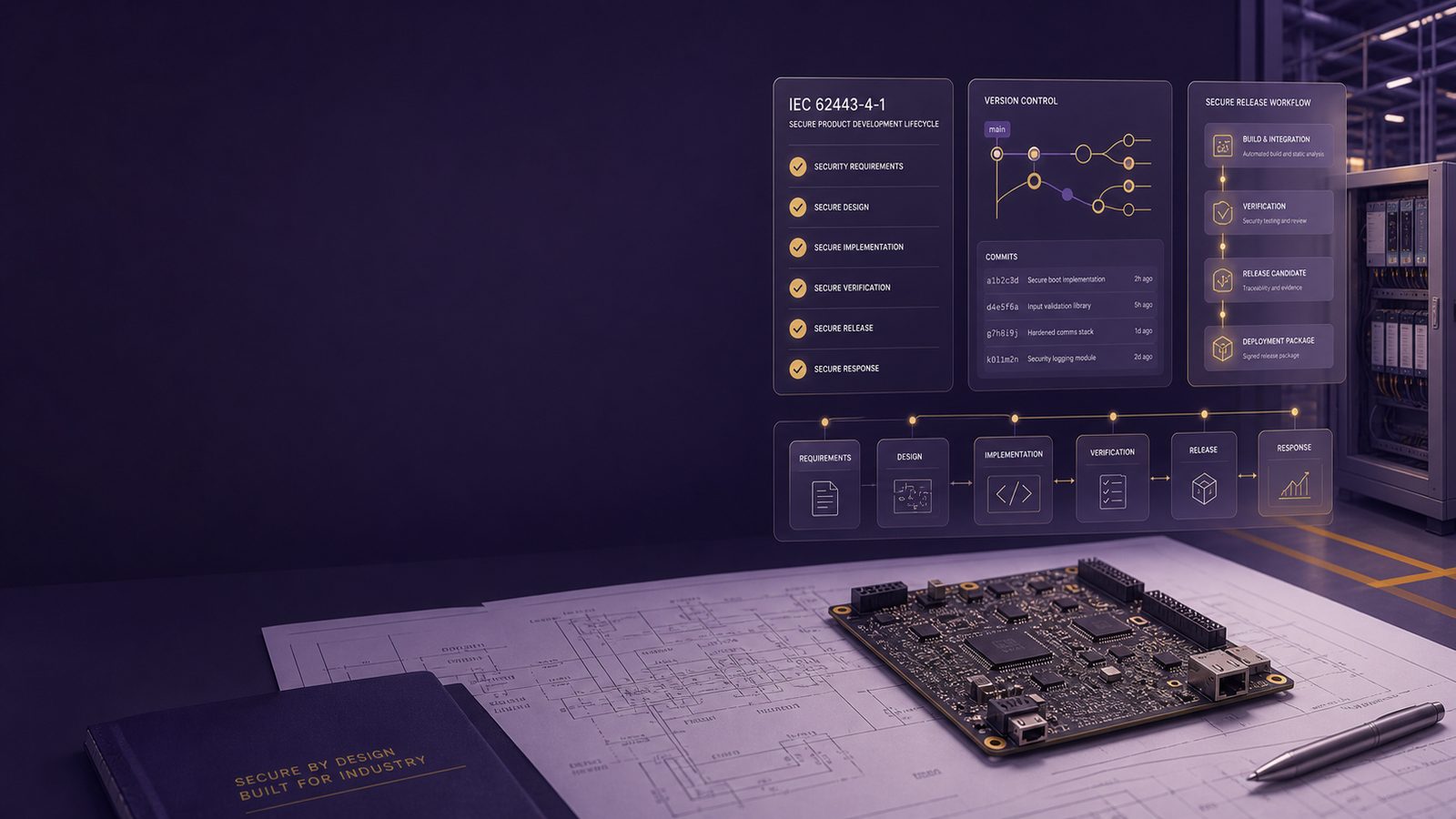
For OT vendors, IEC 62443-4-1 is best understood as a secure product development lifecycle standard. It is not mainly about how a plant network is segmented or how a deployed system is hardened. Instead, it focuses on the engineering process used to design, build, verify, release, and maintain industrial products with security built in from the start.
That distinction matters. A vendor can have a well-designed product architecture and still ship insecure firmware if requirements are vague, build pipelines are weak, component provenance is unclear, or vulnerability handling is ad hoc. In industrial environments, those weaknesses can persist for years because equipment lifecycles are long, patch windows are limited, and replacement is expensive.
For UK SMEs that supply industrial automation, control systems, embedded devices, or specialist software into operational technology environments, the practical value of IEC 62443-4-1 is that it gives structure to secure engineering. It helps teams move from informal good practice to repeatable controls, test evidence, and a defensible development process. If you also need the broader context of the standard family, our IEC 62443 overview for manufacturing organisations is a useful starting point.
Key takeaways
- IEC 62443-4-1 focuses on the secure product development lifecycle, not just the security of the deployed OT system.
- The most useful controls for vendors are clear security requirements, controlled builds, repeatable testing, and documented vulnerability handling.
- Smaller OT vendors can start with lightweight governance, dependency tracking, and security regression tests without overengineering the process.
- Evidence matters: keep design reviews, test results, release records, and patch history linked to each product version.
What IEC 62443-4-1 covers and why OT vendors care
IEC 62443-4-1 is concerned with the product development lifecycle. That includes how security requirements are defined, how design decisions are reviewed, how code and firmware are built, how dependencies are controlled, how security testing is performed, and how vulnerabilities are handled after release. In other words, it is about the vendor’s internal engineering system, not just the final product.
OT vendors care because buyers increasingly expect evidence that security is engineered into products rather than bolted on later. In practice, procurement teams want to know whether the supplier can explain how security requirements are captured, whether code changes are reviewed, whether releases are reproducible, and whether there is a credible patch and disclosure process. Those questions are especially important where the product will sit in a safety-relevant or operationally sensitive environment.
How 62443-4-1 differs from system security and architecture guidance
IEC 62443-4-1 is often confused with the parts of the family that describe system requirements or technical security capabilities. That is understandable, but the focus is different. 62443-4-1 is about process maturity and secure development practice. By contrast, system-level guidance is about what security controls should exist in the deployed solution.
A useful way to think about it is this: 62443-4-1 asks whether you build securely, while other parts of the family ask whether the product or system behaves securely in use. A vendor may need both. For example, a secure development process is of limited value if the product still lacks strong authentication, secure update mechanisms, or logging. Likewise, a technically strong product is harder to trust if the development process is opaque and inconsistent.
Where secure development fits in the wider IEC 62443 family
In vendor conversations, 62443-4-1 usually sits alongside product capability expectations and system integration expectations. That means engineering teams should treat it as part of a broader assurance story. Product development controls, product security requirements, and deployment architecture all need to line up.
For example, if a product is intended for a segmented OT network, the development team should understand the assumptions behind that deployment model. If the product depends on secure communications, the implementation should reflect that in protocol handling, certificate management, and update channels. If the product is expected to operate in constrained environments, the lifecycle should still include secure defaults and a realistic patch strategy. Our article on zone and conduit modelling under IEC 62443 is helpful for understanding how product design and deployment architecture interact.
Core secure development lifecycle activities
Most vendors already have some form of development lifecycle. The question is whether security is explicit, repeatable, and evidenced. Under 62443-4-1, the most important activities are security requirements definition, secure design and implementation, verification and validation, and controlled maintenance after release.
Security requirements definition and security by design
Security requirements should be defined early, before implementation decisions become fixed. For OT products, that usually means identifying the trust boundaries, the expected operating environment, the attacker model, and the consequences of compromise. Requirements should then be translated into concrete engineering expectations such as authentication, authorisation, secure boot, signed updates, audit logging, and fail-safe behaviour.
Security by design is not a slogan. It means the product architecture should make secure operation the default. For example, services should not expose unnecessary interfaces, default credentials should be eliminated, and remote administration should be constrained by role-based access control and strong authentication. Where the product communicates over insecure or mixed-trust networks, transport security should be designed in from the outset. If you need a practical refresher on that area, our guide to secure communications using TLS and mutual authentication covers the design pattern in more detail.
For smaller vendors, the key is not to create a large document set. It is to ensure every meaningful feature has a security requirement, and every requirement can be traced to a design decision, test case, or operational control.
Secure coding, build integrity, and configuration management
Secure coding matters in OT products just as much as in enterprise software, but the implementation constraints are often tighter. Embedded systems may have limited memory, older toolchains, or real-time requirements. Those constraints do not remove the need for secure coding practices. They simply mean the controls need to be adapted carefully.
At code level, teams should use peer review, static analysis, and dependency scanning. For C and C++ code, that usually means attention to memory safety, bounds checking, integer handling, and unsafe library use. For managed code, the focus may shift towards deserialisation, authentication flows, and misuse of cryptography. Configuration management is equally important. Build scripts, compiler flags, signing keys, and release artefacts should be controlled and versioned, with clear separation between development, test, and production environments.
Build integrity is a common weak point. A secure product development lifecycle should make it difficult for unreviewed changes to reach release. Practical controls include protected branches, mandatory approvals, signed commits where appropriate, reproducible builds where feasible, and restricted access to release signing material. If your team is still maturing its environment separation and release control, our article on secure configuration management and environment isolation is a relevant companion piece.
Verification, validation, and security testing
Testing under 62443-4-1 should go beyond functional correctness. It should include security-focused verification that the product behaves as intended under misuse, malformed input, and hostile conditions. For OT vendors, that often means a mix of static analysis, dynamic testing, protocol-aware testing, and targeted abuse case testing.
Verification should be mapped to the security requirements. If the product claims to support authenticated firmware updates, test that unsigned updates are rejected and that rollback protection works. If the product exposes a management API, test access control, session handling, and error handling. If the product processes industrial protocols, test how it handles malformed frames, unexpected state transitions, and rate anomalies. The aim is not to simulate every possible attack. It is to prove that the most important security assumptions hold.
Validation should also consider the deployment context. A product may be secure in a lab but fragile in a noisy plant network or when integrated with older equipment. That is why protocol handling, timeout behaviour, and recovery logic deserve as much attention as traditional application security checks. For teams building test programmes, our article on security regression testing and abuse case testing is a useful reference point.
How to organise governance for a secure product development process
Governance is where many smaller vendors struggle. The challenge is usually not lack of intent, but unclear ownership. A secure development lifecycle needs named responsibilities, decision points, and escalation paths. Without those, security work becomes dependent on individual engineers rather than embedded in the process.
Roles, responsibilities, and security ownership across engineering teams
At minimum, someone should own product security requirements, someone should own secure design review, someone should own vulnerability handling, and someone should own release approval. In a small organisation, those roles may sit with the same person, but they still need to be explicit. Engineering managers should know when a security review is required, what evidence is expected, and who can accept residual risk.
It also helps to define a lightweight security review forum for product changes that affect trust boundaries, authentication, cryptography, update mechanisms, or exposed interfaces. That forum does not need to be bureaucratic. A short checklist and a recorded decision are often enough. The important point is that security decisions are visible and repeatable.
Where product teams work closely with operations or field engineering, feedback loops matter. Issues found in deployment should feed back into requirements, design patterns, and test cases. That is how the lifecycle becomes a learning system rather than a one-way release process.
Supplier and component assurance for embedded and software dependencies
Most OT products depend on third-party components, whether that is an operating system, a library, a device driver, or a hardware module. Under 62443-4-1, suppliers need a clear view of what they are consuming and how they are controlling it. That includes open source components, commercial libraries, and outsourced development.
Practical assurance starts with inventory. Teams should know which components are used, where they are used, and which versions are deployed. They should also know which components are security-critical, such as cryptographic libraries, network stacks, and update services. Where possible, maintain a software bill of materials and link it to release artefacts. That makes vulnerability triage and customer communication much easier.
Supplier assurance should not be limited to questionnaires. Ask for evidence of secure development practices, patch support expectations, and vulnerability notification processes. If a component is embedded in a safety or availability-sensitive product, understand the supplier’s maintenance horizon and end-of-life policy. Our guide to verifying supplier compliance with secure software requirements is relevant here.
Practical implementation for OT product teams
For many UK SMEs, the biggest question is how to implement 62443-4-1 without overengineering. The answer is to start with the product’s real attack surface and the engineering activities that most directly reduce risk. That usually means threat modelling, secure requirements for interfaces and updates, and explicit handling of legacy constraints.
Threat modelling for industrial products and interfaces
Threat modelling should be practical and product-specific. Identify the main assets, the trust boundaries, the external interfaces, and the likely attacker goals. In OT, that often includes unauthorised control, disruption of availability, manipulation of telemetry, and persistence through weak update paths. Techniques such as STRIDE can be useful, but only if they are adapted to industrial realities.
For each interface, ask what happens if it is spoofed, replayed, flooded, or supplied with malformed data. For each trust boundary, ask what assumptions the product makes about the network, the operator, and connected assets. For each update path, ask how authenticity, integrity, and rollback protection are enforced. Those questions should produce concrete requirements, not just a diagram.
If you already use structured threat modelling in software projects, the same discipline can be applied to OT products, but the failure modes are different. Availability and recoverability often matter as much as confidentiality, and in some cases more. That should be reflected in design decisions and test priorities.
Security requirements for firmware, software, and update mechanisms
Firmware and update mechanisms deserve particular attention because they are a common route for persistent compromise. Secure boot, signed firmware, secure update transport, and anti-rollback controls are all worth considering where the platform supports them. If the device cannot support every control, the limitation should be documented and compensated for where possible through operational controls or deployment constraints.
Management interfaces should use strong authentication and least privilege. Where remote access is necessary, use mutually authenticated channels and avoid shared credentials. Logging should capture security-relevant events such as authentication failures, configuration changes, update attempts, and privilege changes. Logs need to be useful to operators, not just developers, so keep them structured and consistent.
For products that expose APIs or integrate with supervisory systems, input validation remains critical. Industrial protocols may be older, but they still need robust parsing and defensive handling. If your team wants a broader software engineering reference for this area, our article on input validation, encoding, and output sanitisation techniques is a good companion.
Handling legacy constraints in industrial environments
Legacy constraints are normal in OT. You may be supporting older operating systems, constrained hardware, or protocols that were not designed with modern security in mind. The right response is not to ignore security, but to be explicit about the constraints and design compensating controls.
That may include limiting exposed functionality, reducing privilege, isolating management functions, enforcing secure deployment assumptions, or documenting operational prerequisites. It may also mean defining a realistic patch strategy for customers who cannot update immediately. In industrial settings, patching often needs to be coordinated with maintenance windows, validation activities, and safety checks. A secure lifecycle should therefore include release notes, rollback guidance, and clear support boundaries.
Evidence and artefacts teams should maintain
One of the most practical benefits of 62443-4-1 is that it encourages teams to keep the evidence they already generate in a more structured form. That makes internal governance easier and reduces friction in customer assurance discussions.
Development policies, review records, and test evidence
Useful artefacts include secure development policies, coding standards, design review records, threat models, test plans, test results, and release approvals. The goal is not paperwork for its own sake. It is traceability. If a security requirement exists, there should be a way to show how it was implemented and verified.
For smaller vendors, a concise evidence pack is often enough. Keep one source of truth for product security requirements, one for design decisions, one for test evidence, and one for release records. Make sure the records are versioned and linked to the relevant build or release identifier. That way, when a customer asks how a feature was secured, the answer is not buried in email threads.
Vulnerability handling, disclosure, and patch release records
Post-release security handling is part of the lifecycle, not an afterthought. Vendors should have a documented process for receiving vulnerability reports, triaging them, assigning severity, developing fixes, validating patches, and communicating with customers. The process should also cover how to handle third-party component issues and how to decide when a workaround is needed before a full patch.
Patch release records should show what was fixed, which versions are affected, what the operational impact is, and whether any compensating controls are required. For OT buyers, this is often as important as the fix itself. They need to know whether a patch is safe to deploy, whether downtime is required, and whether the product remains supported. A mature vulnerability process also helps vendors avoid confusion when multiple customers run different versions in different environments.
Common gaps OT vendors should avoid
There are a few recurring weaknesses that show up in smaller OT vendors. They are usually not caused by negligence. More often, they result from growth, inherited code, or a focus on delivery over process. The good news is that they are fixable.
Weak separation between development and production environments
If developers can directly influence production artefacts, signing keys, or deployment settings, the release process is too loose. Development, test, and production should be separated by access control and process, even if the team is small. That separation reduces the chance of accidental release and makes malicious tampering harder.
Environment separation also helps with evidence. If you can show that builds are promoted through controlled stages, buyers are more likely to trust the release process. It is a simple control with outsized value.
Inconsistent patching and unsupported components
Unsupported libraries, outdated toolchains, and forgotten firmware branches are common in industrial products. They create long-lived exposure and make vulnerability response harder. A secure lifecycle should include a component support policy, an end-of-life process, and a way to track which product versions remain in service.
Where patching is difficult, vendors should at least know the exposure and communicate it clearly. Silent risk is much harder to manage than documented risk.
Missing security testing for communications and protocol handling
Industrial products often fail in the same places: parsers, protocol handlers, authentication flows, and update paths. If testing focuses only on functional behaviour, those weak points can remain hidden until a customer deployment or a security assessment finds them. Security regression tests should therefore include malformed inputs, boundary conditions, and negative cases for the most important interfaces.
That is especially important where products speak protocols such as Modbus, DNP3, or vendor-specific fieldbus variants. The exact protocol matters less than the discipline of testing how the implementation behaves when assumptions are broken.
How 62443-4-1 relates to 62443-4-2 and 62443-3-3
It is helpful to separate product lifecycle expectations from product capability requirements and system-level requirements. 62443-4-1 is about how the product is developed and maintained. 62443-4-2 is about technical security requirements for components or products. 62443-3-3 is about system security requirements for the deployed environment.
In vendor and buyer conversations, these parts should be used together. A vendor can explain that its development process is controlled under 4-1, that the product implements relevant technical capabilities under 4-2, and that the customer’s deployment architecture should satisfy system-level expectations under 3-3. That gives everyone a clearer picture of where responsibilities sit.
For buyers, this distinction helps avoid a common mistake: assuming that a secure product automatically creates a secure system. For vendors, it helps avoid overclaiming. A product may be well engineered, but the final security outcome still depends on deployment, configuration, and operational practice.
A pragmatic adoption roadmap for smaller vendors
Smaller OT vendors do not need to implement everything at once. The most effective approach is to start with the controls that reduce the most risk and create the most reusable evidence.
First, define a basic secure development policy and assign ownership. Second, introduce security requirements for new features and interfaces. Third, add code review, dependency tracking, and release approval controls. Fourth, build a small set of security regression tests around authentication, updates, and protocol handling. Fifth, document vulnerability intake and patch release handling.
Once those basics are in place, improve the process incrementally. Add threat modelling for higher-risk products, expand test coverage, tighten build integrity, and improve supplier assurance. The aim is a repeatable cycle, not a perfect one. In practice, a modest but consistent process is far more valuable than a large framework that nobody follows.
If you are already working towards broader information security management or supplier assurance goals, it can help to align product security work with your wider governance model. That keeps the lifecycle practical and avoids duplicate effort across engineering, operations, and assurance teams.
For OT vendors, IEC 62443-4-1 is ultimately about trust. It gives customers a way to understand how security is built into the product, and it gives engineering teams a way to make that security repeatable. The standard is most useful when it is treated as a working development discipline rather than a badge to chase.
If you would like help translating these ideas into a practical product security roadmap, Speak to a consultant.
Frequently asked questions
What is IEC 62443-4-1 in simple terms for OT vendors?
It is a standard for how OT products should be securely designed, built, tested, released, and maintained across the development lifecycle.
How do 62443-4-1 and 62443-4-2 differ?
62443-4-1 is about the secure development process, while 62443-4-2 is about the technical security capabilities the product should implement.
Is IEC 62443-4-1 only for large manufacturers?
No. Smaller vendors can apply it in a scaled way by focusing on the highest-risk products, clear ownership, controlled releases, and practical evidence.
What evidence do buyers usually expect from OT vendors?
They usually want to see security requirements, design review records, test evidence, release approvals, and a documented process for vulnerability handling and patching.
Comments are closed