
Why secure communications matter in practical system design
Most organisations already know that data should be protected when it is sent across a network. The harder question is how to do that in a way that fits the business, the systems in use, and the team that has to run them.
For UK SMEs, secure communications are not just a technical detail. They affect customer trust, service availability, supplier integration, and the amount of effort needed to support systems over time. If a service exchanges sensitive data, or if one system depends on another to make business decisions, the communication path itself becomes part of the security design.
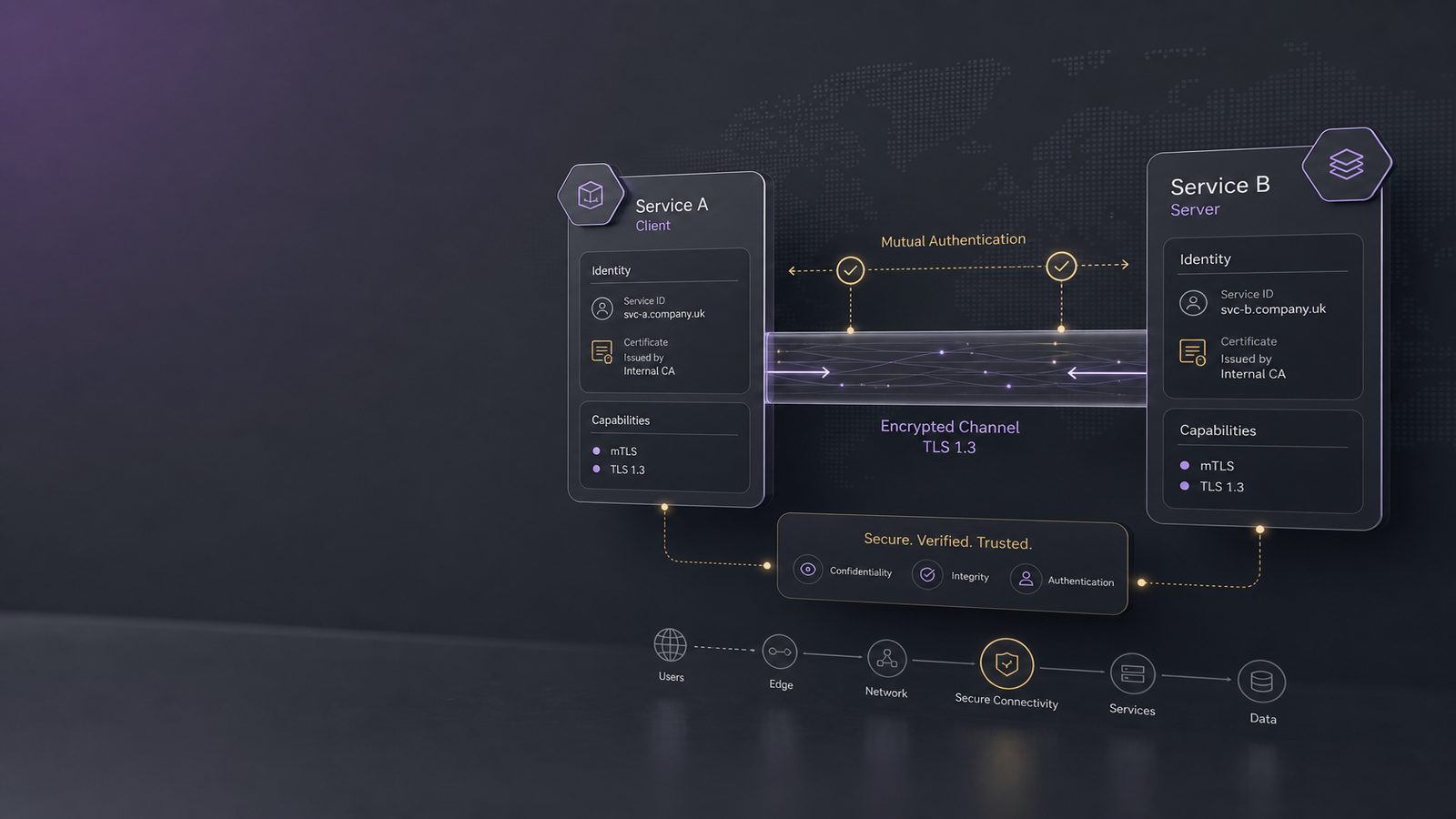
The most common starting point is TLS, which stands for Transport Layer Security. In plain English, TLS creates an encrypted channel between two systems so that data is harder to read or alter while it is moving. It also helps the client check that it is talking to the right server, provided the certificate and trust settings are configured properly.
Mutual authentication goes a step further. Instead of only the client checking the server, both sides prove who they are. This is often done with certificates on both ends. It can be useful where a business wants stronger assurance that only approved systems can connect, especially for system-to-system traffic.
That extra assurance is valuable, but it is not free. Mutual authentication adds operational overhead, including certificate management, renewal, trust distribution, and troubleshooting. For that reason, it should be used where the business need justifies the added complexity, not as a default everywhere.
What TLS does in plain English
TLS protects data in transit. That means it helps keep information confidential and reduces the risk of tampering while data moves between a browser and a website, or between two services. It also supports server identity checks, so users and systems can be more confident they are connecting to the intended endpoint.
For SMEs, TLS is usually the baseline control for any internet-facing service and for most internal services that carry sensitive data. It is a sensible default because it improves security without changing the way most applications work.
It is worth remembering what TLS does not do on its own. It does not fix weak passwords, poor access control, insecure application logic, or compromised endpoints. It also does not automatically prove that the other side of the connection is authorised to use the service. That is where design choices matter.
Where mutual authentication adds extra assurance
Mutual authentication is useful when both parties need to establish trust before any meaningful exchange takes place. In practice, that often means one system should only talk to a known set of other systems, and the organisation wants a stronger control than network location or shared secrets alone.
Examples include internal APIs that move sensitive records, integration points with suppliers, service-to-service calls in a private environment, and administrative interfaces that should only be reachable from managed systems. In these cases, mutual authentication can reduce the chance of unauthorised systems connecting, even if they are inside the network.
It is not a universal answer. If the main risk is user access from unmanaged devices, then identity controls, device posture, and session management may be more important. If the main risk is exposure of public web services, then strong TLS configuration, secure application design, and monitoring may deliver more value than adding mutual authentication everywhere.
When TLS alone is enough, and when mutual authentication is worth considering
A useful way to decide is to start with the data flow. Ask what is being sent, who is sending it, who is receiving it, and what would happen if the communication were intercepted, altered, or redirected. The answer usually points to the right level of control.
Typical SME use cases for customer-facing services
For most customer-facing websites and portals, TLS alone is usually the right baseline. The browser already knows how to validate the server certificate, and the user experience remains straightforward. This is often enough when the service is designed for public access and the main concern is protecting data in transit.
That said, the service still needs careful design. Certificates must be valid and trusted, redirects should be handled consistently, and insecure legacy protocols should be disabled. If the application handles logins, payments, or personal data, the wider design should also include secure session handling, strong authentication, and sensible logging.
Mutual authentication is less common for public websites because it can create friction for legitimate users. It is possible to use it in narrow cases, but for most SMEs it is better reserved for non-public interfaces, partner integrations, or administrative access paths.
Typical SME use cases for system-to-system traffic
System-to-system communication is where mutual authentication often makes more sense. Internal APIs, message brokers, data synchronisation jobs, and service calls between application components may all carry sensitive information without any human user being involved.
In these cases, the business may want to know not only that the channel is encrypted, but also that the calling system is one of a small number of approved systems. Mutual authentication can support that requirement by making the connection dependent on a valid certificate on both sides.
This is especially relevant where systems are hosted across different environments, where suppliers connect into your environment, or where the network itself is not a reliable trust boundary. If a service is exposed to multiple internal teams, or if workloads move frequently, certificate-based identity can be more dependable than IP address allow lists alone.
Even then, it should be part of a broader design. Mutual authentication does not replace application authorisation. A system that is allowed to connect should still only be allowed to perform the actions it needs. That keeps trust narrow and reduces the impact if one component is misused.
Core design choices that affect security and reliability
The security of TLS and mutual authentication depends heavily on the design choices made around certificates, trust, and protocol settings. These choices affect not only protection, but also how easy the service is to operate.
Certificate management and trust boundaries
Certificates are the foundation of trust in these designs. A certificate links a public key to an identity, such as a server name or a service identity. If the certificate is issued, stored, deployed, or renewed badly, the whole trust model becomes fragile.
For SMEs, the first step is to define the trust boundary clearly. Decide which systems are trusted to issue certificates, which systems are trusted to hold private keys, and which teams are allowed to approve changes. If this is left vague, certificate handling often becomes ad hoc and difficult to audit internally.
Private keys should be protected carefully, because anyone who obtains a key may be able to impersonate that service. In practice, that means limiting access, avoiding unnecessary copying, and using secure storage where possible. It also means thinking about what happens if a key is suspected to be exposed, so replacement can happen quickly.
For mutual authentication, both sides need a clear trust model. Each system must know which issuing authority it trusts, and the organisation should avoid trusting more certificates than necessary. Narrow trust is easier to manage and reduces the chance that an unrelated certificate is accepted by mistake.
Protocol versions, cipher choices, and deprecation planning
Not all TLS configurations are equal. Older protocol versions and weak cipher choices can reduce the protection that TLS is meant to provide. A sensible design uses current, supported settings and removes legacy options in a planned way.
For SMEs, the practical point is not to become obsessed with cryptographic detail. Instead, aim for a standard configuration that is modern, supportable, and consistent across services. That makes it easier to review, test, and maintain.
Deprecation planning matters because systems age. A service that works today may rely on a library, appliance, or integration partner that cannot support newer settings forever. If you do not plan for change, you may end up keeping weaker options in place longer than intended.
It is also important to test compatibility before making changes. Secure settings should not break critical business services without warning. A phased approach, with testing in a non-production environment and a rollback plan, is usually the safest route.
Common architecture patterns for secure service communication
There is no single pattern that fits every SME. The right design depends on whether the communication is public or private, human-facing or system-to-system, and whether the traffic crosses trust boundaries.
Browser to web application traffic
For browser-based services, TLS is the standard control. The browser validates the server certificate and establishes an encrypted session. This is the normal pattern for websites, portals, and web applications used by staff, customers, or suppliers.
In this pattern, the main design work is around certificate lifecycle, domain naming, redirect behaviour, and ensuring that the application itself does not undermine the protection TLS provides. For example, a secure channel is of limited value if the application then allows sensitive data to be exposed through weak session handling or poor access control.
Mutual authentication is usually not the first choice for browser traffic because it can complicate onboarding and support. If it is used, it is often for a narrow administrative portal or a restricted partner interface rather than for general customer access.
API to API and internal service communication
For APIs and internal services, the design options are broader. TLS should still be the baseline, but mutual authentication becomes more attractive where the organisation wants to verify both endpoints before data is exchanged.
A common pattern is to use certificate-based identity between services, with each service only trusting a defined set of peers. This can work well in environments where services are automated, where human login is not appropriate, and where the organisation wants a stronger technical control than network segmentation alone.
The key is to keep the design simple enough to operate. If every service has a different trust model, certificate format, or renewal process, the overhead can become hard to manage. A standard pattern, applied consistently, is usually more effective than a highly bespoke approach.
Where possible, align the communication pattern with the business function. For example, a payment integration may need a stricter trust model than an internal reporting feed. A customer data synchronisation job may need tighter controls than a low-risk status update. Matching the control to the risk keeps the architecture proportionate.
Operational controls that keep secure channels working over time
Secure communications are not a one-time design decision. They need routine care. Certificates expire, services change, dependencies move, and teams forget why a setting was chosen in the first place. Good operational controls prevent those issues from turning into avoidable outages or security gaps.
Renewal, rotation, and expiry monitoring
Certificate expiry is one of the most common operational failure points. If a certificate expires unexpectedly, a service may stop working or users may see warnings. For business-critical systems, that can create disruption even if the underlying security design is sound.
To reduce that risk, track certificate lifetimes, renewal dates, and ownership. Make sure someone is accountable for each certificate, and build reminders well before expiry. Where automation is available, use it carefully and test it. Automation is helpful, but only if the renewal path is reliable and monitored.
Rotation should also be planned. If a certificate or key needs to be replaced, the process should be predictable and documented. That includes knowing how to deploy the new certificate, how to confirm the service is using it, and how to revoke or retire the old one.
Logging, alerting, and configuration review
Good logging helps you spot failed handshakes, expired certificates, trust errors, and unexpected connection attempts. That information is useful both for troubleshooting and for security monitoring.
Alerting should focus on the events that matter most. For example, repeated authentication failures between services may indicate a misconfiguration or a problem with trust settings. Sudden changes in certificate usage may also deserve attention. The aim is not to collect noise, but to identify meaningful exceptions.
Configuration review is equally important. Over time, teams may add exceptions, temporary fixes, or legacy settings that never get removed. A periodic review helps confirm that the live configuration still matches the intended design. It also gives you a chance to remove old trust relationships that are no longer needed.
Typical mistakes SMEs should avoid
Many problems with secure communications come from assumptions rather than from the technology itself. The following mistakes are common and avoidable.
Assuming encryption alone proves identity
Encryption protects data in transit, but it does not automatically prove that the other side is the right system for the job. A secure channel can still be established with the wrong endpoint if identity checks are weak or trust is too broad.
This is why mutual authentication can matter. It adds a second layer of assurance by requiring both sides to present valid credentials. Even then, the organisation still needs application-level authorisation, because a trusted connection does not mean unlimited access.
Leaving certificate handling and trust decisions undocumented
If nobody can explain who owns a certificate, where it is stored, how it is renewed, and which systems trust it, the design will be difficult to support. Documentation does not need to be long, but it should be clear enough that another competent person can follow it.
Undocumented trust decisions also create hidden risk. A team may assume a certificate is only used for one service when it is actually trusted by several. That can make changes risky and incident response slower. A simple inventory of certificates, trust anchors, and service owners goes a long way.
A pragmatic implementation approach for growing organisations
Most SMEs do not need to redesign every communication path at once. A more practical approach is to start with the highest-risk data flows and build a repeatable standard from there.
Start with the highest-risk data flows
Begin by identifying the communications that carry the most sensitive data, support the most important business processes, or cross the most uncertain trust boundaries. These are the places where secure design gives the most value.
For some organisations, that may be customer data moving between internal systems. For others, it may be supplier integrations, remote administration, or service-to-service traffic in a cloud environment. The point is to focus on business impact first, not on technical elegance.
Once those flows are identified, decide whether TLS alone is enough or whether mutual authentication is justified. If the communication is public and user-facing, TLS may be sufficient. If it is machine-to-machine and should only accept known peers, mutual authentication may be a better fit.
Build a repeatable standard for new services
After the first few services are secured properly, turn the approach into a standard. That standard should cover certificate ownership, approved protocol settings, renewal timing, logging expectations, and when mutual authentication should be considered.
A repeatable standard helps new projects move faster because the design decisions are already made. It also reduces inconsistency, which is often where risk creeps in. If every team invents its own approach, support becomes harder and the security posture becomes uneven.
Keep the standard proportionate. SMEs usually benefit more from a clear, maintainable pattern than from a highly complex design that only a specialist can operate. The best architecture is the one the business can sustain.
How this fits into a broader security architecture
Secure communications are one part of a wider architecture. They work best when combined with least privilege, segmentation, monitoring, and good change control.
Linking secure communications to least privilege and segmentation
Least privilege means each system or user gets only the access needed to do the job. In communication design, that means a service should only be able to connect to the endpoints it actually needs, and only perform the actions it is authorised to perform.
Segmentation helps by limiting where traffic can flow. Even if a service uses TLS or mutual authentication, it should not be able to reach every other system by default. Narrow network paths and narrow trust relationships reinforce each other.
Together, these controls reduce the impact of mistakes. If one service is compromised or misconfigured, the attacker still has to overcome separate barriers before moving further. That is a practical example of defence in depth.
Using secure channels as part of a defence-in-depth approach
Defence in depth means using several complementary controls rather than relying on one control to do everything. Secure channels are one layer in that model. They protect data in transit and help establish trust, but they should sit alongside identity, access control, monitoring, and resilience measures.
For SMEs, the value of this approach is balance. You do not need the most complicated design to improve security. You need a design that matches the risk, is understandable to the team, and can be operated reliably.
If you are reviewing your own environment, a good question to ask is this: for each important data flow, do we know why TLS is enough, where mutual authentication adds value, and who owns the operational side of keeping it working? If the answer is unclear, that is usually the right place to start.
ClearPath Security can help UK SMEs design practical secure communication patterns as part of a wider security architecture and ISO 27001-aligned information security management approach. The aim is not to add complexity for its own sake, but to make the right controls easier to run.
Speak to a consultant if you would like help turning these principles into a workable standard for your organisation.
Frequently asked questions
What is the difference between TLS and mutual authentication?
TLS creates an encrypted channel and usually lets the client verify the server. Mutual authentication adds a second step, where both sides prove their identity to each other, usually using certificates. That can be useful for system-to-system traffic where only approved peers should connect.
Do UK SMEs need mutual authentication for every internal service?
No. In many cases, TLS alone is enough, especially where the service is low risk or where user experience matters. Mutual authentication is worth considering when the data is sensitive, the trust boundary is unclear, or the service should only accept a small number of known systems.
How often should certificates be reviewed?
They should be reviewed regularly, with expiry dates tracked well in advance. The exact timing depends on the environment, but the important point is to avoid last-minute renewals and to make ownership clear.
Is mutual authentication a replacement for access control?
No. It helps verify the identity of the connecting system, but it does not decide what that system is allowed to do. Application authorisation and least privilege are still needed.
Comments are closed