
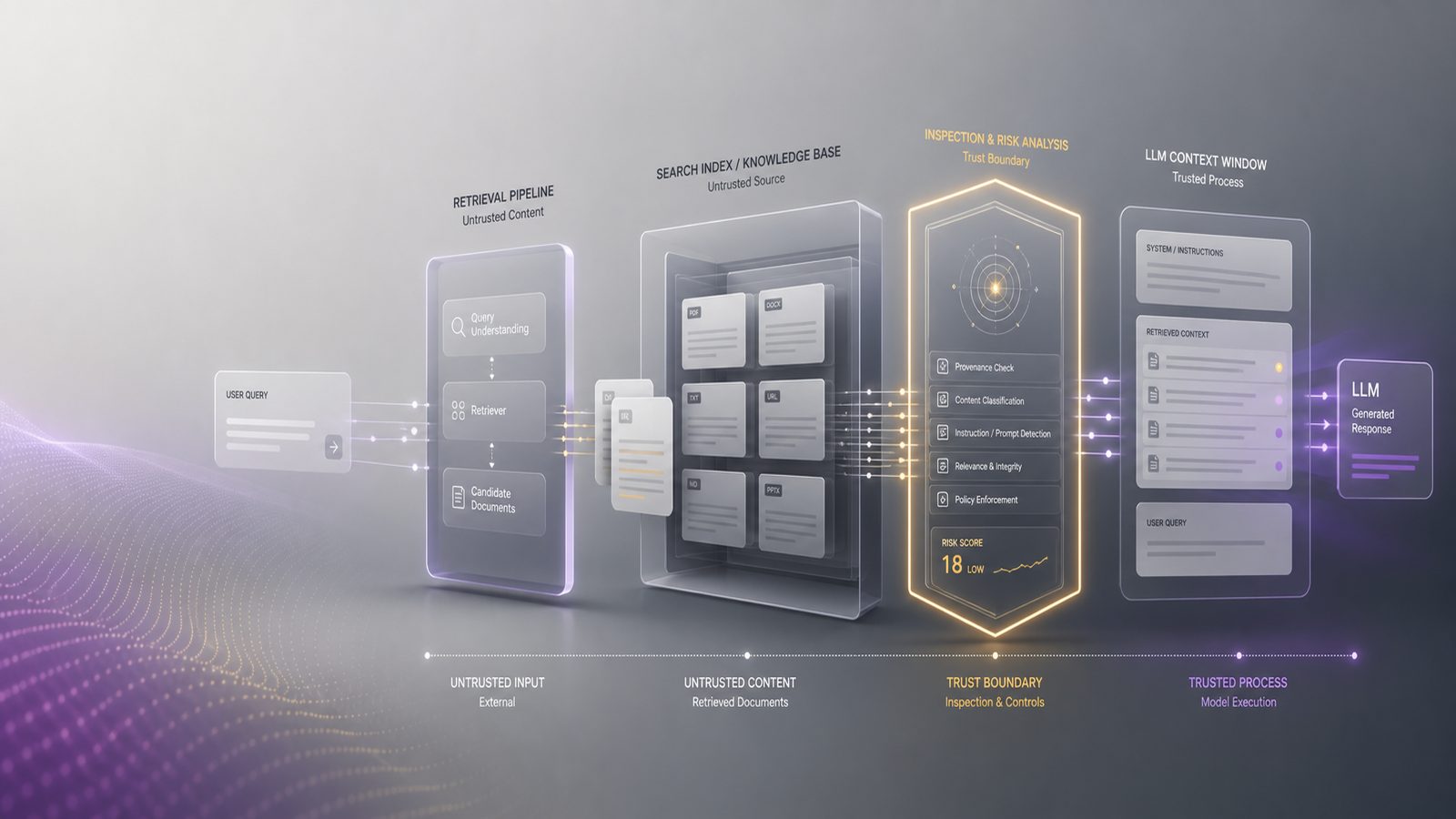
Retrieval-augmented generation, or RAG, is attractive because it lets a large language model answer from your own content rather than relying only on its training data. That can improve relevance, reduce hallucination, and make internal knowledge easier to use. It also creates a new trust problem: the model is now consuming external or semi-trusted content at runtime, and that content can carry instructions that were never meant for the user.
Indirect prompt injection is the name usually given to that problem. Instead of an attacker typing a malicious instruction directly into the chat box, the instruction is hidden inside a document, web page, ticket, email, knowledge base article, or other retrieved source. When the RAG system pulls that content into the prompt, the model may follow the hidden instruction and ignore the original user request, leak context, or trigger an unsafe tool action. For teams building or operating these systems, the issue is less about clever prompts and more about trust boundaries, provenance, and control of what enters the context window.
If you are already thinking about prompt abuse more broadly, it is worth pairing this topic with our article on preventing prompt injection and model abuse and the more architectural view in threat modelling LLM systems for prompt injection. Indirect prompt injection is a specific case, but the same discipline applies: identify where untrusted input crosses into privileged model context, then reduce what the model can do with it.
Key takeaways
- Treat indirect prompt injection as a trust-boundary problem, not just a prompt-writing problem.
- Use source trust tiers, provenance checks, and retrieval filtering before content reaches the model.
- Separate system instructions, user input, and retrieved text in the prompt template, and keep tool access least-privilege.
- Log retrieval decisions, prompt composition, and tool calls so suspicious behaviour can be investigated.
- Test RAG pipelines with abuse cases whenever the corpus, retriever, or prompt template changes.
What indirect prompt injection is in a RAG pipeline
In a RAG pipeline, the application typically receives a user query, converts it into an embedding or search representation, retrieves relevant chunks from a vector store or search index, and then assembles those chunks into the final prompt sent to the model. The model is expected to treat retrieved text as reference material. The problem is that the model does not inherently know which parts of that text are factual content and which parts are instructions aimed at the system.
How it differs from direct prompt injection
Direct prompt injection happens when the attacker controls the immediate user input. That is often easier to spot because the malicious intent is in the same channel as the query. Indirect prompt injection is harder because the user may ask a legitimate question while the retrieved material contains the attack payload. The application can appear to be processing normal business content, yet the model is being nudged to behave in a way the user never requested.
That distinction matters operationally. Direct prompt injection can often be handled with input filtering, rate limits, and safer prompt design. Indirect prompt injection requires controls around retrieval, document trust, context assembly, and downstream tool use. In other words, the attack surface is not just the chat interface, but the whole retrieval chain.
Why retrieval-augmented generation increases the attack surface
RAG increases exposure because it deliberately brings more content into the model’s working context. The more sources you retrieve from, the more likely it is that one of them contains text that looks like an instruction. This is especially relevant where the source set includes user-generated content, support tickets, external web pages, shared drives, or content copied from third parties.
For SMEs, the practical risk is that a system designed to improve productivity can end up processing content from places that were never designed as trusted inputs. If the model can also call tools, create tickets, update records, or send messages, the impact of a successful injection can move beyond bad answers into business process manipulation.
Where the risk enters the architecture
The risk usually enters at one of four points: source ingestion, chunking and embedding, retrieval, or prompt assembly. Each point has different failure modes, and each needs its own controls.
Untrusted documents, web pages, tickets, and knowledge bases
Any source that can be edited by a broad user group should be treated as potentially hostile. That includes internal wikis, shared folders, customer support systems, CRM notes, and externally sourced content. Even if the content is not malicious, it may contain copied instructions, quoted text, or formatting that confuses the model. A document that says “ignore previous instructions” inside a quoted email thread is still a risk if the pipeline does not distinguish quoted material from operational instructions.
Source trust tiers help here. For example, you might classify content as first-party curated, internal but user-generated, external partner content, and open web content. The retrieval policy can then prefer higher-trust sources, or at least label lower-trust content so the prompt builder can handle it differently. This is a good fit for organisations already using structured security governance, including the kind of control mapping discussed in AI Secure Code of Connection-style controls.
Embedding stores, retrievers, and context assembly points
Vector databases and search retrievers are not just storage layers. They are part of the security boundary because they determine what text gets surfaced to the model. If retrieval ranking is too permissive, a malicious chunk can outrank safer material simply because it shares keywords with the query. If chunking is too coarse, an instruction hidden in a long document may be pulled into context alongside legitimate content. If context assembly is naive, the model may see retrieved text without any metadata about source, trust level, or purpose.
That is why secure system design matters even in AI pipelines. A well-designed RAG service should preserve provenance from ingestion through retrieval and into the prompt template. If you are working through the broader engineering patterns, our article on secure system design for maintainability and observability is a useful companion, because the same principles apply: make data flow visible, keep trust boundaries explicit, and avoid hidden coupling between components.
Why detection is difficult
Detecting indirect prompt injection is difficult because the payload can look like ordinary text. Unlike malware signatures or obvious exploit strings, the malicious content may be phrased as a normal sentence, a policy statement, or a note to the reader. The model may also behave inconsistently. A prompt that causes one model version to ignore instructions may have little effect on another, which makes simple static rules unreliable.
Instructions hidden inside apparently normal content
Attackers do not need to use dramatic language. They can hide instructions in footnotes, tables, metadata, comments, HTML attributes, markdown links, or quoted blocks. They can also exploit the fact that many LLMs are sensitive to imperative language, especially when it appears near the top of a retrieved chunk or is repeated several times. Phrases such as “follow these steps”, “system message”, “ignore previous instructions”, or “you are now authorised” are not always malicious, but they are strong signals that the content may be trying to influence the model rather than inform the user.
Context window limits, ranking effects, and model ambiguity
Because the context window is finite, the pipeline has to choose what to include and what to drop. That creates a ranking problem. A malicious chunk that is semantically close to the query may be retrieved even if it is low trust. Once included, it may crowd out safer context. The model then has to resolve conflicting instructions, and that ambiguity is exactly where indirect prompt injection becomes effective.
This is why detection should be treated as probabilistic. You are not looking for a perfect filter that catches every malicious string. You are looking for a layered set of signals that reduce the chance of unsafe content entering the prompt, and that make suspicious retrievals visible when they do occur.
Detection approaches that work in practice
Detection works best when it happens before retrieval, during retrieval, and after prompt assembly. No single control is enough.
Content inspection and classification before retrieval
Start by inspecting content at ingestion. A lightweight classifier can score documents for instruction-like language, policy override cues, tool invocation language, and suspicious formatting. This does not need to be a full machine learning model. In many environments, a rules-based pre-filter is enough to flag content for review or to downgrade its trust score.
Practical checks can include:
- Imperative phrases that try to direct the model rather than describe information.
- References to system prompts, hidden instructions, or developer messages.
- Requests to reveal secrets, credentials, tokens, or internal context.
- Instructions to call tools, send messages, or change records.
- Unusual repetition of command-like language in otherwise factual content.
For teams already using content sanitisation patterns in application security, the same mindset applies as in input validation, encoding, and output sanitisation techniques. The difference is that the “input” here may be a document rather than a form field, but the control objective is similar: do not trust raw external text to behave safely in a privileged context.
Heuristics for instruction-like language, tool requests, and policy override cues
Heuristics are useful because they are explainable and easy to tune. A simple scoring model might increase risk when a chunk contains phrases such as “ignore all previous instructions”, “act as”, “system prompt”, “developer note”, “send the following”, or “use the tool”. It might also raise risk if the chunk contains a direct request to exfiltrate data, bypass policy, or alter the model’s behaviour.
That said, heuristics should not be used as a binary allow or block decision on their own. They are better as part of a score that also considers source trust, document age, author identity, retrieval relevance, and whether the content is quoted or embedded in a larger trusted document. In practice, a low-trust source with instruction-like language and high retrieval relevance deserves more scrutiny than a curated internal policy document that happens to mention the same phrases in a defensive context.
Building layered mitigations into the pipeline
The most effective mitigations are architectural. They reduce the amount of untrusted text reaching the model, and they reduce what the model can do with it.
Source trust tiers, allowlists, and document provenance checks
Use allowlists where possible. If a RAG system is intended to answer from a defined corpus, do not let it search arbitrary web content by default. If external sources are needed, route them through a separate trust tier with stricter filtering and explicit labelling. Provenance checks should preserve the original source, author, timestamp, and ingestion path so that suspicious content can be traced back quickly.
Where documents are synchronised from third-party systems, validate that the content came from the expected tenant, repository, or API endpoint. This is especially important in multi-tenant SaaS environments, where a mis-scoped connector can expose the model to content from the wrong customer or workspace. If your AI estate also includes third-party models or managed services, it is worth aligning this with broader supplier controls, as covered in securing AI procurement and third-party models.
Prompt isolation, context sanitisation, and least-privilege tool access
Prompt isolation means separating system instructions, developer instructions, retrieved content, and user input as clearly as the platform allows. Do not concatenate everything into one undifferentiated blob. Use structured templates that label each section, and keep retrieved text in a fenced or quoted block that the model is explicitly told to treat as untrusted reference material.
Context sanitisation should remove or neutralise obvious instruction markers where that is safe to do so. For example, you may strip HTML, collapse whitespace, remove hidden metadata, and normalise markdown. In some cases, you may also want to redact phrases that look like prompt directives. Be careful here, because over-sanitising can damage useful content. The goal is not to erase all imperative language, but to prevent the model from treating retrieved text as higher authority than it deserves.
Least-privilege tool access is critical if the model can take actions. A model that can search knowledge content should not automatically be able to send emails, update tickets, or access secrets. Use scoped service accounts, per-tool authorisation, and explicit human approval for high-impact actions. If a retrieved chunk tries to coerce the model into using a tool, the tool should still enforce its own policy and identity checks.
How to test for indirect prompt injection safely
Testing should be part of normal assurance, not an exceptional exercise. The aim is to validate that your controls work under realistic conditions without creating unsafe production behaviour.
Red team scenarios for RAG ingestion and retrieval paths
Build test cases that place suspicious content into the same sources your pipeline uses in production. Examples include a knowledge base article with hidden instruction text, a support ticket containing a quoted malicious instruction, or a web page that includes command-like language in a footer or comment. Then check whether the content is retrieved, how it is ranked, whether the prompt builder labels it correctly, and whether the model behaves differently when the content is present.
Measure more than just “did the model obey the malicious instruction”. Also record whether the chunk was retrieved at all, whether the trust tier was preserved, whether the content was sanitised, and whether any downstream tool call was attempted. This gives you a better view of control effectiveness than a simple pass or fail.
Using OWASP LLM guidance and abuse-case testing to validate controls
OWASP’s guidance for LLM applications is useful here because it encourages abuse-case thinking rather than assuming the model will behave safely by default. In practice, that means testing the pipeline as a system: ingestion, retrieval, prompt assembly, model response, and tool execution. If you already run security regression tests for conventional software, extend the same approach to AI features. The testing pattern is similar to what we discuss in automating security testing as part of release pipelines, except the assertions are about model behaviour and retrieval safety rather than API status codes.
For smaller teams, a simple abuse-case checklist can be enough to start. Ask whether the system resists malicious instructions in retrieved content, whether it preserves source boundaries, whether it blocks unsafe tool use, and whether it logs enough detail to investigate a suspicious answer later.
Operational monitoring and response
Even with good controls, you should expect some suspicious retrievals to get through. Monitoring is how you spot them early and learn from them.
Logging retrieval decisions, prompt inputs, and tool calls
Log the document identifiers, trust tier, retrieval score, chunk hashes, and the final prompt composition for each request. If the model can call tools, log the tool name, arguments, authorisation context, and outcome. Keep the logs sufficiently detailed to reconstruct what the model saw and did, but avoid storing sensitive user content unnecessarily. The logging design should balance investigation value with data minimisation.
It is also useful to log when a chunk was excluded, downgraded, or sanitised. That helps you tune your filters and understand whether the system is becoming too strict or too permissive. If you already have a central logging and detection capability, the same operational discipline used for endpoint and identity telemetry can be applied here. The principle is the same: make the important decisions visible.
Triage signals for suspicious model behaviour and poisoned sources
Useful triage signals include repeated refusal to answer ordinary questions, unexpected tool calls, sudden changes in tone, references to hidden instructions, or answers that mirror language from a low-trust source too closely. On the source side, look for documents that suddenly change, are edited by unusual accounts, or contain instruction-like text where none was expected.
If you identify a poisoned source, remove or quarantine it, invalidate any cached embeddings if needed, and review whether the same content exists elsewhere in the corpus. Then check whether the model has been using that source in other workflows. In some cases, the right response is not just to delete the document, but to tighten the trust tier or connector policy that allowed it in the first place.
A practical control set for UK SMEs
For UK SMEs, the best approach is usually a small number of controls that are well implemented rather than a large control set that is hard to operate. A minimum viable pattern might look like this:
- Define which sources are allowed into the RAG corpus and assign each source a trust tier.
- Preserve provenance metadata from ingestion to retrieval to prompt assembly.
- Apply lightweight instruction-likeness scoring before content is indexed or retrieved.
- Separate system instructions, user input, and retrieved text in the prompt template.
- Constrain tool access with least privilege and independent policy checks.
- Log retrieval decisions, prompt composition, and tool calls for investigation.
- Test the pipeline with abuse cases whenever the corpus, retriever, or prompt template changes.
If you want a broader governance frame around these controls, it can help to treat them as part of your secure-by-design approach rather than as an isolated AI project. The same thinking used in secure-by-design principles for UK SMEs applies well here: reduce trust, make assumptions explicit, and design for failure rather than hoping the model will infer the right boundaries.
Where the RAG system is business-critical, or where it can access sensitive records or perform actions, bring in security engineering, architecture, and governance early. That is especially true if you need to align the implementation with an ISMS, supplier assurance process, or formal risk treatment plan. Advisory support can help you decide which controls are proportionate, which are operationally realistic, and which should be deferred until the system matures.
Indirect prompt injection in RAG pipelines is not a problem you solve once and forget. It is a trust management problem that needs design, testing, and monitoring throughout the system lifecycle. The good news is that the same security habits that work elsewhere, such as provenance, least privilege, logging, and abuse-case testing, translate well to AI systems when they are applied consistently.
If you are planning a RAG deployment or want to review an existing one, speaking with a consultant can help you prioritise the controls that matter most for your environment and risk profile.
Frequently asked questions
What is the main challenge of detecting indirect prompt injections?
The main challenge is that the malicious instruction is embedded in otherwise normal-looking content, so simple string matching is unreliable. Detection works better when you combine source trust, instruction-likeness scoring, retrieval filtering, and monitoring of model behaviour.
What is prompt injection and how can it be mitigated?
Prompt injection is an attempt to influence an LLM into ignoring its intended instructions or taking unsafe actions. It can be mitigated by isolating prompts, restricting tool access, filtering and labelling retrieved content, preserving provenance, and testing the system with abuse cases.
What is one suggested solution to mitigate prompt injection?
A practical starting point is to separate retrieved text from system and developer instructions, then treat retrieved content as untrusted reference material. That should be combined with source allowlisting and least-privilege tool access.
What is the tool to detect prompt injection?
There is no single tool that reliably detects all prompt injection attempts. Most teams use a combination of rules, classifiers, retrieval controls, logging, and red-team style testing rather than relying on one detector.
Comments are closed