
Reducing PCI DSS scope effectively: practical steps for UK SMEs
If your business takes card payments, PCI DSS can feel like a lot of work. The good news is that you do not always need to treat every system as part of the payment environment. If you reduce PCI DSS scope effectively, you can lower cost, reduce admin, and cut the number of systems exposed to card data risk.
For many UK SMEs, the real win is not trying to make every system “more compliant”. It is designing payment flows so that fewer systems ever touch card data in the first place. That usually means less evidence to collect, fewer controls to maintain, and fewer places where a mistake could cause a problem.
This article explains scope in plain English and gives practical steps you can use to shrink it without disrupting the business.
What PCI DSS scope means in plain English
PCI DSS scope is simply the set of systems, people, and processes that can store, process, or transmit card data, or that could affect the security of those systems.
In practice, that can include:
- Payment pages on your website
- Point of sale terminals in a shop or office
- Servers, databases, and cloud services that handle card details
- Staff laptops or desktops used to access payment systems
- Support tools, logs, backups, and remote access systems
It is easy to assume scope only covers the payment terminal or checkout page. In reality, it can be wider than that if other systems can influence the security of the payment flow.
Which systems are in scope
Any system that stores, processes, or transmits card data is in scope. So is any system that connects directly to those systems or can change how they are protected.
That means scope can spread through shared networks, shared user accounts, remote support tools, and poorly separated cloud services. A small business can end up with a much larger scope than expected if card data is allowed to pass through general business systems.
Why scope affects cost, effort, and risk
The larger the scope, the more you need to secure, document, test, and review. That usually means more time from internal staff, more supplier questions, and more external support.
It also increases business risk. If card data is spread across more systems, there are more places where it could be exposed, copied, or mishandled. Reducing scope is therefore both a compliance and a risk management decision.
Why reducing scope matters for SMEs
For smaller organisations, PCI DSS scope can quickly become a burden. A wide scope often means more cost, more complexity, and more chance of missing something important.
Less compliance work to maintain
A smaller scope usually means fewer systems to review, fewer staff to train, and fewer controls to keep up to date. That can make annual reviews, supplier checks, and evidence gathering much more manageable.
It also helps when your business changes. If you add a new website, new office, or new supplier, it is easier to assess the impact when the payment environment is tightly contained.
Fewer systems exposed to card data risk
Every extra system that touches card data creates another chance for error. That could be a misconfigured server, a weak password, an over-permissioned user account, or a backup that contains data it should not.
Reducing scope lowers the number of systems that need to be trusted with sensitive information. That is often the most practical way to reduce the chance of a payment-related incident affecting the wider business.
Start by mapping where card data actually flows
You cannot reduce scope effectively until you know where card data goes. Many SMEs discover that the real payment flow is more complicated than they thought.
Identify payment entry points and storage locations
Start with every place a customer can pay:
- Website checkout
- Telephone payments
- In-person card machines
- Invoices paid through payment links
- Recurring payments or subscriptions
Then ask three simple questions for each one:
- Where is the card data entered?
- Where does it travel next?
- Where, if anywhere, is it stored?
If the answer is unclear, that is a sign your scope may be larger than you think.
Trace third parties, plugins, and connected systems
Many businesses use payment providers, website plugins, booking tools, customer relationship systems, or accounting software. These can all affect scope.
Check whether any of them:
- Handle card data directly
- Store payment tokens or partial card details
- Connect to systems that do handle card data
- Have admin access to payment-related systems
Do not forget support arrangements. Remote support tools, shared inboxes, and helpdesk platforms can become part of scope if they are used to access payment systems or card data.
Practical ways to reduce scope without disrupting the business
The best scope reduction changes are usually simple in concept, even if they need careful planning. Focus on removing card data from your own systems wherever possible.
Use hosted payment pages or payment service providers where suitable
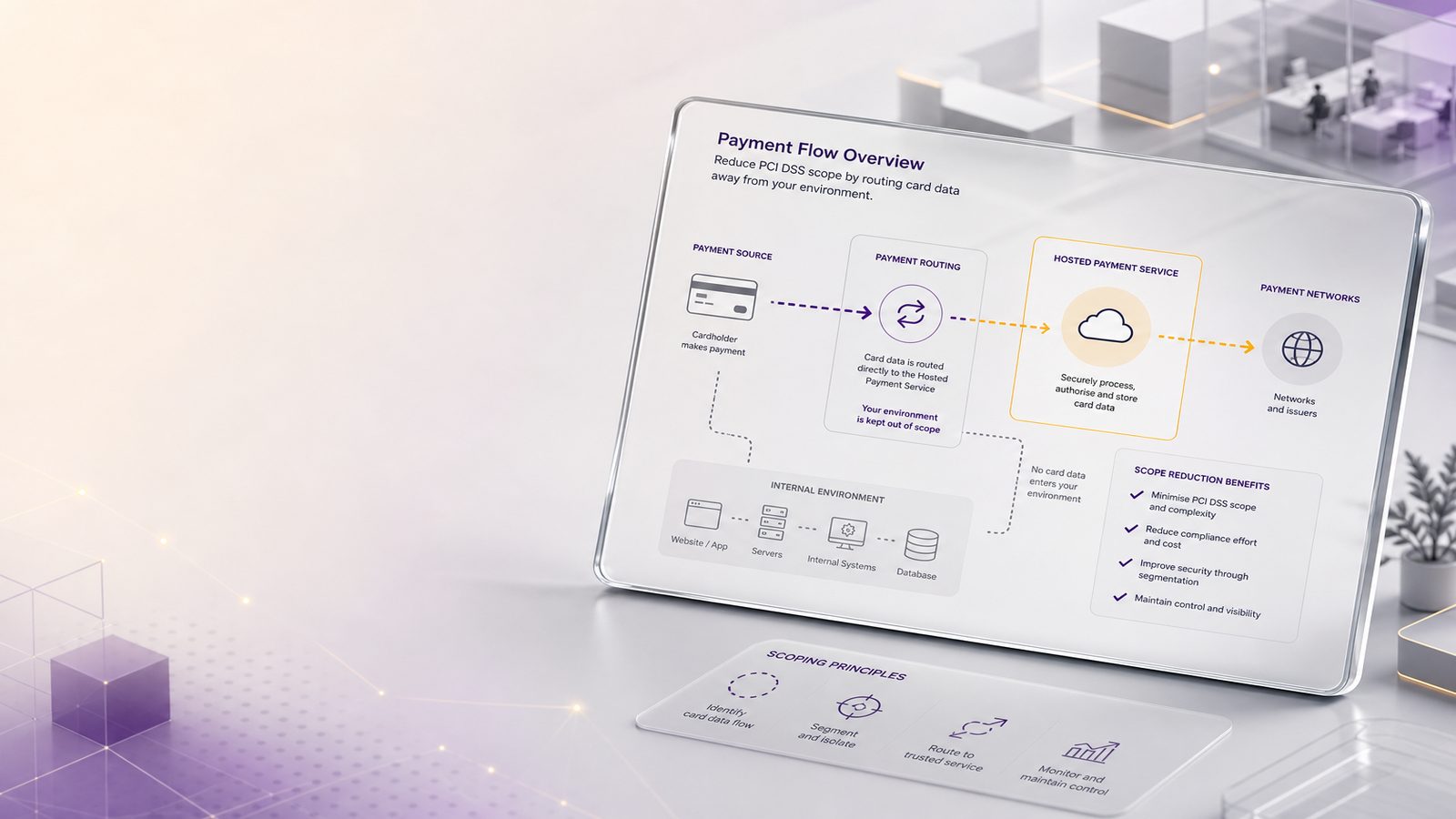
One of the most effective ways to reduce scope is to let a specialist payment provider handle the card entry and processing. In this model, the customer enters card details on the provider’s page or payment form rather than on your own website or system.
This can reduce the number of systems in your environment that ever see card data. It can also simplify your internal controls, because your business is no longer responsible for protecting card details across as many systems.
That said, outsourcing payments does not remove all responsibility. You still need to understand how the payment flow works, what data you receive back, and which parts of your environment remain connected to the payment process.
Keep card data out of internal systems
If staff are copying card details into spreadsheets, emails, notes, or customer records, scope will grow quickly. It also creates avoidable risk.
Practical steps include:
- Do not let staff write down card details unless there is a very specific, controlled reason
- Do not store card data in email, chat tools, or shared documents
- Remove card data fields from forms and databases where they are not needed
- Use payment references or tokens instead of full card details where possible
In many SMEs, this single change removes a surprising amount of risk and admin.
Separate cardholder data from the rest of the network
If any part of your business still handles card data directly, keep it separate from general office systems. Separation means limiting who and what can reach the payment environment.
That may involve:
- A separate network segment for payment systems
- Different user accounts for payment administration
- Restricting remote access to only those who need it
- Keeping payment devices away from everyday browsing and email use
For a small business, separation does not need to be complicated. The aim is to stop a problem on one system from spreading into the payment environment.
Common scope mistakes that keep businesses larger than they need to be
Some businesses make scope bigger than necessary without realising it. These mistakes are common and often easy to fix.
Storing card data unnecessarily
If you do not need full card details, do not keep them. Businesses sometimes retain card data “just in case” or because an old process was never removed.
Ask whether the business really needs to store anything beyond a payment confirmation or reference number. If the answer is no, remove the storage path and delete any old data that is no longer required for operations.
Letting staff devices or shared systems touch card data
A shared laptop, a general office PC, or a remote support account can bring a lot of extra systems into scope if they are used to access payment data.
Try to keep payment administration on a limited set of devices and user accounts. The fewer endpoints that can reach card data, the easier it is to manage risk and prove control.
Overlooking logs, backups, and support tools
Logs and backups are often forgotten during scoping exercises. Yet they can contain card data if systems are not configured carefully.
Support tools can also be overlooked. If a helpdesk platform, remote access tool, or monitoring system can view or change payment systems, it may need to be considered in scope.
Review these areas specifically. They are common places where scope expands quietly over time.
How to decide what should stay in scope
A useful rule is to ask two questions for every system:
- Does it store, process, or transmit card data?
- Can it affect the security of a system that does?
If the answer to either question is yes, treat it as potentially in scope until you have checked carefully.
Systems that store, process, or transmit card data
These are the obvious ones. They include payment terminals, checkout pages, payment databases, and any service that directly handles card details.
These systems need the most attention because they are closest to the data itself.
Systems that can affect the security of those systems
This is where scope often surprises people. A system may not handle card data directly, but it can still matter if it controls access, configuration, or connectivity.
Examples include:
- Admin laptops used to manage payment systems
- Identity and access tools that control user logins
- Firewalls and routers that protect the payment network
- Monitoring and logging tools with privileged access
If a system could weaken the protection of card data, it should be reviewed as part of scoping.
A simple action plan for the next 30 days
You do not need to redesign everything at once. A short, structured review can make a real difference.
Review your payment flow
Map every way customers pay you and note where card data enters, moves, and is stored. Include suppliers, plugins, and support tools.
Keep the map simple. A one-page diagram is often enough to spot unnecessary exposure.
Remove avoidable card data handling
Look for places where staff, systems, or documents are handling card data without a clear business need. Remove those steps first.
Focus on quick wins such as:
- Stopping card details being emailed or stored in spreadsheets
- Moving to hosted payment pages where suitable
- Deleting old stored card data that is no longer needed
- Limiting access to payment systems
Document the new scope and keep it under review
Once you have reduced scope, write it down. Record which systems are in scope, why they are in scope, and who is responsible for keeping that list current.
Review it whenever you change payment suppliers, launch a new website, add a new office, or introduce a new support tool. Scope tends to grow quietly if nobody owns it.
When to get outside help
Some businesses can manage scoping internally. Others benefit from outside support, especially where payment flows are spread across several suppliers or the business is unsure what can safely be excluded.
It can be sensible to get help if:
- Your payment setup includes several platforms or outsourced services
- You are not sure which systems can be removed from scope
- Your team is unsure whether card data is being stored somewhere unexpectedly
- You want to simplify the environment before a formal review or assessment
Independent advice can help you avoid both over-scoping and under-scoping. The aim is to keep the payment environment as small and manageable as possible, while still protecting customers and the business.
Reducing PCI DSS scope effectively is usually about design choices, not extra paperwork. If you keep card data out of your own systems, separate what remains, and review the flow regularly, you can make compliance more practical and reduce business risk at the same time.
If you would like a pragmatic review of your payment setup and scope, speak to a consultant.
Frequently asked questions
What is PCI DSS scope in simple terms?
It is the set of systems, people, and processes that store, process, or transmit card data, or that can affect the security of those systems.
Can outsourcing payments reduce PCI DSS scope?
Yes, often it can. Using a payment provider or hosted payment page may keep card data out of your own systems, which can reduce scope. You still need to check what data comes back to your business and which connected systems remain involved.
Comments are closed