
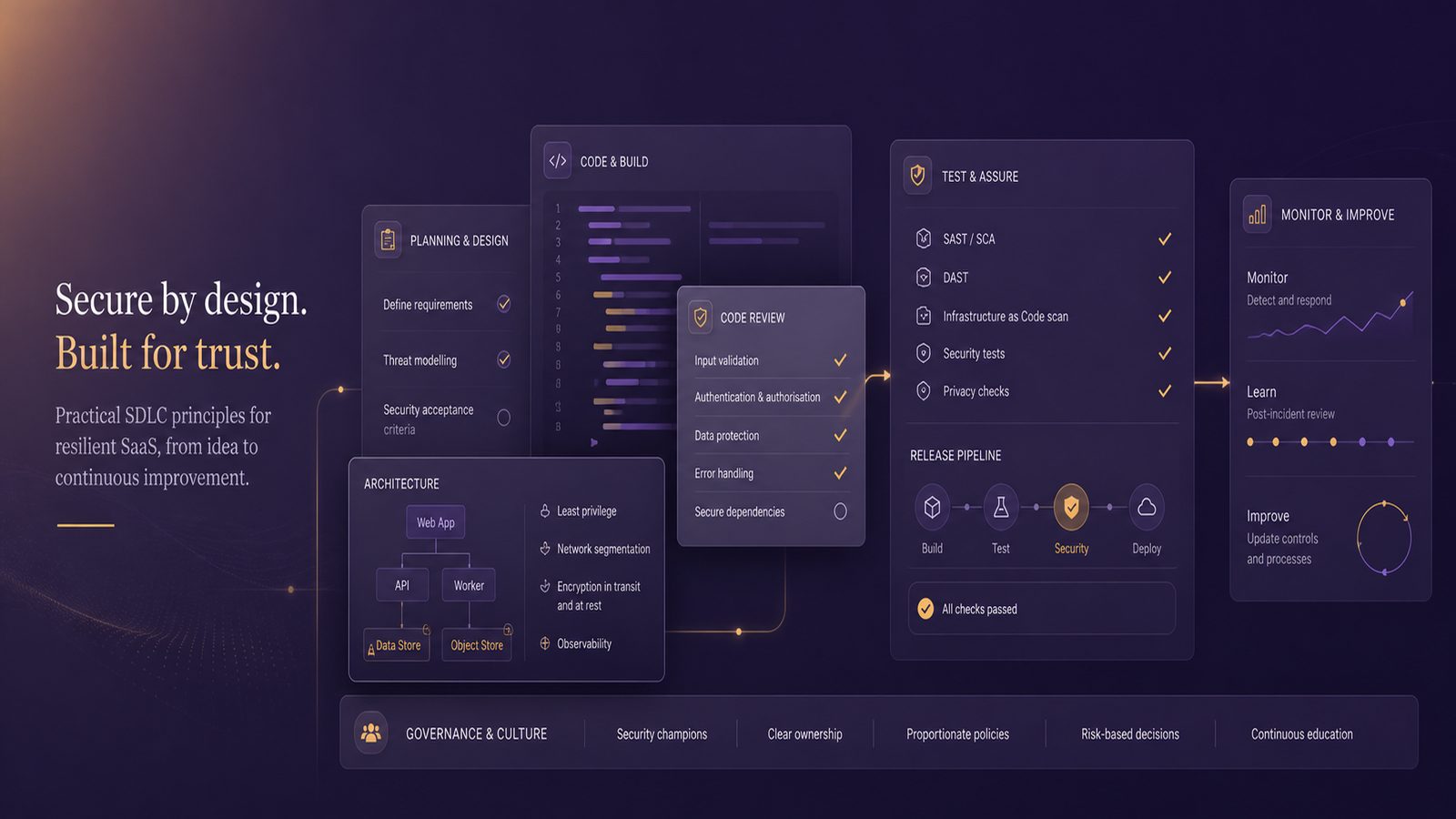
Key takeaways
- Secure SDLC helps SaaS founders reduce breach risk, rework, and customer trust damage by building security into normal delivery.
- The most effective controls are simple and repeatable across planning, design, build, test, release, and maintenance.
- Small teams can make real progress with clear ownership, peer review, automated checks, and a basic release checklist.
- DevSecOps supports secure SDLC by automating routine checks and keeping development, operations, and security aligned.
What secure SDLC means in plain English
Secure SDLC means building security into the way software is planned, designed, built, tested, released, and maintained. SDLC stands for software development lifecycle, which is simply the full journey from an idea to a live product and beyond. For SaaS founders, the point is not to turn every release into a long security project. The point is to reduce the chance that a mistake in the product becomes a costly incident, a customer complaint, or a loss of trust.
In a growing software business, speed matters. But speed without control often creates hidden costs later. A rushed feature can lead to a data exposure, a broken customer journey, or a patch that takes engineers away from product work for days. Secure SDLC gives you a structure that helps teams move quickly with fewer surprises.
It is also worth separating secure SDLC from a one-off security review. A review at the end can still be useful, but it is not enough on its own. By the time code is finished, design choices are already made and changes are more expensive. That is why secure development is most effective when it is part of normal delivery, not an extra step bolted on at the end. If you want a broader business view of the topic, our article on why secure software development matters sets out the commercial case in more detail.
The core principles of a secure software development lifecycle
Build security in early rather than bolting it on later
The first principle is simple: fix problems before they become expensive. A security issue found during planning or design is usually cheaper to address than one found after launch. That is because early changes are mostly decisions, while late changes can mean rework, testing delays, customer support effort, and emergency patching.
For founders, this is a budget issue as much as a technical one. Every hour spent reworking a poor design is an hour not spent improving the product. Secure SDLC helps you spend engineering time once, rather than paying for the same mistake several times.
Make security repeatable, not dependent on one person
Many small teams rely on one security-minded developer or a founder who “keeps an eye on things”. That can work for a while, but it is fragile. If that person is away, busy, or leaves, the process weakens quickly. A better approach is to make security checks part of the normal workflow so they happen every time, regardless of who is on the team.
Repeatability matters because it reduces inconsistency. The goal is not perfection. The goal is a reliable baseline that protects the business even when the team is under pressure.
What the SDLC stages look like when security is included
Planning and requirements
Security starts with deciding what the product should and should not do. At this stage, founders should ask a few practical questions: What data will the product hold? Who should be able to see it? What would happen if that data were exposed, changed, or deleted? Which features create the highest business risk if they fail?
This is also the right time to define security expectations in plain language. For example, if the product handles customer records, payment details, or sensitive business information, the team should know that access must be limited, activity should be logged, and important changes should be reviewed. These are not abstract controls. They are business protections.
Design
Design is where many expensive mistakes are made. A system can look fine on paper but still create risk if it trusts the wrong data, shares too much information, or gives users more access than they need. Good design work asks how the product could fail and what the impact would be if it did.
A simple way to improve design is to map the main data flows. Ask where information enters the system, where it is stored, who can access it, and where it leaves. This helps the team spot weak points before code is written. Our guide on applying data-flow diagrams to security threat modelling shows how that thinking works in practice.
Build
During development, the main aim is to reduce avoidable mistakes. That means using secure coding standards, reviewing changes before they are merged, and avoiding shortcuts such as hard-coded passwords or unchecked user input. It also means making sure developers understand the difference between a feature that works and a feature that is safe to use.
For SaaS founders, the build stage is where discipline pays off. A small amount of structure here can prevent a large amount of clean-up later. It also helps new developers join the team more quickly because they are working to a clear standard rather than learning by trial and error.
Test
Testing should cover more than whether the product behaves as expected. It should also check whether it behaves safely when users do unexpected things. That includes trying invalid input, weak passwords, unusual access patterns, and common misuse cases. The aim is to find weaknesses before customers do.
Security testing does not have to be heavy or expensive to be useful. For smaller teams, a mix of automated checks and targeted manual review is often enough to catch the issues that matter most. The key is to test the parts of the product that would cause the biggest business impact if they failed.
Release
Release is the point where a mistake becomes public. A secure release process should make sure that only approved code goes live, that secrets are not included in the build, and that any important security checks have passed. This does not need to slow delivery if the checks are automated and the rules are clear.
Founders should think of release controls as a safety gate, not a blocker. If a release fails a security check, that is useful information. It means the business has avoided shipping a problem to customers.
Maintenance
Security does not end when the software is live. New vulnerabilities appear, dependencies change, and customer use patterns evolve. Maintenance is where teams keep the product safe over time by patching quickly, removing unused features, and watching for signs that something has changed.
This stage is often overlooked by fast-growing SaaS companies. Yet many incidents happen not because the original product was badly built, but because it was not maintained carefully enough. A secure lifecycle treats maintenance as part of product ownership, not an afterthought.
Practical controls founders can ask for at each stage
Secure design reviews and threat modelling
Before major features are built, ask the team to review the design and identify what could go wrong. This is often called threat modelling, which simply means thinking through likely misuse, failure, and attack paths in advance. It does not need to be a long workshop. Even a short structured discussion can uncover issues such as excessive permissions, weak authentication, or sensitive data being copied into the wrong place.
Founders do not need to run the exercise themselves, but they should expect it to happen for important changes. If a feature can affect customer data, billing, access control, or integrations with other systems, it deserves a design review.
Code review, testing, and release checks
Every change should be reviewed by someone other than the person who wrote it. That review should look for security as well as correctness. Are inputs checked properly? Is access limited to the right users? Are secrets stored safely? Does the change create a new dependency or integration risk?
Automated testing should support the review process. For example, the team can scan for common coding mistakes, check for known vulnerable components, and look for secrets accidentally committed to the repository. If you want a deeper view of one of the most common problem areas, our article on input validation, encoding, and output sanitisation techniques explains why untrusted input needs careful handling.
How to fit secure SDLC into a small SaaS team
Minimum viable controls for early-stage teams
Small teams do not need a large security programme to make meaningful progress. A sensible minimum set of controls would include:
- Clear ownership for security decisions, even if that owner is the founder or product lead.
- Basic design review for new features that handle sensitive data or access control.
- Peer review for code changes before release.
- Automated checks for common mistakes and known vulnerable components.
- A simple process for fixing high-risk issues quickly.
- Regular review of who can access production systems and customer data.
These controls are practical because they fit into normal delivery. They do not require a separate department. They do require consistency.
How to avoid slowing delivery unnecessarily
The most common mistake is to make security too manual. If every release needs a long meeting, a spreadsheet, and several sign-offs, the team will either move slowly or start bypassing the process. That creates risk of a different kind. Good secure SDLC is light where it can be and strict where it must be.
Use automation for repetitive checks. Keep human review for decisions that need judgement, such as whether a feature introduces new customer risk or whether a design change affects sensitive data. This balance helps the team stay fast without becoming careless.
Common application risks secure SDLC should reduce
Injection flaws, broken access control, and exposed secrets
Three risks show up again and again in SaaS products. The first is injection flaws, where untrusted input is treated as if it were safe. The second is broken access control, where users can see or change things they should not. The third is exposed secrets, such as passwords or access keys being stored in code or shared in the wrong place.
These issues are dangerous because they can lead to customer data exposure, service disruption, or unauthorised changes. They are also avoidable when secure practices are built into the lifecycle. Good design, code review, and testing reduce the chance of these mistakes reaching production.
Third-party dependency and supply chain risk
Modern SaaS products rely on libraries, services, and hosted tools built by other organisations. That is normal, but it means your product inherits some of their risk. A dependency can introduce a vulnerability, a service outage, or a change in behaviour that affects your customers.
Founders should know what the product depends on, why those dependencies are needed, and how quickly they can be updated if a problem appears. This is one reason software supply chain assurance matters. Our guide on software supply chain assurance controls is a useful companion piece if you want to go further on this topic.
How DevSecOps supports secure SDLC in practice
Automating checks in the delivery pipeline
DevSecOps means bringing development, operations, and security together so checks happen as part of delivery rather than as a separate activity at the end. In practical terms, that often means automated checks in the build and release process. These checks can look for common coding issues, known vulnerable components, and accidental secret exposure.
Automation helps because it is consistent. It runs the same way every time and does not depend on someone remembering to do a manual check. For a SaaS business, that consistency is valuable because it reduces the chance of a simple oversight becoming a customer-facing problem.
Keeping developers, operations, and security aligned
DevSecOps works best when everyone understands the same goals. Developers want to ship features. Operations want stability. Security wants to reduce risk. Those goals are not in conflict if the team agrees on what matters most and how decisions will be made.
Founders can support that alignment by setting clear priorities. For example, critical customer data must be protected, urgent fixes should be able to move quickly, and low-risk cosmetic changes should not be held up by heavy process. That kind of clarity prevents friction and helps the team make better trade-offs.
How to measure whether your secure SDLC is working
Useful metrics for founders and product leaders
You do not need a complicated dashboard to know whether your process is improving. A few simple measures are enough to start with:
- How many high-risk issues are found before release rather than after.
- How long it takes to fix serious security issues.
- How often the team skips or bypasses security checks.
- How many production changes are made without review.
- How many critical dependencies are out of date.
These measures are useful because they connect directly to business risk. They show whether the team is finding problems early, responding quickly, and keeping control of the product.
Signs that the process is too weak or too heavy
If security issues are regularly found by customers, the process is too weak. If the team is constantly working around the process, it may be too heavy or too unclear. Both are signs that the lifecycle needs adjustment.
The right balance is one where security is visible but not disruptive. Teams should know what to do, when to do it, and who decides when something is acceptable to release.
A simple starter checklist for SaaS founders
People, process, and tooling basics
If you are starting from scratch, focus on the basics first:
- Assign one person to own secure development decisions.
- Write down the minimum security checks required before release.
- Make sure every code change gets a second pair of eyes.
- Use automated scanning for common coding and dependency issues.
- Keep production access limited to the people who genuinely need it.
- Review the product’s most sensitive data flows and integrations.
First actions to take in the next 30 days
In the next month, you could do three useful things. First, list the features or systems that would hurt the business most if they failed. Second, agree a simple release checklist that includes security review. Third, make sure the team knows how to report and fix a security issue quickly.
That is enough to create momentum. You can then improve the process in small steps rather than trying to redesign everything at once.
For founders who want help turning this into a practical operating model, ClearPath Security can provide advisory support on secure development, supplier risk, and risk-based governance that fits the size of your business. If you would like to talk it through, speak to a consultant.
Frequently asked questions
What is the concept of secure SDLC?
Secure SDLC is the practice of building security into every stage of software delivery, from planning and design through to testing, release, and maintenance. It helps teams find and fix problems earlier, when they are cheaper and easier to address.
What are the principles of secure software development lifecycle?
The main principles are to build security in early, make checks repeatable, review design before coding, test for misuse as well as normal use, control releases carefully, and keep the product secure after launch through ongoing maintenance and patching.
Comments are closed