
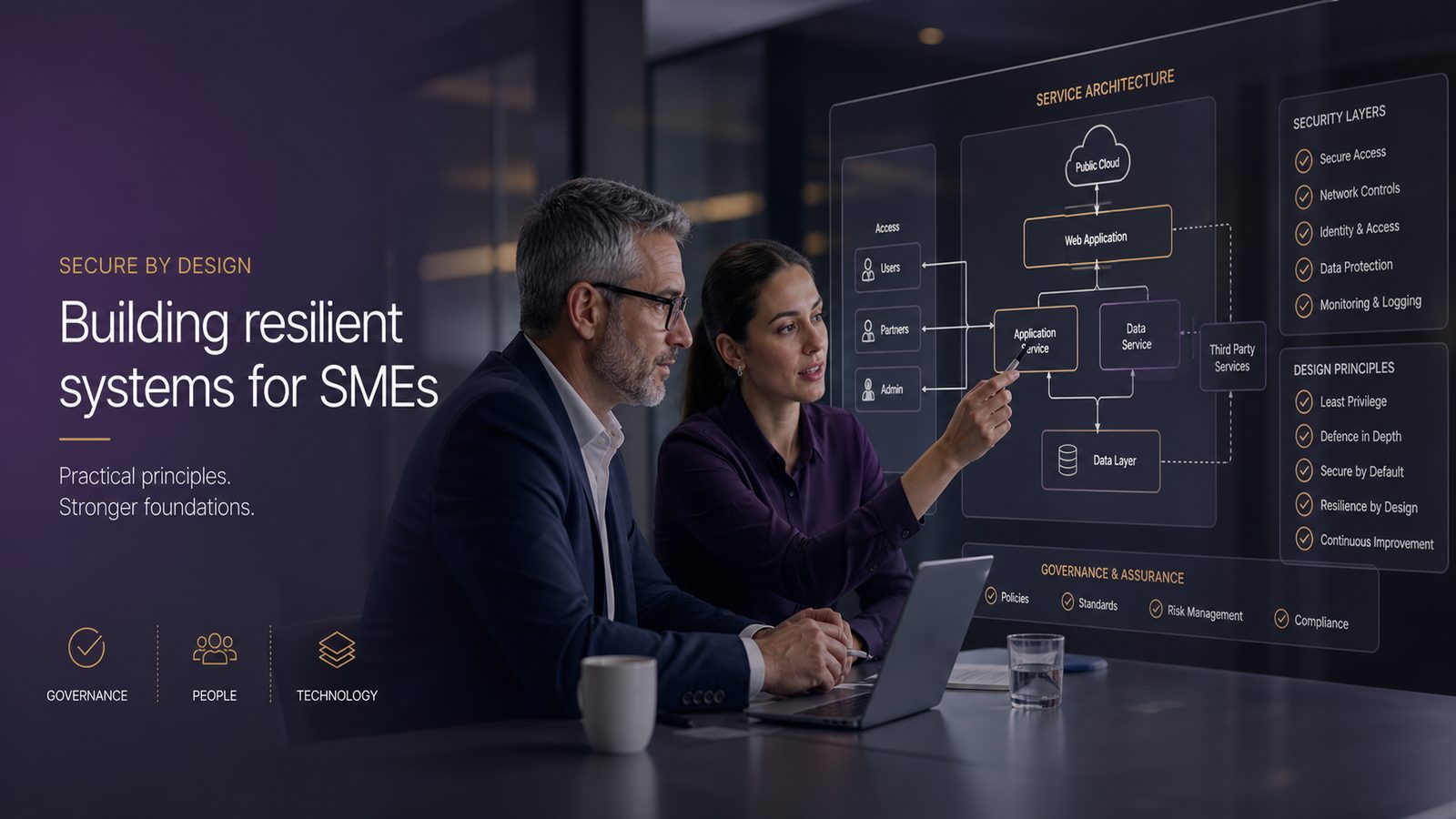
What secure-by-design means in plain English
Secure-by-design means building security into a system, process, or service from the start rather than trying to bolt it on later. For a small or medium-sized business, that usually means making sensible decisions early so you avoid expensive rework, rushed fixes, and avoidable disruption.
This is not about turning every project into a long security exercise. It is about asking the right questions before you buy software, launch a website, change a process, or connect a new service to your business. If security is considered early, the result is usually simpler, cheaper, and easier to run.
Why it matters for small businesses
SMEs often work with limited time, limited staff, and tight budgets. That makes poor design choices more costly, because there is less room to absorb mistakes. A system that is awkward to secure can lead to:
- extra support costs
- delays to projects and customer work
- avoidable downtime
- more pressure on small teams when something goes wrong
- damage to trust if customers or suppliers lose confidence
Secure-by-design helps you reduce those risks before they become business problems.
How it differs from fixing problems later
Fixing security issues after a system is live is usually slower and more expensive. At that point, you may already have staff using the system, customers depending on it, and contracts or deadlines to meet. Changes can be disruptive, and some weaknesses are difficult to remove without redesigning parts of the system.
By contrast, secure-by-design lets you make better choices while the cost of change is still low. That might mean choosing a product with stronger access controls, limiting what data is collected, or designing a process so only the people who need access can use it.
The business benefits of building security in early
For business leaders, the main value of secure-by-design is not technical neatness. It is avoiding waste, protecting continuity, and reducing the chance that a security issue becomes an operational one.
Reducing rework, delays, and avoidable cost
When security is considered late, teams often have to revisit decisions they thought were finished. That can mean reconfiguring systems, changing suppliers, rewriting procedures, or retraining staff. Each change takes time and money.
Secure-by-design reduces that rework. It helps you choose solutions that fit your needs from the outset, rather than discovering after go-live that the system is difficult to control or monitor.
Protecting reputation, customers, and day-to-day operations
Customers and suppliers expect businesses to handle information responsibly and keep services available. A security weakness can affect all three. Even if an incident is contained quickly, it can still create concern about how the business is run.
Secure-by-design supports reliability as well as security. If a system is easier to manage, easier to recover, and less exposed to unnecessary risk, it is more likely to keep working when the business needs it most.
The core principles SMEs should focus on
You do not need a large security team to apply secure-by-design. Most SMEs get the best results by focusing on a few practical principles and applying them consistently.
Start with the most important risks
Not every system needs the same level of protection. Start by identifying what would hurt the business most if it were lost, altered, or exposed. That usually includes customer data, payment information, key business systems, and anything that would stop staff from working.
Once you know what matters most, you can decide where to spend time and budget. This keeps security efforts proportionate and avoids overcomplicating low-risk areas.
Keep systems simple and reduce unnecessary access
Complexity creates mistakes. The more systems, accounts, exceptions, and manual workarounds you have, the harder it becomes to manage security properly. Simpler designs are usually easier to understand, easier to support, and easier to protect.
Reducing unnecessary access is equally important. Staff should only have the access they need for their role, and suppliers should only be given access for the specific task they are performing. The same principle applies to data. If a process does not need a piece of information, do not collect or store it.
How to apply secure-by-design to common SME decisions
Secure-by-design becomes useful when it changes everyday decisions. The aim is to make security part of normal business planning, not a separate exercise that happens once a year.
Buying software and services with security in mind
When you are choosing a new system or service, ask practical questions before you commit:
- Who will use it, and what access will they need?
- What information will it store or process?
- Can access be limited by role?
- Can you remove access quickly if someone leaves or a supplier contract ends?
- How will you know if something goes wrong?
- How will data be backed up and recovered?
If a supplier cannot answer these questions clearly, that is a warning sign. You do not need perfect answers, but you do need enough confidence that the service can be run safely in your environment.
Designing new processes, websites, and internal systems
When you create a new process or system, think about how it will be used in real life. A design that looks fine on paper can fail if staff have to work around it to get their job done.
For example, if a process relies on people sharing accounts, emailing sensitive files, or approving actions without checking them, the design is creating risk. A better approach is to build in clear ownership, sensible approval steps, and straightforward record keeping.
The same applies to websites and customer portals. Make it easy for users to do the right thing, and do not ask for more information than you need. Good design reduces both security risk and customer frustration.
A practical secure-by-design checklist for busy teams
You can use the following checklist before approving a change, buying a system, or launching a new process.
Questions to ask before you approve a change
- What business problem are we solving?
- What could go wrong if this is designed badly?
- What information will be involved?
- Who needs access, and who does not?
- Can we limit the amount of data collected or stored?
- How will we monitor use and spot problems?
- How will we recover if the system fails?
- Who owns this once it is live?
If you cannot answer these questions clearly, pause and get more detail before you proceed.
Simple checks to repeat for every new system
- Use named accounts rather than shared logins where possible
- Turn on multi-step sign-in for important systems
- Remove access that is no longer needed
- Keep records of key decisions and approvals
- Test recovery before you depend on the system
- Make sure someone is responsible for reviewing it after go-live
These are not advanced controls. They are basic habits that make systems easier to manage and less likely to create avoidable problems.
Common mistakes that make security harder later
Many security problems start with good intentions but poor design. The most common mistakes are often simple to avoid.
Adding controls too late
One of the biggest mistakes is waiting until a system is nearly finished before thinking about security. At that point, the design may already be fixed, contracts may already be signed, and staff may already be expecting delivery.
That is when security becomes a delay rather than a design choice. It is much better to raise security questions early, even if the answer is simply to adjust the plan before work goes too far.
Treating security as a one-time task
Secure-by-design is not something you do once and forget. Businesses change, suppliers change, staff change, and systems change. A design that was sensible last year may no longer be fit for purpose today.
That is why security should be reviewed whenever you make a meaningful change. New integrations, new suppliers, new data types, and new ways of working can all alter the risk picture.
How to make secure-by-design part of normal business change
The easiest way to make secure-by-design stick is to build it into existing decision-making. It should sit alongside cost, delivery, and operational impact, not compete with them as a separate issue.
Assigning ownership and keeping decisions visible
Every important system or process should have a named owner. That person does not need to be technical, but they should know who is responsible for security decisions and who to speak to when something changes.
Keep a simple record of key choices, such as why a supplier was selected, what access was granted, and what recovery arrangements were agreed. This makes it easier to review decisions later and avoids relying on memory.
Reviewing lessons after incidents, near misses, and major changes
When something goes wrong, or nearly goes wrong, treat it as useful information. Ask what the design allowed, what the process missed, and what could be improved next time.
The same applies after major changes. A new system, a merger, a supplier change, or a move to hybrid working can all reveal gaps in the original design. A short review after each significant change can prevent small issues from becoming larger ones later.
When to ask for outside help
Some businesses can handle secure-by-design decisions internally. Others benefit from a second opinion, especially when the change is important, the risks are unclear, or the team is already stretched.
Signs your team needs a second opinion
- You are unsure what data a system will hold
- Several suppliers are involved and responsibilities are unclear
- The same people are making both business and technical decisions without challenge
- You are planning a major change but have not reviewed the security impact
- You know the current approach is weak, but no one has time to improve it
Outside support can help you keep the process practical and focused on business risk, rather than turning it into a long technical exercise.
How advisory support can reduce risk without overcomplicating things
Good advisory support should help you make clearer decisions, not add unnecessary paperwork. The value is usually in asking the right questions, highlighting blind spots, and helping you prioritise what matters most.
For SMEs, that often means getting help with system design choices, supplier selection, access control, recovery planning, and making sure security responsibilities are clear. The goal is to reduce risk in a way that fits the size and pace of your business.
Final thought
Secure-by-design is really about good business judgement. If you think about security early, keep designs simple, and review changes as you go, you are far more likely to avoid costly mistakes and keep the business running smoothly.
You do not need to do everything at once. Start with the systems and processes that matter most, apply the basics consistently, and build from there.
If you would like help turning these principles into practical decisions for your business, speak to a consultant.
Frequently asked questions
What does secure-by-design mean for a small business?
Secure-by-design means building security into a system, process, or service from the start, rather than trying to add it later. For SMEs, that usually means making sensible decisions early so you avoid rework, delays, and avoidable disruption. It is about asking the right questions before you buy software, launch a website, or change a process.
Why is secure-by-design important for SMEs?
SMEs often have limited time, staff, and budget, so poor design choices can be harder to absorb. A system that is awkward to secure can create extra support costs, delays, avoidable downtime, and more pressure on small teams. Building security in early helps reduce those business problems before they grow.
What should I look at first when applying secure-by-design?
Start with the risks that would hurt the business most if they were lost, changed, or exposed. That usually includes customer data, payment information, key business systems, and anything that would stop staff from working. Focusing on the most important risks helps keep security effort proportionate.
What questions should I ask when buying software or services?
Ask who will use the service, what information it will store or process, and whether access can be limited by role. It is also sensible to ask how access is removed when someone leaves, how you will know if something goes wrong, and how data will be backed up and recovered. If a supplier cannot answer clearly, that is worth following up.
How can I keep a new process or system simple and secure?
Keep the design as simple as possible and reduce unnecessary access. Staff should only have the access they need for their role, and suppliers should only have access for the task they are doing. It also helps to avoid collecting or storing information that the process does not actually need.
Comments are closed