
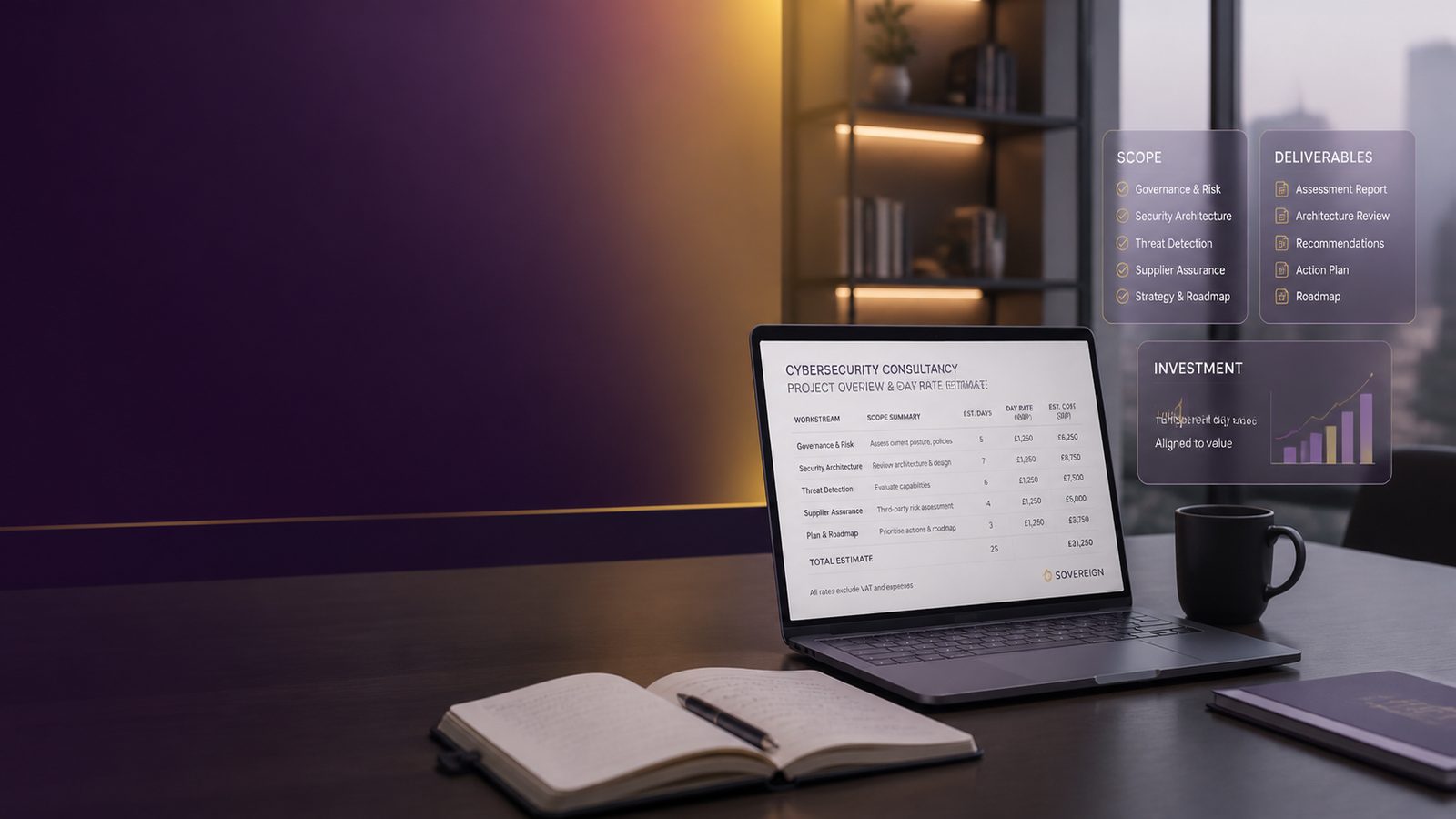
Key takeaways
- A consultant day rate is only good value if the scope, deliverables, and outcomes are clear.
- Lower rates can cost more overall if they lead to rework, delays, or generic advice.
- SMEs usually get better value from focused, practical support than from broad, vague engagements.
- Prepare documents and nominate one decision-maker before the work starts to reduce wasted time.
What a cyber security consultant day rate usually covers
If you are buying cyber security support for a small or medium-sized business, the day rate is only part of the story. What really matters is what you get for the money, how quickly the work moves, and whether the advice helps you reduce risk without wasting time or budget.
A consultant day rate usually covers a full working day of professional time. That may include meetings, reviewing your current setup, writing recommendations, helping your team make changes, or supporting a specific project. In some cases, the consultant will also spend time preparing before the day itself and following up afterwards.
Advice, planning, and hands-on support
Some consultants focus mainly on advice. Others are more hands-on and help you turn decisions into action. For example, they may help you define priorities, review policies, assess suppliers, or improve how your team handles incidents. A more practical, delivery-focused consultant often saves time because they can move from assessment to action more quickly.
If you need help understanding the difference between strategic advice and operational support, it is worth being clear about the outcome you want before you buy. A consultant who is strong at planning may not be the best fit if you need someone to work alongside your team and get changes implemented.
How day rates differ from fixed-price work
A day rate gives flexibility. It works well when the scope is still evolving, when you need expert input over several weeks, or when you want to start with a short discovery phase. Fixed-price work is usually better when the task is tightly defined, such as a specific assessment or a clearly bounded review.
For SMEs, the key question is not whether day rate or fixed price is cheaper in isolation. It is which model gives you the clearest path to a useful result. A low fixed price can still be poor value if it produces a generic report that does not help you make decisions.
Typical day rate ranges in the UK
There is no single standard rate for cyber security consultancy in the UK. Prices vary based on experience, specialism, location, and the type of work involved. For SMEs, it is sensible to expect a broad range rather than a single number.
As a rough guide, many independent consultants and smaller consultancies sit somewhere in the low hundreds to the high hundreds of pounds per day. More senior specialists, niche experts, and consultants with strong delivery experience can charge more. Larger firms often charge more again, especially where the work includes account management, formal reporting, or multiple layers of review.
That does not mean the highest rate is always the best choice. It means you should compare the likely business value, not just the headline figure.
What affects the price for SMEs
For a small business, the price is often influenced by how much context the consultant needs to learn. If your environment is straightforward and your goals are clear, the work can be more efficient. If your systems are spread across several platforms, your processes are undocumented, or your team has limited time to support the engagement, the cost can rise because the consultant needs more time to get to a reliable answer.
Another factor is whether the consultant is helping you with a narrow task or a wider improvement programme. A short review of a single area will usually cost less than support that spans governance, policies, suppliers, technical controls, and staff awareness.
Why specialist experience can cost more
Specialist experience often costs more because it reduces guesswork. A consultant who has seen similar problems before can usually identify the real issue faster and avoid unnecessary work. That can be especially useful where the business impact of getting it wrong is high, such as weak access control, poor backup arrangements, or unclear incident handling.
Specialists may also bring experience from regulated or complex environments. That can be valuable if you need practical advice that stands up to scrutiny from customers, insurers, or internal stakeholders. It is similar to the difference between a general tradesperson and a specialist contractor. You may pay more, but you are often buying speed, confidence, and fewer mistakes.
What changes the cost of a consultancy engagement
The day rate matters, but the total cost depends on several other factors. Two consultants with the same rate can produce very different overall costs if one is better prepared, clearer in scope, and more efficient in delivery.
Scope, urgency, and complexity
The wider the scope, the more time you will need. A focused piece of work, such as reviewing a policy set or assessing a small number of risks, is usually easier to price than a broad programme covering people, process, and technology.
Urgency also affects price. If you need support at short notice, or if the consultant has to work around a deadline set by a customer, insurer, or board meeting, you may pay a premium. Complex environments can also increase cost because they take longer to understand and validate.
Remote support versus on-site work
Remote work is often more cost-effective because it avoids travel time and expenses. It can be a good fit for planning, document review, workshops, and many advisory tasks. On-site work can still be worthwhile when the consultant needs to understand how your business operates in practice, meet key staff, or review physical processes and controls.
If a consultant is charging for travel, ask how that is handled. Some include it in the day rate, while others charge separately. The same applies to expenses such as mileage, accommodation, or parking. Clear terms avoid surprises later.
One-off advice versus ongoing support
One-off support is useful when you want a second opinion or help with a specific issue. Ongoing support is better when you need regular input, such as monthly reviews, project oversight, or a steady point of contact for security decisions.
Ongoing support can also be more efficient because the consultant builds context over time. That can reduce repeated explanations and help them spot patterns earlier. For many SMEs, this is one reason a retainer can be better value than buying days sporadically.
How consultants charge in practice
Most consultants use one of four common charging models: day rate, half-day rate, hourly rate, or retainer. The right model depends on how much certainty you need and how much work is involved.
Day rate, half-day rate, and hourly rate
A day rate is the most common model for structured consultancy work. It is useful when the consultant needs enough time to understand the issue, analyse it, and produce something useful. Half-day rates can work for shorter meetings, workshops, or focused reviews, although they may be less efficient if the work expands.
Hourly rates are less common for strategic work, but they may be used for very small tasks or ad hoc advice. For SMEs, hourly charging can be harder to manage because it makes the final cost less predictable. If you choose this model, ask for an estimate and a clear limit.
Retainers and packaged support
A retainer is an ongoing arrangement where you pay for a set amount of support each month or quarter. This can be useful if you want regular advice without starting from scratch every time. It may suit businesses that need help with governance, supplier issues, policy updates, or security planning.
Packaged support can also be useful when the scope is clear. For example, a consultant might offer a fixed package for an assessment, a gap review, or a short improvement programme. This can make budgeting easier, provided the deliverables are clearly defined.
How to judge whether a rate is good value
A good rate is not the cheapest rate. It is the rate that gives you the most useful outcome for the least wasted effort. That means looking at what the consultant will actually do, how they work, and whether they understand the needs of a business like yours.
What outcomes you should expect
Before you agree to any work, be clear about the outcome. Do you need a risk review, a practical action plan, help improving controls, or support preparing for a customer requirement? The more specific the outcome, the easier it is to judge value.
For example, if you are commissioning an assessment, you should expect more than a list of issues. You should expect prioritised recommendations, clear next steps, and enough context to help you decide what to do first. If you are buying support for policy work, you should expect documents that are usable by your team, not just generic templates.
If you are unsure what a structured review should look like, our guide to internal audits under ISO 27001 shows the sort of practical checks that can make a review more useful for a small business.
Questions to ask before you agree the work
Ask the consultant what they will deliver, how long they expect it to take, and what they need from you. Also ask how they handle uncertainty. A good consultant should be able to explain what is included, what is not included, and what happens if the scope changes.
You should also ask how they will communicate progress. Will you get a short call, a written summary, or a workshop? Will they help your team implement the recommendations, or only provide advice? These details matter because they affect both cost and usefulness.
What UK SMEs should budget for common security projects
Different types of work attract different levels of effort. A simple review may only take a day or two. A broader improvement programme can take several weeks or longer. Budgeting becomes easier when you think in terms of outcomes rather than hours.
Assessments and gap reviews
Assessments and gap reviews are often the starting point for SMEs. They help you understand where you are now and what needs attention. Costs vary depending on the number of systems, the amount of evidence to review, and whether the consultant needs to interview several people.
For a small business, a focused review can be a sensible first step because it helps you avoid spending money on the wrong controls. If you are comparing this type of work with more formal testing, our article on technical control testing in Cyber Essentials Plus explains why the level of scrutiny can change the amount of effort involved.
Policy and process improvement
Policy and process work is often underestimated. Writing a policy is only part of the job. It also needs to fit how your business actually operates. That means reviewing approvals, ownership, escalation, and how staff will follow the process in practice.
If your consultant is helping with this area, ask whether they will tailor the work to your business or simply provide a template. Tailoring usually costs more, but it is often better value because it reduces the chance of documents sitting unused.
Virtual chief information security officer support
Virtual chief information security officer support, often shortened to vCISO, is ongoing strategic support from an external security lead. For SMEs, this can be a practical way to get senior input without hiring a full-time executive. The cost depends on how much involvement you need, how often decisions need to be made, and whether the consultant is expected to attend leadership meetings.
This model is often best when you need someone to help prioritise risk, guide investment, and keep security moving forward. It is less suitable if you only need a one-off answer to a narrow question.
ISO 27001 advisory work
ISO 27001 advisory work can range from light-touch guidance to hands-on implementation support. The cost depends on how mature your current arrangements are and how much of the management system already exists. If you are starting from scratch, expect more time to be needed than if you already have policies, risk records, and basic governance in place.
For businesses looking at this area, the important point is not to buy certification promises. Instead, buy practical support that helps you build a sensible management system and improve control over time. If you want to understand the kind of work involved, our guide on policies and procedures required by ISO 27001 is a useful starting point.
Ways to keep consultancy costs under control
There are several straightforward ways to reduce cost without reducing quality. The aim is to make the consultant effective quickly, so you get more value from each day purchased.
Prepare information before the engagement starts
Good preparation saves money. Share the key documents, current policies, system diagrams, and any previous assessments before the work begins. If the consultant spends the first day collecting basic information, you are paying for avoidable discovery time.
It also helps to name a single point of contact. That person can answer questions, gather information, and make sure decisions do not stall. Without this, the consultant may spend time chasing different people for the same answer.
Prioritise the highest-risk issues first
Do not try to fix everything at once. Start with the issues that create the biggest business risk, such as weak access control, poor backup arrangements, unclear incident response, or gaps in supplier oversight. A consultant can help you sequence the work so the most important items are addressed first.
This approach is usually more cost-effective because it reduces the chance of spending time on low-value tasks while bigger problems remain unresolved.
Use a clear scope and decision-maker
A clear scope reduces rework. Before the engagement starts, agree what is in scope, what is out of scope, and who will make decisions if priorities change. If the consultant has to pause repeatedly while the business decides what it wants, the cost will rise.
It is also useful to agree what success looks like. That might be a prioritised action plan, a set of improved documents, or a clearer view of risk. The more concrete the goal, the easier it is to keep the work focused.
When a lower day rate can cost more overall
A lower day rate is not always cheaper in the end. If the consultant is inexperienced, slow, or not a good fit for your business, the total cost can rise through rework, delays, and missed priorities.
Hidden rework and vague deliverables
Some low-cost engagements produce vague outputs that need to be rewritten internally. That means your team spends time turning general advice into something usable. In practice, this can cost more than paying for a stronger consultant who gets closer to the answer first time.
Watch out for deliverables that sound impressive but do not help you act. A long report is not automatically a useful report. For SMEs, clarity and prioritisation are usually more valuable than volume.
Poor fit for your business needs
A consultant can be excellent in one setting and poor in another. Someone who works well in large, complex environments may not be the right fit for a smaller business that needs practical, proportionate advice. Likewise, a generalist may not be the best choice if you need deep experience in a specific area.
That is why it helps to ask for examples of similar work and to understand how the consultant approaches SMEs. If you want to see how broader security skills can support better outcomes, our article on why offensive security skills should be in every team’s toolkit explains why practical experience often improves the quality of advice.
How to compare quotes from different consultants
When you compare quotes, do not focus only on the rate. Compare the scope, assumptions, deliverables, and level of support. A quote that looks more expensive may actually include more useful work.
Look beyond the headline rate
Ask what the rate includes. Does it cover preparation, workshops, reporting, and follow-up? Are there travel costs or expenses? Is the consultant expected to work with your team to implement changes, or only to advise? These differences can change the real cost significantly.
Compare deliverables, assumptions, and timeframes
Make sure each quote describes the same thing. If one consultant is offering a broad review and another is offering a narrow one, the prices will not be directly comparable. Check the assumptions too. A quote based on a well-prepared business with clear documentation will not be the same as one based on a messy, undocumented environment.
Timeframes matter as well. A quicker turnaround may be worth paying for if you need decisions made before a customer deadline or board meeting. On the other hand, if the work is exploratory, a slower and more considered approach may be better value.
A simple checklist before you hire a consultant
Before you sign anything, make sure you know what you are buying. A short checklist can prevent confusion later and help you choose a consultant who fits your business.
- Confirm the scope in writing, including what is included and what is excluded.
- Agree the expected deliverables, such as a report, workshop, action plan, or follow-up session.
- Ask how the consultant will gather information and who they need to speak to.
- Check whether travel, expenses, and extra meetings are included or charged separately.
- Ask for examples of similar work with SMEs and how the consultant approaches practical implementation.
- Make sure there is a single decision-maker on your side to avoid delays and mixed messages.
If you want support that is practical, risk-based, and shaped around the needs of an SME, it is worth speaking to someone who can help you define the right scope before you commit budget. The best engagements are usually the ones that start with a clear business problem and end with a clear next step.
Speak to a consultant if you would like help working out what level of support makes sense for your business.
Frequently asked questions
How much do consultants charge per day in the UK?
There is no single standard rate, but many cyber security consultants in the UK charge from the low hundreds to the high hundreds of pounds per day, with specialist or senior support costing more. The right comparison is not just the rate, but the value of the outcome and how much work is included.
How much do cyber security consultants charge?
Charges depend on the type of work, the consultant’s experience, and whether you need one-off advice, a short project, or ongoing support. SMEs should expect pricing to vary by scope, urgency, and complexity, so it is best to ask for a clear written proposal rather than compare rates alone.
Comments are closed