
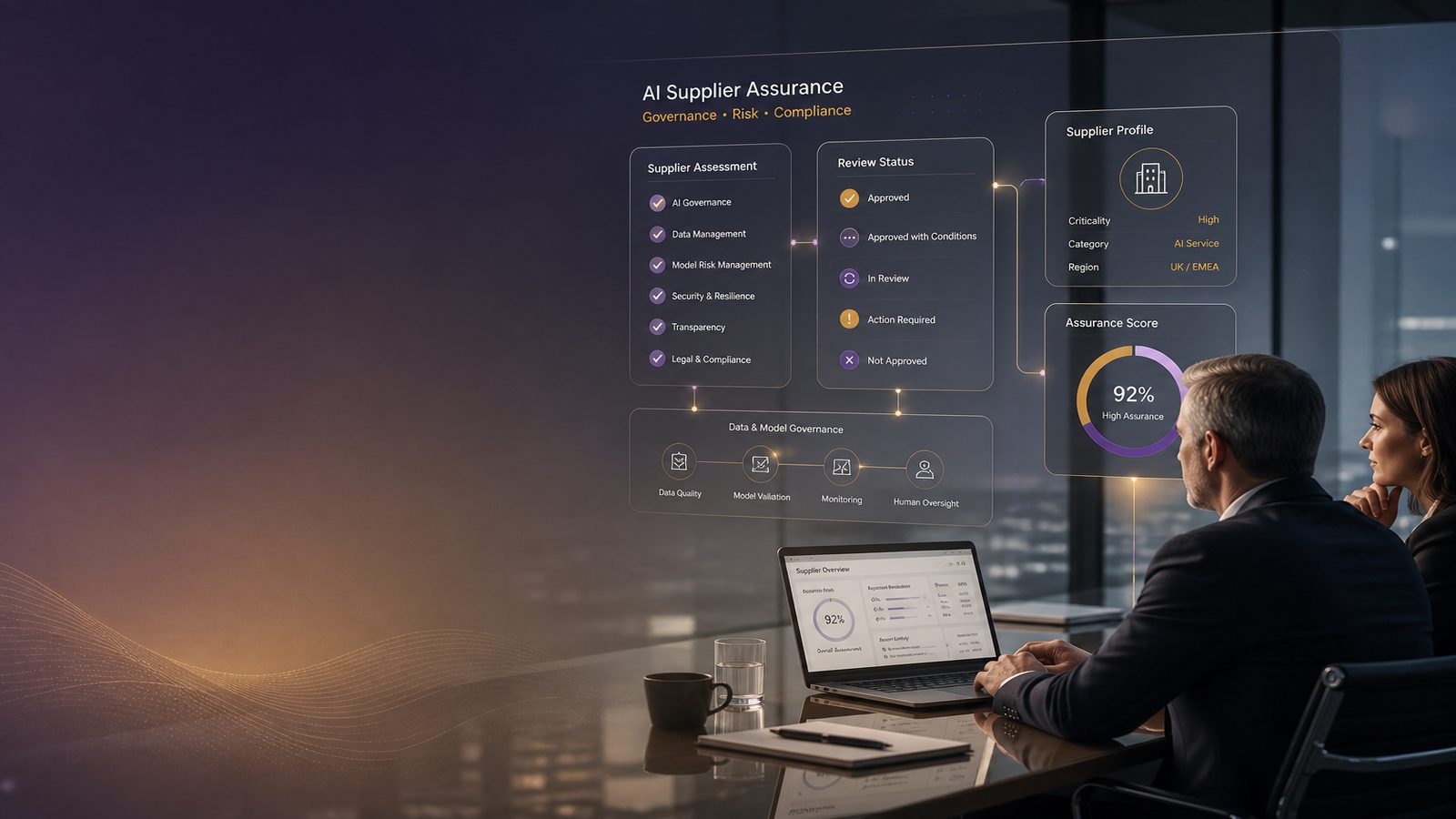
For many UK SMEs, the biggest risk with artificial intelligence is not whether the tool looks impressive in a demo. It is whether the supplier can be trusted to handle your data, support your business safely, and behave predictably when something goes wrong.
That is where AI supplier assurance and governance expectations matter. In plain terms, this means checking that a provider has sensible security, privacy, and management controls before you buy, then keeping an eye on them after the system goes live. If you skip that step, you can end up with avoidable costs, service disruption, reputational damage, and awkward conversations with customers or partners.
This article is written for business owners, managers, and non-technical decision-makers. It focuses on practical questions you can ask, the evidence you should expect, and the simple controls that help you stay in charge of the risk.
Key takeaways
- AI supplier assurance is about checking how a provider handles data, security, and change, not just whether the tool works.
- Good governance means clear ownership, simple approval rules, and a process for escalating concerns before they become business problems.
- Ask suppliers direct questions about data retention, model training, subcontractors, security controls, and incident response.
- Keep the evidence set small but specific, and treat vague answers as a warning sign rather than reassurance.
- Reassess suppliers when their service, data handling, ownership, or your own use of the tool changes.
What AI supplier assurance means in practice
AI supplier assurance is the process of checking whether a provider is safe and suitable for your organisation. It is broader than asking, “Does the product work?” You are also asking, “Can this supplier protect our information, explain how the service behaves, and support us if there is a problem?”
How it differs from general supplier due diligence
General supplier checks often focus on financial stability, service levels, and basic security. AI adds a few extra concerns. The system may process customer data, staff data, or confidential business information. It may also make recommendations that influence decisions, which means errors can have a real business impact even when no one has deliberately done anything wrong.
For that reason, AI supplier assurance should cover how the tool uses data, whether it learns from your inputs, how outputs are reviewed, and what happens if the supplier changes the model or service terms. If you already use a structured supplier review process, AI should sit inside it, not outside it. A practical starting point is to treat AI suppliers as a higher-risk category until they have been assessed properly. Our article on supplier assurance for UK SMEs explains how to keep that process proportionate.
Why governance matters as much as security
Security controls are important, but they are only part of the picture. Governance is about who is allowed to approve the tool, who owns the risk, what the acceptable use rules are, and how issues are escalated. Without governance, even a secure tool can be used in ways that create problems.
For example, a team might start pasting customer information into a public AI service because it is quick. Or a manager might rely on AI-generated output without checking it. Those are business decisions, not just technical mistakes. Good governance gives people clear boundaries so the organisation can use AI without losing control.
Why UK SMEs should care about AI supplier risk
SMEs often assume supplier risk is only a concern for large organisations. In reality, smaller businesses can be more exposed because they have less spare capacity to absorb disruption. If an AI service fails, changes its pricing, or mishandles data, the effect can be immediate.
Business impact: cost, reputation, and service disruption
The most common business impacts are straightforward:
- Extra cost from rework, manual checking, or switching suppliers at short notice.
- Lost time when staff have to stop using a tool that no longer meets expectations.
- Reputational damage if customers think their information has been handled carelessly.
- Service disruption if an AI feature is embedded into sales, support, or operations.
There is also a hidden cost. If staff do not trust the tool, they either avoid it or over-rely on it. Both outcomes reduce value. Good assurance helps you get the benefit of the technology without creating unnecessary friction.
Common risks from third-party AI tools and services
Third-party AI tools can introduce risk in several ways. The supplier may store prompts and outputs for longer than you expect. They may use your data to improve their service unless you opt out. They may rely on other providers behind the scenes, which can make it harder to understand where your information goes.
There is also the risk of poor output quality. AI systems can produce inaccurate, incomplete, or misleading content. If your team uses that output without review, the business may make poor decisions or send the wrong message to customers. For a broader view of third-party technology risk, see how third-party software introduces cyber risk for UK SMEs.
What good AI governance looks like
Good governance does not need to be complicated. It needs to be clear, documented, and actually used. The goal is to make sure the right people can approve AI use, understand the risks, and stop unsafe use before it becomes a problem.
Roles, ownership, and decision-making
Every AI tool should have an owner. That person does not need to be technical, but they should understand what the tool is used for, who depends on it, and what would happen if it failed. They should also know when to involve security, legal, data protection, or senior management.
At a minimum, define:
- Who can request a new AI tool.
- Who approves it.
- Who reviews the supplier evidence.
- Who signs off on any data sharing.
- Who monitors the service after launch.
If no one owns the risk, it usually ends up being owned by everyone, which means it is effectively owned by no one.
Policies for approved use, review, and escalation
You do not need a long policy document to start. A short, practical set of rules is often better. It should say what types of AI tools are allowed, what data must never be entered, whether staff can use public services for work, and what needs approval before use.
It should also explain what to do when something looks wrong. For example, if the tool gives a strange answer, if the supplier changes its terms, or if a team wants to use a new feature that changes how data is handled, there should be a clear route for review. This is especially important if the AI tool supports customer-facing work or business-critical decisions.
The key questions to ask an AI supplier
When you speak to a supplier, keep the conversation focused on practical risk. You are not trying to test them like a regulator. You are trying to understand whether they can be trusted with your business.
Data handling, retention, and model training
Start with the basics. Ask what data the service collects, where it is stored, how long it is kept, and who can access it. Ask whether your prompts, files, or outputs are used to train the model or improve the service. If the answer is yes, ask whether that can be turned off and what the default setting is.
You should also ask whether the supplier uses subcontractors or other service providers. If they do, you need to know whether those parties have access to your data and whether the supplier can explain the chain clearly. If the supplier cannot answer these questions in plain English, that is a warning sign.
Security controls, testing, and incident response
Ask what security controls protect the service. That includes access control, encryption, logging, and how they separate customer data. You do not need a technical deep dive, but you do need enough detail to judge whether the controls are sensible for the sensitivity of the information involved.
Also ask how they test the service for weaknesses, how often they review security, and what their process is for handling incidents. If there is a security problem, how quickly will they tell you? What support will they provide? How will they help you understand whether your data was affected?
If the supplier cannot explain their incident process clearly, you may struggle to get useful answers when you need them most.
How to assess supplier evidence without overcomplicating it
Many SMEs get stuck because they ask for too much evidence, then do not have time to review it. The answer is not to collect everything. It is to request a small set of documents that help you make a sensible decision.
Useful documents and assurances to request
Useful evidence usually includes:
- A short description of how the service handles data.
- A summary of security controls.
- A privacy notice or data processing summary.
- Details of any independent security review or assessment.
- A service level summary covering support and incident notification.
If the supplier provides a questionnaire response, that can help, but only if it is specific. Vague statements such as “we take security seriously” are not enough. You want clear answers about what they do, not general promises.
For suppliers that build software rather than just provide a hosted service, it can also help to ask how they manage their own development and supply chain controls. Our guide to software supply chain assurance controls is useful if you need to go a level deeper.
How to judge whether the answers are credible
Credible answers are specific, consistent, and proportionate to the service. If the supplier says they do not store your data, ask how the service works in practice. If they say they encrypt everything, ask what that means for data in transit and data at rest. If they say they have strong controls but cannot describe them, treat that as a gap rather than a reassurance.
You are looking for alignment between the risk and the control. A low-risk internal productivity tool does not need the same level of scrutiny as a system that handles customer records or supports operational decisions. But every supplier should be able to explain its basics clearly.
What to include in contracts and procurement checks
Contracts are where your expectations become enforceable in practice. They should not be full of legal jargon that nobody reads. They should set out the minimum standards you need to manage the relationship properly.
Minimum security and governance expectations
At a minimum, consider including requirements for:
- How data may be used and whether it can be used for model training.
- How quickly the supplier must notify you of a security incident.
- What support they will provide during an incident.
- How changes to the service will be communicated.
- How access is controlled and removed when staff leave or roles change.
If the supplier is unwilling to commit to basic protections, that tells you something important about the relationship.
Exit planning, change notification, and support terms
Do not overlook exit planning. If you stop using the service, can you retrieve your data in a usable format? How long will it take? What happens to stored prompts, outputs, or logs? These questions matter because switching away from an AI service can be more disruptive than switching a simple software tool.
You should also ask how the supplier handles changes. AI services can change quickly, and not always in ways that suit your business. If the model, data handling, or pricing changes, you need enough notice to review the impact. This is where good procurement discipline protects both budget and continuity.
How to manage ongoing oversight after go-live
Assurance is not a one-time exercise. A supplier that looked fine at purchase may become a problem later if the service changes, the business use expands, or staff start using it in new ways.
Review cycles, monitoring, and change control
Set a review cycle that matches the risk. For a low-risk tool, that might be once a year. For a customer-facing or sensitive service, it may need to be more frequent. The review should check whether the supplier has changed its terms, whether the tool is still being used as intended, and whether any incidents or complaints have occurred.
Keep an eye on how staff actually use the tool. If people are entering sensitive data, relying on outputs without review, or using the service for tasks it was never approved for, the risk has changed. That should trigger a fresh assessment.
When to re-assess a supplier
Re-assess the supplier when something material changes. Common triggers include:
- A change in data handling or retention.
- A new feature that affects how information is processed.
- A security incident involving the supplier.
- A change in ownership or subcontractors.
- A new business use that increases the sensitivity of the service.
These checks do not need to be heavy-handed. They just need to be consistent. The aim is to avoid surprises.
A simple AI supplier assurance checklist for SMEs
If you want a straightforward way to start, use this two-stage checklist.
Before purchase
- Confirm what business problem the AI tool is meant to solve.
- Identify what data it will process and whether that data is sensitive.
- Ask how the supplier stores, uses, and deletes data.
- Check whether your data is used for model training.
- Review the supplier’s security summary and incident process.
- Decide who owns the risk and who approves the purchase.
After deployment
- Tell staff what the tool can and cannot be used for.
- Monitor whether people are using it as intended.
- Review supplier changes and incidents on a regular basis.
- Check whether the business still needs the tool and whether the risk remains acceptable.
- Keep a record of decisions so you can explain them later if needed.
If you already have a wider approach to governance, it may help to compare this with your existing AI policy or risk register. Our article on responsible AI governance for UK SMEs provides a useful starting point for that broader conversation.
Final thoughts
AI supplier assurance is not about blocking innovation. It is about making sure the business gets the benefit of AI without taking on avoidable risk. For UK SMEs, the most practical approach is to ask clear questions, keep the evidence light but meaningful, and make sure someone owns the decision.
If you can explain why a supplier is suitable, what data it will handle, and how you will oversee it after launch, you are in a much stronger position than most organisations that rush into adoption. That discipline protects cash flow, customer trust, and day-to-day operations.
If you would like help reviewing your AI supplier checks, governance approach, or wider information security controls, Speak to a consultant.
Frequently asked questions
What does AI assurance mean?
AI assurance means checking that an AI supplier has sensible controls for security, privacy, data handling, and service management before you buy, and keeping oversight in place after deployment.
What is good governance in AI?
Good governance in AI means clear ownership, approved use rules, review and escalation steps, and regular checks that the supplier and the tool still meet your business needs.
Comments are closed