
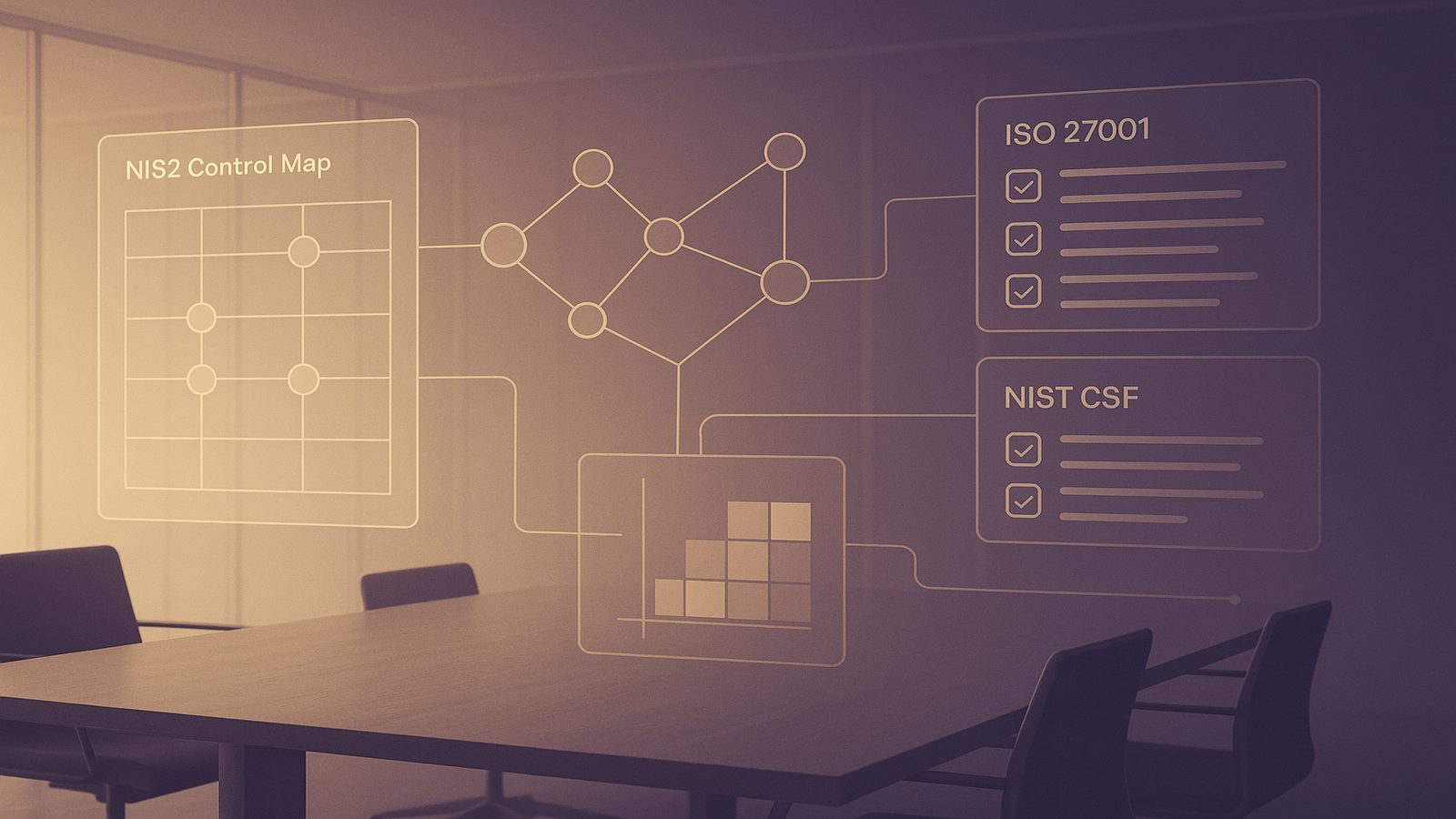
If you already use ISO 27001 or the NIST Cybersecurity Framework, you may be closer to NIS2 than you think. For many UK SMEs, the useful question is not whether the three frameworks are identical, but how much of your existing security work can be reused, and where the gaps are likely to sit.
This matters because smaller organisations rarely have the time or budget to build separate security programmes for every framework. A better approach is to map the common control areas, reuse what already works, and focus effort where it reduces the most business risk.
Why this mapping matters for UK SMEs
NIS2 is a European cyber security directive that places emphasis on risk management, incident handling, business continuity, supply chain security and accountability at management level. ISO 27001 is a management system standard, so it helps you organise security in a structured way. NIST CSF is a practical framework for understanding and improving cyber security outcomes across functions such as identify, protect, detect, respond and recover.
For a UK SME, the value of mapping these frameworks is straightforward. It helps you avoid duplicate work, spot missing controls earlier, and explain to leadership why certain improvements are worth doing now rather than later. It also gives you a clearer way to talk to customers and suppliers about security expectations without turning every conversation into a separate exercise.
Where NIS2, ISO 27001 and NIST CSF overlap
The overlap is strongest in the basics. All three expect you to understand your risks, assign responsibility, protect important systems and information, prepare for incidents, and review controls over time. They also all assume that security is not just a technology issue. People, process and governance matter just as much.
That overlap is useful because it means an SME can often build one set of policies, one risk process and one incident response approach, then use them to support several different objectives. The frameworks use different language, but the underlying business need is often the same.
What this article will and will not cover
This article is a practical comparison, not a clause-by-clause interpretation. It is designed to help UK SMEs understand the shape of the overlap and decide where to invest effort first. It does not claim that any framework automatically makes you compliant with another, and it does not replace a formal assessment where one is needed.
A practical way to compare the three frameworks
The easiest way to compare them is to think about what each one is trying to achieve.
ISO 27001 is about running an information security management system, often shortened to ISMS. That means setting direction, assessing risk, choosing controls, tracking evidence and improving over time. NIST CSF is more outcome-focused. It helps you organise security work into clear functions and categories. NIS2 is more directive in style. It expects organisations in scope to put appropriate risk management measures in place and to be able to show that those measures are being operated.
Control objectives versus management system requirements
This distinction is important. A control objective describes what you want to achieve, such as reducing the chance of unauthorised access or improving incident response. A management system requirement is about how you run the programme, such as assigning ownership, reviewing risks and keeping records.
In practice, ISO 27001 often gives you the structure, NIST CSF gives you a simple way to organise the work, and NIS2 gives you the external pressure to make sure the work is real and proportionate. For SMEs, that combination can be helpful if it is handled sensibly.
How to read the mapping without overcomplicating it
Do not try to force a perfect one-to-one match. That usually creates confusion and wastes time. Instead, map by theme. Ask three questions for each area: what is the business risk, what existing control already addresses it, and what evidence would show the control is actually being used?
That approach is more useful than building a large spreadsheet that looks complete but does not help anyone make decisions. It also keeps the focus on outcomes, which is where SMEs usually get the best return on effort.
Core NIS2 control areas and their closest ISO 27001 and NIST CSF counterparts
The following is a practical way to think about the main overlap areas.
Governance, risk management and accountability
NIS2 places clear emphasis on management responsibility, risk-based decision-making and oversight. The closest ISO 27001 counterpart is the ISMS itself, especially leadership commitment, risk assessment, control selection and continual improvement. In NIST CSF terms, this sits mainly in the identify function, with support from governance, risk and supply chain categories.
For an SME, this usually means having a named owner for security, a current risk register, a sensible policy set and a regular review cycle. It also means leadership understands the main risks well enough to make decisions, rather than leaving security as an informal IT task.
Incident handling, business continuity and supplier security
NIS2 expects organisations to be able to detect, manage and report incidents, and to maintain continuity where disruption occurs. ISO 27001 maps well here through incident management, business continuity planning, backup arrangements, logging, access control and supplier management. NIST CSF maps through detect, respond and recover, with supporting work in identify and protect.
For SMEs, the practical question is whether you can spot an incident quickly, contain it, communicate internally, recover key services and learn from what happened. Supplier security is part of the same picture because many incidents now involve third parties, hosted services or outsourced support.
What UK SMEs can reuse from an existing ISO 27001 or NIST CSF programme
If you already have an ISO 27001-aligned ISMS or a NIST CSF-based programme, you may be able to reuse a large amount of material. The key is to check whether it is current, owned and actually used.
Policies, risk registers and evidence packs
Policies are often the easiest starting point. Access control, incident response, backup, supplier management, acceptable use and asset management policies usually map well across the three frameworks. A risk register is also highly reusable, provided it reflects current systems, suppliers and business priorities.
Evidence packs can save time too. Meeting minutes, training records, incident exercises, supplier reviews and control testing results can all support a broader mapping exercise. The important point is not to collect evidence for its own sake, but to show that controls are operating in a way that is proportionate to the risk.
Gaps that usually need extra attention
Even where the overlap is strong, SMEs often find gaps in three areas. First, management oversight may be too informal. Second, incident response may exist on paper but not be tested. Third, supplier management may not go far enough into dependency and resilience questions.
Another common gap is recovery planning. Backups are not the same as recovery. You need to know what you would restore first, who would do it, how long it would take and what the business can tolerate while systems are unavailable.
Common gaps when organisations try to map controls too literally
Mapping can be useful, but it can also become misleading if it is treated as a mechanical exercise.
Treating frameworks as a one-to-one checklist
One of the biggest mistakes is assuming that every NIS2 expectation must map neatly to one ISO 27001 control or one NIST CSF category. That is rarely true. Some requirements are broader than a single control, while others are supported by several smaller controls working together.
A better method is to map by intent. If the intent is resilience, look at backup, recovery, continuity, supplier dependency and incident response together. If the intent is governance, look at leadership ownership, risk review, policy approval and reporting together.
Missing operational ownership and review cycles
Another common issue is creating a mapping document that looks impressive but is not owned by anyone. Controls drift when there is no review cycle, no named owner and no follow-up on actions. That is especially relevant for SMEs, where people often wear several hats and security responsibilities can become blurred.
If a control is important, someone should own it, know how often it is reviewed and understand what good looks like. Without that, the mapping becomes a static document rather than a working management tool.
A simple prioritisation approach for smaller teams
Most SMEs do not need a large transformation programme. They need a sensible sequence of improvements that fits the business.
Start with the controls that reduce the most business risk
Begin with the areas that protect core operations. For many organisations, that means identity and access management, backups, incident response, supplier assurance, logging, patching and leadership oversight. These controls tend to deliver value across multiple risk scenarios, not just one framework requirement.
Ask which weaknesses would cause the most disruption if they failed tomorrow. That question usually produces a more useful priority list than trying to score every control equally.
Sequence improvements around people, process and technology
A practical sequence is to start with ownership and process, then strengthen technology where needed. For example, it is hard to improve incident response if nobody knows who leads it. It is hard to improve backup resilience if restore testing has never been done. It is hard to manage suppliers if no one keeps a current inventory of critical third parties.
By sequencing work this way, you reduce the chance of buying tools before you have the process to use them properly.
How to use the mapping in a real improvement plan
The best use of a mapping exercise is to turn it into a short, actionable plan.
Turning the mapping into a short action list
Keep the output simple. For each control area, record the current state, the gap, the owner, the target date and the evidence you expect to have at the end. If you can keep the list to the most important actions, it is far more likely to be used.
For an SME, a good improvement plan is usually one that can be explained in a single leadership meeting. It should show what is already in place, what needs work and what the business gets in return.
Using it to brief leadership and suppliers
The mapping can also help you brief non-technical stakeholders. Leadership usually wants to know where the business risk sits, what the priorities are and what the cost or effort looks like. Suppliers may need a clearer view of the controls you expect from them, especially where they support critical services or hold sensitive data.
That makes the mapping useful as a communication tool, not just a technical one. It helps turn security from a vague concern into a structured conversation about risk and responsibility.
When to bring in external support
Some SMEs can do this themselves, especially if they already have a mature security lead or an established ISMS. Others benefit from outside help when the overlap is unclear or the internal team is stretched.
If you need help interpreting the overlap
External support can be useful when you are unsure how to translate framework language into practical actions, or when you want to avoid building duplicate processes. A consultant can help you identify the controls that matter most, remove unnecessary complexity and make sure the mapping reflects how the business actually operates.
If you want a pragmatic gap assessment
A gap assessment can be a sensible next step if you want to understand where your current controls are strong and where they need attention. For SMEs, the value is usually in prioritisation rather than volume. You want a clear view of the most important gaps, not a long report that is difficult to act on.
If you already have ISO 27001 or NIST CSF work in place, the right support should help you reuse it, not replace it. That is often the most cost-effective route.
Conclusion
Mapping NIS2 controls to ISO 27001 and NIST CSF is best treated as a practical exercise in reuse and prioritisation. For UK SMEs, the goal is to build on what already exists, close the most important gaps and keep the programme manageable.
If you focus on governance, risk, incident handling, continuity and supplier security, you will cover much of the useful overlap. If you then keep ownership clear and review the controls regularly, the mapping becomes a working part of your security management rather than a one-off document.
That is usually the most realistic and business-friendly way to approach it.
If you would like help interpreting the overlap or turning it into a pragmatic improvement plan, speak to a consultant.
Frequently asked questions
How do I map NIS2 controls to ISO 27001 without starting from scratch?
Start by grouping controls by theme rather than trying to match every clause exactly. The article suggests looking at governance, risk management, incident handling, business continuity and supplier security, then reusing the controls you already have in those areas. A simple question for each theme is whether the existing control reduces the business risk and whether you can show it is being used.
What parts of ISO 27001 are closest to NIS2 for a UK SME?
The closest overlap is usually around the information security management system itself, especially leadership commitment, risk assessment, control selection and continual improvement. The article also points to incident management, business continuity, backup arrangements, logging, access control and supplier management. These areas are often where an SME can reuse existing work most effectively.
How does NIST CSF fit with NIS2 requirements?
NIST CSF is described in the article as a practical way to organise security work into identify, protect, detect, respond and recover. That makes it a useful companion to NIS2 because the directive also focuses on risk management, incident handling, continuity and accountability. For many SMEs, NIST CSF helps structure the work while NIS2 sets the expectation that the work is real and proportionate.
Do I need separate policies for NIS2, ISO 27001 and NIST CSF?
Not necessarily. The article says many SMEs can build one set of policies, one risk process and one incident response approach, then use them to support several frameworks. The key is to make sure the policies reflect the business risks and that they are actually followed, reviewed and updated over time.
What should I focus on first if my organisation is already partly aligned to ISO 27001 or NIST CSF?
The article recommends starting with the areas that reduce the most business risk, rather than trying to complete a large mapping exercise first. In practice, that usually means checking governance, incident handling, continuity and supplier security, then identifying any gaps in ownership, evidence or review. This keeps the effort practical and easier to explain to leadership.
Comments are closed