
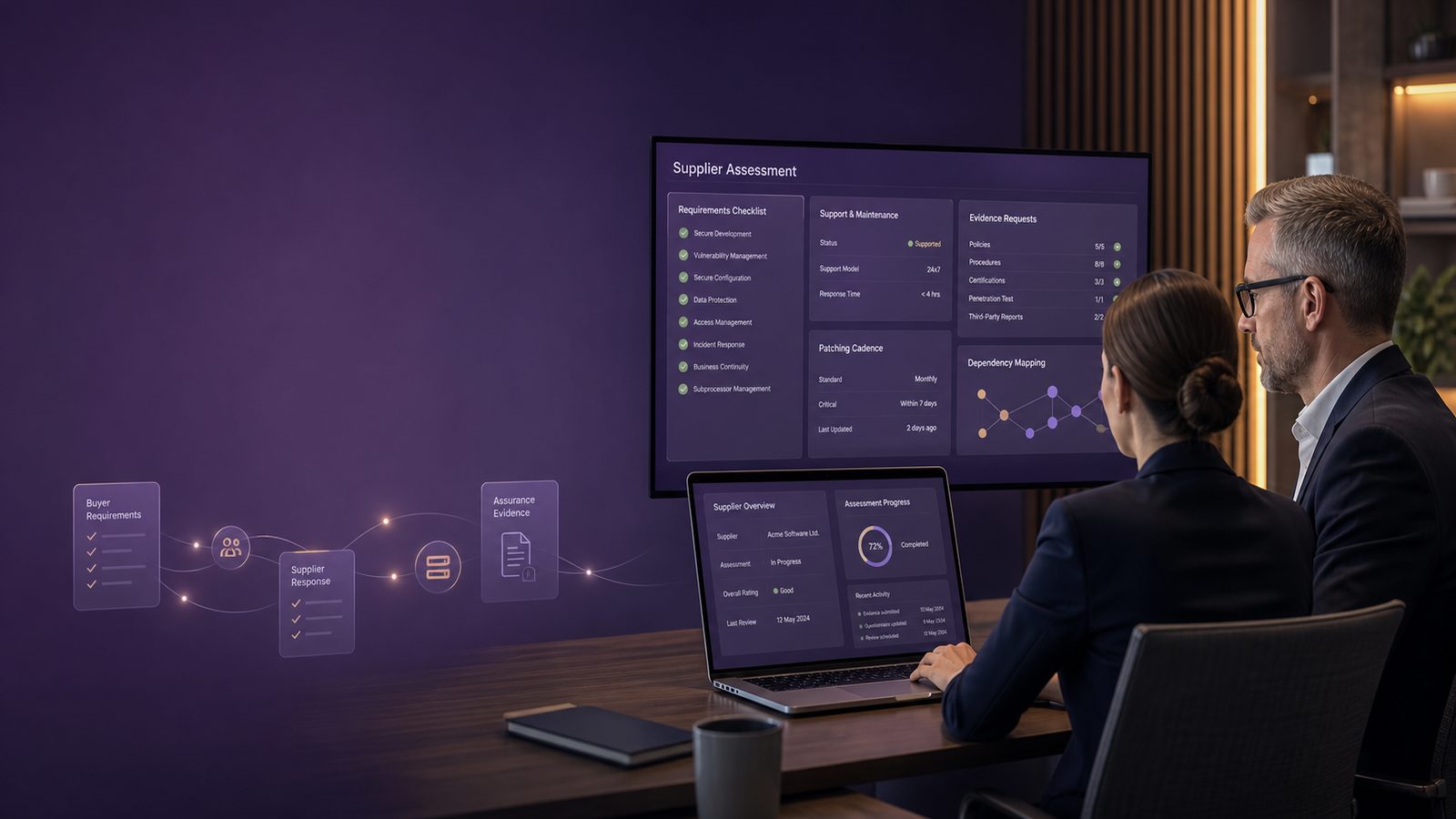
For many UK SMEs, software buying decisions are now security decisions. A poor choice can lead to service disruption, extra support costs, data loss, and reputational damage that is hard to undo. The challenge is not to turn procurement into a full audit. It is to ask the right questions early enough to avoid buying avoidable risk.
Secure software procurement requirements for suppliers should help you understand whether a product has been built, changed, supported, and monitored in a sensible way. That matters whether you are buying a business application, a software as a service platform, or a hosted service with software at its core. The aim is simple: reduce the chance that a supplier becomes the weak point in your own operations.
Key takeaways
- Ask suppliers for clear evidence of how they build, test, patch, and support software, not just broad security claims.
- Match the depth of your questions to the business risk, the data involved, and how critical the software is to operations.
- Make security part of the normal buying process so important purchases are reviewed before the contract is signed.
- Use contract terms to cover fixes, incident notification, support periods, and what happens when the service ends.
Why secure software procurement matters for UK SMEs
When software is bought quickly, security is often treated as a later concern. That can be expensive. A supplier that does not manage vulnerabilities well may leave you exposed for longer than expected. A supplier that cannot explain how access is controlled may create unnecessary account risk. A supplier that stops supporting a product can leave you with a rushed replacement project and unplanned costs.
There is also a wider business impact. If a supplier outage affects your ability to serve customers, issue invoices, or access records, the problem becomes operational very quickly. If a supplier mishandles your data, the reputational impact can be worse than the technical issue itself. For SMEs, that can mean lost trust, delayed projects, and management time spent on recovery instead of growth.
Good procurement reduces those risks by making security part of the buying decision, not a separate exercise after the contract is signed. It also helps you compare suppliers more fairly. A product with strong security practices may cost more upfront, but it can be cheaper over its life if it reduces incidents, support effort, and replacement work. If you want a broader view of how third-party software creates exposure, our article on how third-party software introduces cyber risk for UK SMEs is a useful companion read.
What buyers usually mean by secure software requirements
In plain English, secure software requirements are the things you expect a supplier to do before, during, and after release to keep the product safe enough for its intended use. They are not a promise that nothing will ever go wrong. They are a set of practical expectations that show the supplier takes security seriously.
For most SMEs, the useful questions are:
- How is the software designed and changed?
- How are vulnerabilities found and fixed?
- Who can access the system and how is that access controlled?
- How are secrets such as passwords and keys protected?
- What logs are kept, and how quickly can the supplier respond to an incident?
The exact requirements should vary by service type. A software as a service platform, where the supplier runs the service for you, should usually provide more detail about hosting, monitoring, and incident handling. A packaged application installed in your environment may place more responsibility on your own team for configuration and patching. A hosted service sits somewhere in between, so you need to be clear about who is responsible for what.
This is why a one-size-fits-all questionnaire rarely works. The right approach is to match the depth of the questions to the business impact of the software and the sensitivity of the data it will handle.
The core requirements to ask suppliers for
Secure development practices and change control
Ask the supplier how security is built into the development process. You do not need a lecture on engineering methods. You do need to know whether changes are reviewed before release, whether security testing is part of the normal process, and whether there is a clear way to approve and track changes.
Useful questions include whether the supplier:
- reviews significant changes before release,
- tests for common security weaknesses,
- separates development, testing, and live environments,
- keeps records of what changed and why.
If the supplier cannot explain this clearly, that is a warning sign. It does not automatically mean the product is unsafe, but it does suggest the supplier may not have mature controls around change and release.
Vulnerability management and patching commitments
Every software product will have vulnerabilities at some point. What matters is how quickly they are identified, prioritised, and fixed. Ask suppliers how they receive vulnerability reports, how they assess severity, and what their target times are for fixing different levels of issue.
You should also ask how they handle dependencies, which are the third-party components their own software relies on. A supplier may build a secure product but still be exposed through a library or service they use underneath. That is one reason why software buyers increasingly ask for a software bill of materials, or SBOM, which is a list of the main components used in a product. Our article on SBOMs explained for non-technical stakeholders covers this in more detail.
At a minimum, ask for:
- how vulnerabilities are reported,
- how quickly critical issues are fixed,
- whether customers are told when action is needed,
- how long the product will be supported.
Identity, access, and secrets handling
Access control is one of the easiest areas to ask about and one of the most important. You want to know who can access your data, how supplier staff access is approved, and whether access is limited to what people need to do their job.
Ask whether the supplier uses multi-factor authentication, which means a second step beyond a password, for administrative access. Ask how passwords, application keys, and other secrets are stored. They should not be written into code or shared casually by email. If the supplier uses cloud services, ask how access is separated between customers and whether your data is isolated from other customers.
For SMEs, this is often where hidden risk appears. A supplier may have a polished product but weak internal access controls. That can create unnecessary exposure if a staff account is compromised or if support access is too broad.
Logging, monitoring, and incident response basics
If something goes wrong, you need enough visibility to understand what happened and what to do next. Ask what logs the supplier keeps, how long they retain them, and whether they can share relevant information during an incident. You should also ask how they detect suspicious activity and how they notify customers if there is a security event that affects them.
Good suppliers will have a basic incident response process. That means they know who investigates, who communicates, and how they decide whether customers need to take action. You do not need every operational detail, but you do need confidence that the supplier can respond in a structured way rather than improvising under pressure.
Supply chain evidence suppliers should be able to provide
Security claims are only useful if they can be backed up. The evidence should be proportionate, but it should be real. For most suppliers, useful evidence includes a short security overview, a summary of testing, a statement of how vulnerabilities are managed, and a description of support arrangements.
Where relevant, ask for:
- a security policy summary or control overview,
- recent security testing results in summary form,
- an SBOM for higher-risk products,
- details of support and patching commitments,
- a brief statement of how incidents are handled.
Do not expect a small supplier to produce the same volume of evidence as a large enterprise vendor. That is rarely practical and can create unnecessary friction. Instead, focus on whether the evidence answers the business questions you actually have. If the supplier is already familiar with structured assurance, our guide on verifying supplier compliance with secure software requirements may help you turn those answers into a repeatable process.
If a supplier cannot provide evidence, ask why. Sometimes the answer is simply that they have not packaged it in a customer-friendly way. In other cases, the absence of evidence reflects a genuine control gap. Either way, you should record the gap and decide whether the risk is acceptable for the service you are buying.
How to assess supplier answers without creating unnecessary friction
The best procurement process is firm but proportionate. If you ask too many questions, smaller suppliers may struggle to respond and your own team may spend time chasing low-value detail. If you ask too few, you may miss important risk.
A practical approach is to split suppliers into three rough groups:
- low risk, where the software is not critical and does not handle sensitive data,
- medium risk, where the software supports important business processes,
- high risk, where the software handles sensitive data, customer records, or business-critical operations.
For low-risk purchases, a short checklist may be enough. For medium and high-risk purchases, ask for more detail and involve someone with security or technical knowledge. If a supplier gives vague answers such as “we take security seriously” or “we follow best practice” without explaining what that means, ask for specifics. Good suppliers should be able to describe their controls in plain language.
Watch for incomplete answers too. A supplier may answer the question you asked but avoid the one you meant. For example, they may describe their product security but say nothing about support periods, customer notifications, or access control. That usually means you need to follow up.
Practical procurement checks before you sign
Security should not stop at the questionnaire. The contract matters because it turns expectations into obligations. You do not need to write a legal document yourself, but you should make sure the agreement covers the basics.
Useful contract points include:
- who is responsible for fixing security issues,
- how quickly the supplier must notify you of a serious incident,
- how long the product will be supported,
- what happens if a key component reaches end of life,
- how data is returned or deleted when the contract ends.
Exit planning is often overlooked. If a product becomes unsupported, too expensive, or too risky to keep, you need a way out. That means knowing how to export your data, how long that will take, and whether the supplier will help you move to another service. End-of-life planning is especially important for smaller businesses because there is often less spare capacity to manage a rushed migration.
It is also sensible to ask whether the supplier has concentration risk. If a critical service depends on a single hosting provider, a single development team, or a single external platform, the business impact of failure can be higher than it first appears. You are not trying to eliminate all dependency. You are trying to understand where the weak points are before they become expensive.
How to build these requirements into your buying process
For SMEs, the easiest way to improve procurement is to make security part of the normal buying flow. That can be as simple as adding a short security section to your purchase request or supplier onboarding form.
A practical process might look like this:
- The business owner or manager defines why the software is needed and what it will be used for.
- Procurement or finance checks commercial terms and support periods.
- IT or a security adviser reviews the security questions for medium and high-risk purchases.
- The final decision records any accepted risks and who owns them.
Keep the process light where the risk is light. A small business should not need a heavyweight approval chain for every low-value tool. But the process should be consistent enough that important purchases do not slip through without review.
If you are building a broader supplier assurance approach, it can help to align software procurement with your wider third-party risk process. That way, the same principles apply whether you are buying software, outsourced services, or other critical supplier support.
Common mistakes SMEs make when buying software
The most common mistake is buying on features alone. A product may look attractive, but if the supplier cannot support it properly or fix issues quickly, the long-term cost can be much higher.
Another common mistake is accepting generic security claims without evidence. “We are secure” is not a control. It is a statement. You need enough detail to judge whether the supplier’s approach matches your risk.
A third mistake is ignoring dependency risk. A supplier may be reliable today but still depend on components, platforms, or subcontractors that you have never reviewed. That does not mean you should avoid the product. It means you should understand the dependency before it affects your operations.
Finally, some SMEs treat procurement as a one-time event. In practice, security is ongoing. Suppliers change, products age, and support arrangements shift. A short annual review of your important software suppliers can prevent unpleasant surprises later.
A simple supplier checklist you can reuse
Use this as a starting point for most software purchases:
- What does the software do, and what business process depends on it?
- How does the supplier build, test, and approve changes?
- How are vulnerabilities reported and fixed?
- How is access to the system controlled?
- How are passwords, keys, and other secrets protected?
- What logs are kept, and how are incidents handled?
- How long will the product be supported?
- What evidence can the supplier provide to support its answers?
For higher-risk products and services, add these questions:
- Can the supplier provide an SBOM or equivalent component list?
- How quickly are critical issues patched?
- How will the supplier notify you of a serious incident?
- What happens if a key dependency or hosting service fails?
- How will you get your data out if you leave?
These questions are not about creating bureaucracy. They are about making sure the business understands what it is buying and what it is relying on.
For suppliers who want to understand the supplier side of these expectations, our article on UK Secure Software Code of Connection explained for suppliers may also be useful.
Secure software procurement works best when it is practical, proportionate, and tied to business risk. If you are buying software that supports core operations, handles sensitive information, or would be difficult to replace, it is worth asking for clear answers before you commit. That small amount of effort up front can save time, money, and disruption later.
If you would like help turning these ideas into a supplier checklist, contract wording, or a simple review process for your team, speak to a consultant.
Frequently asked questions
How do you secure a software supply chain?
Start by asking suppliers how they build and change software, how they manage vulnerabilities, how they control access, and what evidence they can provide. Then make those expectations part of your buying process and contract terms so they are not left as informal promises.
What compliance requirements should vendors meet?
That depends on the type of software and the risk it creates for your business. For most SMEs, the practical focus is on secure development, vulnerability management, access control, logging, incident handling, and support commitments. If the software is higher risk, ask for stronger evidence and involve someone with security knowledge in the review.
Comments are closed