
Key takeaways
- The cost of a cyber security assessment in the UK depends mainly on scope, complexity, and whether testing is included.
- For many SMEs, a useful assessment costs more than a basic checklist review, but it should produce clear actions and business value.
- The cheapest quote is not always the best value if it is too vague or too shallow to identify real risk.
- Comparing proposals on deliverables, assumptions, and exclusions is more useful than comparing price alone.
What a cyber security assessment usually includes
If you are trying to budget for a cyber security assessment, the first thing to know is that the price depends on what you want checked. A basic review of your current controls costs far less than a deeper assessment that includes testing, interviews, evidence review, and a written improvement plan.
For most UK SMEs, the real question is not just “what does it cost?” but “what business problem are we trying to solve?” A good assessment should help you reduce the chance of disruption, avoid wasted spend, and give you a clearer view of where the biggest risks sit.
Common assessment types for UK SMEs
Cyber security assessments come in several forms. The most common are:
- A high-level review of your current security posture, often based on a questionnaire and a short meeting with key staff.
- A risk assessment that looks at your most important systems, suppliers, data, and ways of working.
- A technical review of devices, cloud settings, user access, and security logging.
- A more detailed assessment that includes testing of controls or limited security testing of systems.
Some organisations also commission assessments for a specific purpose, such as preparing for a customer due diligence exercise, improving board reporting, or understanding gaps before a wider programme of work. If you are working towards a structured security improvement plan, it can help to read our guide to risk assessment and treatment under ISO 27001, even if you are not aiming for that standard itself. The ideas are useful for any business that wants to make sensible decisions about risk.
What you should expect to receive at the end
A worthwhile assessment should leave you with more than a slide deck and a vague sense that “more work is needed”. At minimum, you should expect:
- A clear summary of the main risks in plain English.
- An explanation of what was reviewed and what was not.
- A list of practical recommendations, ideally ranked by priority.
- An indication of which issues are urgent, which are important, and which can wait.
- Enough detail to help you decide what to fix first and what to budget for next.
If the output does not help you make a decision, the assessment may be cheap but not good value.
Typical cost ranges and pricing models
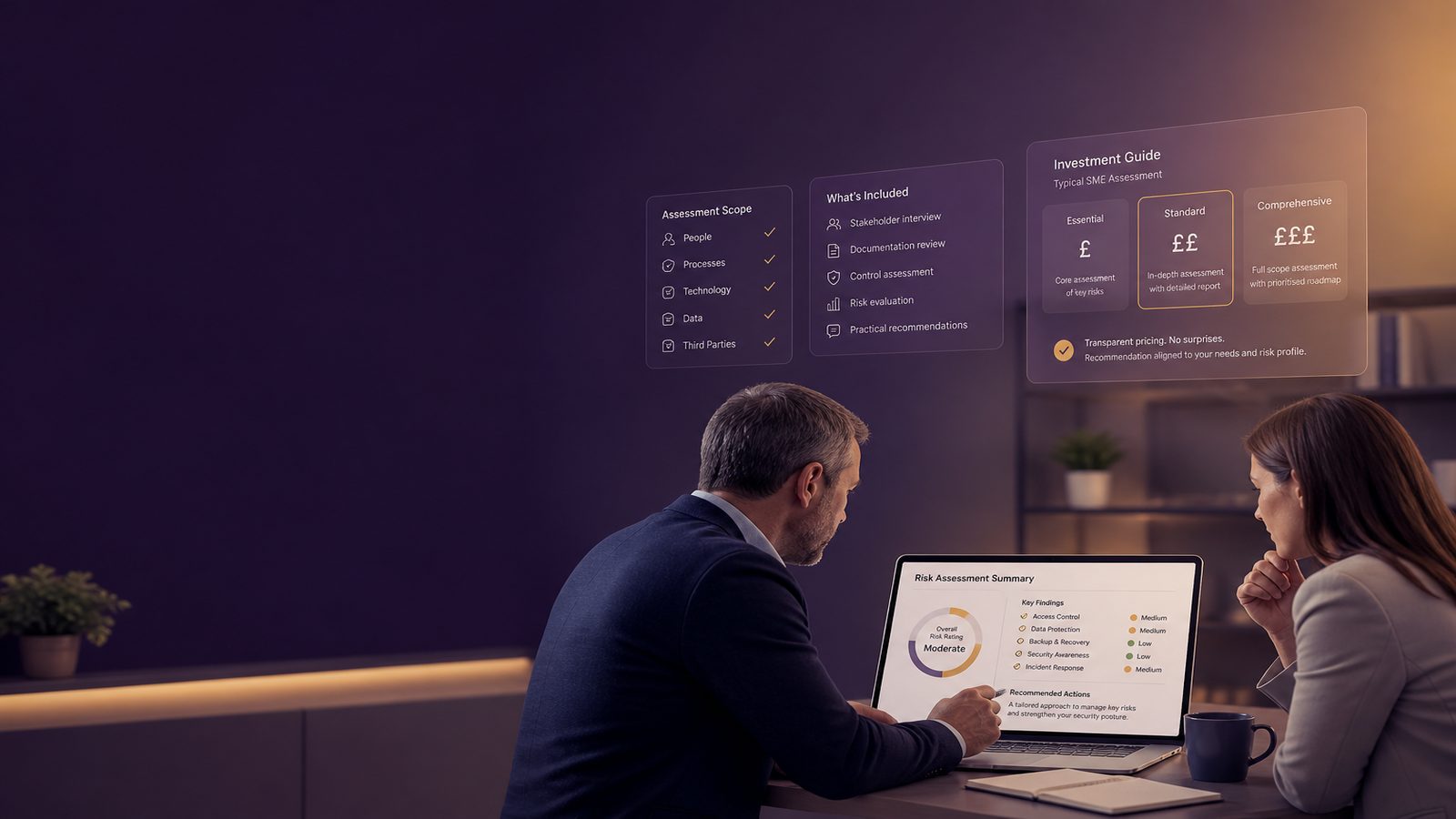
There is no single market price for a cyber security assessment in the UK. For SMEs, the cost usually ranges from a few hundred pounds for a very light review to several thousand pounds for a more useful, tailored assessment. More detailed work, especially where testing is included, can cost more again.
As a rough guide, many small businesses should expect:
- Basic review or questionnaire-led assessment: around £500 to £2,000.
- Practical SME assessment with interviews and a written report: around £2,000 to £7,500.
- Deeper assessment with technical testing or multiple sites and systems: often £7,500 to £20,000 or more.
These are broad ranges, not promises. The right price depends on how much time the consultant needs, how much evidence they must review, and how much complexity sits behind the scenes.
Fixed fee versus day rate pricing
Most SMEs will see one of two pricing models.
A fixed fee gives you a set price for a defined scope. This is often easier to budget for and works well when you know what you want checked. The risk is that the scope may be too narrow if you do not define it carefully.
A day rate means you pay for the consultant’s time. This can be useful when the scope is uncertain or when you want flexibility. It can also be harder to predict the final bill, especially if the work expands as new issues are discovered. If you want a better sense of how day rates are usually framed, our article on cyber security consultancy day rates in the UK explains the commercial side in more detail.
What changes the price for a small business
Two SMEs can ask for a “cyber security assessment” and receive very different quotes. One may only need a short review of cloud settings and user access. Another may need a full look at laptops, servers, remote working, supplier risk, and incident readiness. The more moving parts you have, the more time the assessment will take.
That is why the cheapest quote is not always the best one. A lower price may simply mean less time spent understanding your business.
The main factors that affect cost
The biggest cost drivers are usually straightforward. They are not about buzzwords. They are about time, access, and complexity.
Size, complexity, and number of systems
A business with 15 staff, one office, and a small set of cloud services is easier to assess than a business with multiple sites, remote workers, several suppliers, and a mix of old and new systems. More systems mean more questions, more evidence, and more chances for hidden risk.
Complexity also matters. If your business uses a lot of outsourced services, the assessor may need to spend time understanding who is responsible for what. If your team uses different tools for email, file storage, finance, customer management, and support, the assessment becomes broader and takes longer.
Scope, depth, and whether testing is included
Scope is the single biggest factor in cost. A narrow assessment that only checks policies and basic controls will cost less than one that also looks at technical settings, user access, backups, logging, and resilience.
If testing is included, the price usually rises. Testing takes more time and requires more care. It may involve checking whether controls are actually working rather than just whether they are written down. That extra depth can be valuable, because many businesses discover that their paperwork looks better than their real-world setup.
Some assessments also include a review against a framework or set of objectives. If that is relevant to your organisation, our guide to CAF objectives for UK SMEs may help you understand how structured assessments are often organised.
How to compare quotes fairly
When you compare suppliers, do not focus only on the headline price. Two quotes can look similar and still offer very different outcomes.
Questions to ask before you agree the scope
Before you accept a quote, ask:
- What exactly will be reviewed?
- How many meetings or workshops are included?
- Will the consultant review policies, technical settings, or both?
- Will the final output include practical recommendations?
- Will you get a prioritised action plan, or just observations?
- What information do you need to provide in advance?
- Are there any assumptions that could change the price later?
These questions help you compare like with like. They also reduce the chance of surprise costs later.
Warning signs that a quote is too vague
Be cautious if the proposal uses broad language without saying what will actually happen. A vague quote may hide a shallow review. Warning signs include:
- No clear scope or deliverables.
- No explanation of what evidence will be reviewed.
- No mention of who will be interviewed.
- No statement about exclusions.
- No indication of how findings will be prioritised.
A good supplier should be able to explain the work in plain English. If they cannot, the engagement may not be well defined.
What good value looks like for an SME
Good value is not the same as low cost. For an SME, good value means the assessment helps you make better decisions with limited time and budget.
Outputs that help you make decisions
The most useful assessments usually produce outputs that are easy to act on. Look for:
- A short executive summary for leadership.
- A longer report with enough detail for the person who will do the work.
- A prioritised list of actions.
- Clear wording on business impact, not just technical findings.
- Practical next steps that fit your size and budget.
If the report is full of technical detail but does not tell you what to do next, it may not be helping you enough.
How to avoid paying for unnecessary work
You can keep costs sensible by being clear about your goals. For example, if your immediate concern is supplier assurance, you do not need a broad review of every device in the business. If your main issue is weak access control, focus the assessment there first.
It is often better to start with a focused assessment and then expand later if needed. That approach gives you a clearer picture without paying for work that does not change your decisions.
It can also help to use a self-check before commissioning external support. Our cyber security assessment tool article may help you gather your thoughts before you ask for quotes.
How to prepare so the assessment is more efficient
Good preparation saves time and money. The more organised you are, the less time the consultant spends chasing basic information.
Information to gather before the engagement
Before the assessment starts, try to gather:
- A list of your main systems and services.
- A simple overview of how staff access those systems.
- Any existing policies or procedures.
- A list of key suppliers and outsourced services.
- Recent incidents, near misses, or concerns.
- Any previous security reviews or audits.
You do not need perfect documentation. A rough but honest picture is usually enough to begin with.
Ways to reduce wasted time and cost
Choose one person to coordinate the engagement. That avoids duplicated effort and mixed messages. Be clear about the business questions you want answered. If you are trying to reduce risk, improve customer confidence, or prepare for a bigger programme of work, say so early.
It also helps to agree the scope before the work begins. Scope creep is one of the easiest ways for costs to rise. If you keep adding systems, sites, or questions after the assessment has started, the final bill will usually grow too.
When a cheaper assessment may cost more later
A low-cost assessment can be attractive, especially for a small business. But if it is too shallow, you may end up paying twice. First for the assessment, then again for a proper review after the gaps become obvious.
Shallow reviews that miss real risk
Some low-cost reviews only ask a few questions and then produce generic advice. That can miss important issues such as weak access control, poor backup arrangements, unclear supplier responsibility, or gaps in incident response.
The danger is not just that the report is unhelpful. It is that you may believe you have reduced risk when you have not.
Why follow-up work can matter more than the headline price
Sometimes the assessment itself is only the first step. The real value comes from what you do afterwards. If the findings lead to better controls, clearer ownership, and a realistic improvement plan, the money is well spent. If the findings sit in a folder and nothing changes, even a cheap assessment has limited value.
That is why it is sensible to ask how the assessor can support next steps. In many cases, the best outcome is not a one-off report but a practical roadmap that your team can actually use.
Conclusion
So, how much does a cyber security assessment cost in the UK? For SMEs, the answer is usually somewhere between a few hundred pounds for a basic review and several thousand pounds for a more useful, tailored assessment. The right price depends on scope, complexity, and whether you want simple observations or a detailed improvement plan.
The best way to judge value is to look at the output, not just the price. A good assessment should help you understand your biggest risks, prioritise action, and spend your budget where it matters most.
If you would like help defining the right scope for your business, speak to a consultant for a practical discussion about what would be most useful for your organisation.
Frequently asked questions
What is the typical cost of a cyber security assessment?
For UK SMEs, a basic review may cost around £500 to £2,000, a practical assessment with interviews and a written report may cost around £2,000 to £7,500, and deeper work with technical testing can cost more.
How much does a NIST assessment cost?
The cost depends on how much of your business is being reviewed, how much evidence is needed, and whether the work is a light gap review or a deeper assessment against a framework. For SMEs, it is often priced in the same broad way as other cyber security assessments, but the scope should be defined carefully before you compare quotes.
Comments are closed