
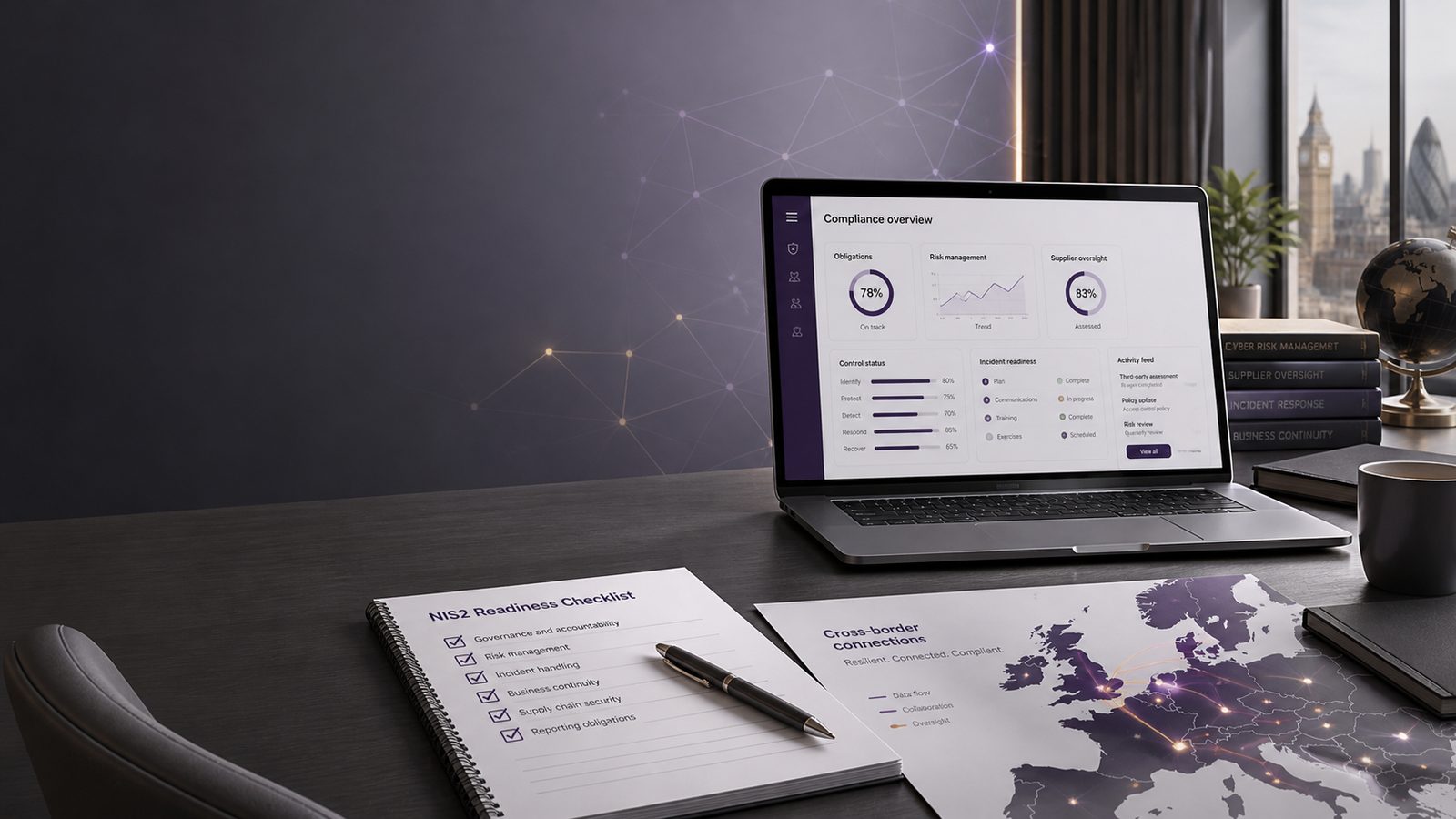
If your business sells into the EU, supports EU customers, or sits somewhere in a wider supply chain, NIS2 may matter to you even if your head office is in the UK. For many small and medium-sized businesses, the issue is not a direct legal label but the practical pressure that comes from customer contracts, supplier questionnaires, and higher expectations around security and incident handling.
That can sound abstract, but the business impact is straightforward. If you cannot show that you manage cyber risk sensibly, report incidents promptly, and keep control of third parties, you may face delays in sales, tougher contract terms, and more scrutiny from customers. In some cases, the cost is not just compliance work. It is lost revenue, extra assurance effort, and avoidable reputational damage.
Key takeaways
- NIS2 may affect UK SMEs indirectly through customer contracts, supplier requirements, and EU supply chains even when it does not apply directly.
- The most important practical areas are risk management, incident escalation, and control over third parties with access to your systems or data.
- Small businesses should focus first on basics such as multi-factor authentication, patching, backups, logging, and clear ownership of cyber risk.
- If you already use ISO 27001-style processes or the NIST Cybersecurity Framework, you may be able to reuse much of that work for NIS2-related expectations.
What NIS2 is and why UK organisations should care
NIS2 is European cyber security legislation designed to raise the standard of risk management, incident reporting, and supply chain security across a wide range of organisations. It is aimed at improving resilience in sectors that matter to the economy and society, such as digital services, transport, energy, health, and some managed service providers.
For a UK business, the important point is this: even if the legislation does not apply to you directly, your customers or partners may still expect you to behave as though it does. That is especially true if you provide services into the EU, host data for EU clients, or support an organisation that is itself in scope.
In practice, NIS2 is less about a single document and more about a set of expectations. You should be able to show that you understand your risks, have sensible controls in place, know how to escalate incidents, and manage suppliers carefully. If you already work with frameworks such as Cyber Essentials or maintain a structured security programme, you may already have some of the building blocks in place.
Does NIS2 apply to your business?
The first question is whether your organisation is directly in scope. That depends on the sector you operate in, the type of service you provide, and the country in which the in-scope entity is established. For UK-based organisations, direct applicability is often less common than indirect pressure through contracts and supply chains, but it is still worth checking carefully.
You are more likely to need to pay attention if you are one of the following:
- A supplier to an EU customer in a regulated sector
- A managed service provider, cloud service provider, or technology supplier
- A company with offices, operations, or legal entities in the EU
- A business that handles sensitive operational services for a larger regulated organisation
Even if you are not directly covered, your customer may ask you to meet certain security standards, provide evidence of controls, or support incident reporting within tight timescales. That can create obligations in practice, because failing to meet them may put the contract at risk.
A common UK scenario is a small software firm that supports an EU customer. The firm may not be regulated itself, but the customer may require stronger access control, logging, backup, supplier oversight, and incident notification terms. Another common case is a managed service provider supporting a larger business that has to demonstrate supply chain resilience. In both cases, the pressure lands on the smaller supplier.
The main obligations to understand
Risk management and security controls
NIS2 expects organisations to take a structured approach to cyber risk. In plain English, that means knowing what you need to protect, what could go wrong, and what controls reduce the chance or impact of an incident.
For a small business, this does not need to be complicated. Start with the basics:
- Keep software up to date
- Use strong access control and multi-factor authentication, which means a second check when logging in
- Back up important data and test recovery
- Log important events so you can investigate problems
- Limit who can access systems and data
- Review supplier access and contracts
The aim is not perfection. It is to show that security is managed deliberately rather than left to chance. If you want a simple way to think about this, the article on backup and recovery planning is a useful companion, because recovery capability is often what separates a manageable incident from a business-disrupting one.
Incident reporting and internal escalation
NIS2 places strong emphasis on incident reporting. The exact reporting duties depend on the organisation and the circumstances, but the practical message is clear: if something serious happens, you need to know quickly, escalate it internally, and be ready to communicate with the right people without delay.
For SMEs, the biggest weakness is often not the technology. It is the lack of a clear process. People are unsure who should be told, what counts as a serious incident, what evidence to preserve, and who is allowed to speak to customers. That uncertainty adds cost and slows response.
You should have a simple incident path that covers:
- Who receives the first alert
- Who decides whether it is serious
- Who informs leadership
- Who contacts customers or partners
- Who records the timeline and actions taken
If you have not already done so, it is worth aligning this with your wider response process. Our article on incident reporting requirements under NIS2 goes deeper into the practical side of timing, escalation, and evidence handling.
Supplier and third-party security expectations
NIS2 also pushes organisations to look beyond their own walls. That matters because many incidents start with a supplier, a contractor, or a service provider that has too much access and too little oversight.
For a UK SME, this usually means three things. First, know which suppliers can affect your operations. Second, understand what access they have. Third, make sure your contracts and onboarding process reflect the level of risk they bring.
Practical steps include:
- Keeping a list of critical suppliers
- Checking whether they use multi-factor authentication
- Asking how they report incidents
- Reviewing whether they can access your systems remotely
- Making sure contracts cover security responsibilities clearly
This is not about creating bureaucracy for its own sake. It is about reducing the chance that a supplier issue becomes your issue. If you already run supplier reviews, the article on third-party cyber risk assessments can help you structure that work in a practical way.
What good practice looks like for a small business
Policies, ownership, and basic governance
Good governance does not mean a large committee or a shelf full of documents. It means someone is clearly responsible for security, decisions are recorded, and the business knows what good looks like.
At a minimum, you should be able to answer these questions:
- Who owns cyber risk in the business?
- Who approves security priorities and budget?
- Which systems are most important to keep running?
- What would count as a serious incident?
- How do we know our controls are still working?
If the answer to any of these is unclear, that is usually where to start. A short policy set, a named owner, and a monthly review of key risks will do more for resilience than a large but unused document library.
Practical controls you can prioritise first
If you are trying to improve quickly without overcomplicating things, focus on the controls that reduce the most common business risks:
- Multi-factor authentication for email, remote access, and admin accounts
- Patch management for laptops, servers, and internet-facing systems
- Backups that are protected from accidental deletion or tampering
- Logging for key systems, especially identity and admin activity
- Least privilege, meaning people only get the access they need
- Supplier review for any partner with system access
These controls are not unique to NIS2. They are the sort of measures that also support broader resilience, reduce the chance of disruption, and make customer assurance conversations easier. If you are building from a low baseline, the article on endpoint security capabilities is a helpful way to think about protecting the devices your staff rely on every day.
How NIS2 compares with familiar UK frameworks
Where it overlaps with ISO 27001
Many UK SMEs already know about ISO 27001, which is a framework for managing information security through policies, risk assessment, controls, and continual improvement. NIS2 is not the same thing, but there is useful overlap in the way both approaches expect organisations to manage risk in a structured manner.
If you already have an information security management system, you may find that much of the groundwork is reusable. Risk registers, incident handling, supplier management, access control, and management review all help. The difference is that NIS2 tends to be more explicit about resilience and reporting expectations, especially where supply chains are concerned.
That means a business with a mature ISO 27001-aligned approach is often better placed to respond to NIS2-related customer demands. It is still important to check the details, but you are less likely to be starting from scratch.
How it relates to the NIST Cybersecurity Framework
The NIST Cybersecurity Framework is another useful reference point. It groups security work into broad functions such as identifying risk, protecting systems, detecting issues, responding to incidents, and recovering services. That structure is helpful for SMEs because it keeps the conversation focused on outcomes rather than paperwork.
If you are comparing frameworks, think of NIS2 as a set of obligations and expectations, while the NIST framework gives you a practical way to organise your work. The article on mapping NIS2 controls to ISO 27001 and NIST CSF is useful if you want to see how the ideas fit together without duplicating effort.
A simple readiness checklist for UK SMEs
You do not need a huge programme to get started. A short, honest review is often enough to show where the gaps are.
Ask your team these questions:
- Do we know whether any of our customers or suppliers expect NIS2-aligned security?
- Do we have a named person responsible for incident escalation?
- Can we identify our critical suppliers and their access to our systems?
- Are our backups tested and protected?
- Do we know which systems and data matter most to the business?
- Can we produce evidence of key controls quickly if asked?
Useful evidence usually includes policies, a list of critical suppliers, access reviews, backup test records, incident logs, and proof that security issues are discussed at management level. You do not need to create everything at once, but you should know where it lives and who owns it.
If you already keep records for other purposes, such as customer assurance or insurance, you may be closer than you think. The key is to make the evidence easy to find and consistent enough to stand up to scrutiny.
What to do next if you think NIS2 may affect you
Start by confirming your exposure. Look at your customer contracts, supplier agreements, and any services you provide into the EU. If a customer mentions NIS2, ask what they need from you in practical terms. That may include incident notification times, security controls, or evidence of supplier oversight.
Then map those expectations against what you already do. In many SMEs, the gap is not huge, but it is often undocumented or inconsistently applied. A short gap review can quickly show whether you need to improve governance, tighten access, strengthen backups, or formalise incident reporting.
If you are unsure whether the obligations apply directly, or if a customer is asking for something that is difficult to interpret, specialist advice can save time. The aim is not to over-engineer the response. It is to understand the real business impact and focus effort where it reduces risk most effectively.
For organisations that want a practical starting point, a consultant can help you assess exposure, review supplier requirements, and turn vague expectations into a manageable action plan. If that would be useful, you can speak to a consultant for advisory support.
Handled well, NIS2 is not just a compliance burden. It is a prompt to tighten the basics, improve resilience, and make your business easier to trust. For UK SMEs that work with larger customers, that can become a commercial advantage as well as a security improvement.
Frequently asked questions
Does NIS2 apply in the UK?
NIS2 is EU legislation, so it does not automatically apply to every UK business. However, UK organisations can still be affected if they supply in-scope EU customers, operate in the EU, or are asked to meet NIS2-style requirements through contracts and supply chains.
What is the UK version of NIST?
There is no single UK equivalent that matches NIST exactly. In practice, UK organisations often use a mix of frameworks and guidance, such as ISO 27001, Cyber Essentials, and sector-specific requirements, depending on their size and risk profile.
Comments are closed