
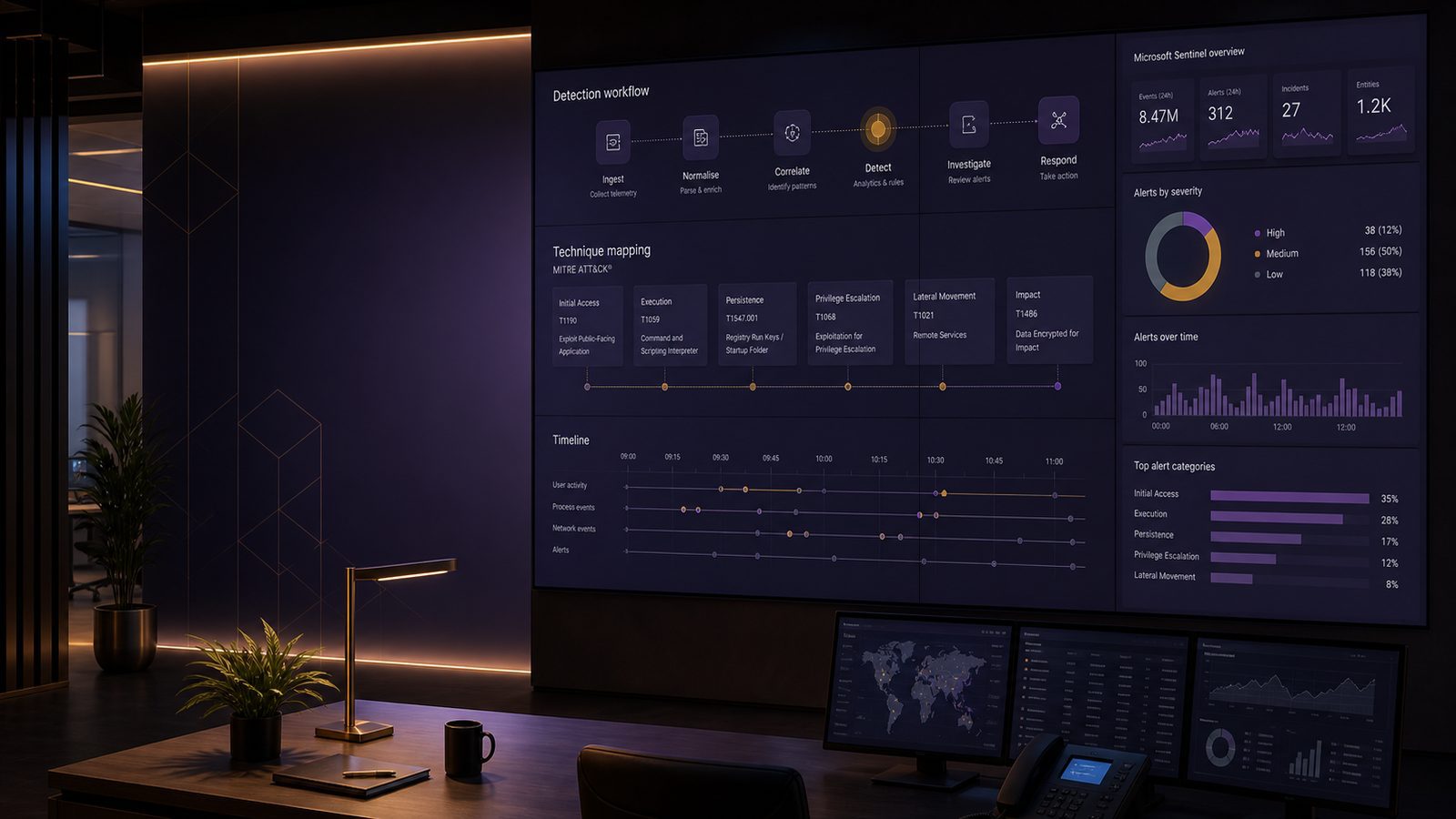
Microsoft Sentinel can do a lot of heavy lifting for a small security team, but the value comes from the quality of the detections you build, not from the platform alone. One of the most practical ways to structure that work is to start with MITRE ATT&CK techniques and turn them into analytics rules that reflect the behaviours you actually want to catch.
That sounds straightforward, but in practice many teams jump too quickly from a technique name to a query. The better approach is to define the behaviour first, confirm you have the right telemetry, and only then build the KQL. If you do that well, your Sentinel rules become easier to tune, easier to explain, and more useful for coverage reporting and incident response.
This article is aimed at technical practitioners in UK SMEs who want a repeatable way to build detections in Microsoft Sentinel without creating a noisy rule set that nobody trusts.
Key takeaways
- Start with the behaviour and the telemetry, then map the detection to MITRE ATT&CK and implement the KQL.
- Treat Sentinel analytics rules as living controls that need tuning, validation, and regular review.
- Use entity mapping, thresholds, and context to improve fidelity and reduce analyst noise.
- Measure coverage by technique, but judge success by how well the rule performs in production.
- Keep detections in version control so changes, tuning, and rollback are manageable.
Why map Sentinel analytics to MITRE ATT&CK
MITRE ATT&CK gives you a common language for adversary behaviour. In a detection engineering context, that matters because it helps you describe what a rule is intended to catch, where it sits in the attack chain, and what gaps remain in your monitoring. Instead of saying a rule detects “suspicious activity”, you can say it targets a specific technique such as credential dumping, remote service execution, or persistence through scheduled tasks.
That mapping is useful in three ways. First, it helps prioritisation. If you know which techniques are most relevant to your environment, you can focus on the behaviours that matter most to your threat model. Second, it supports coverage tracking. You can see which techniques have at least one meaningful detection and which are still blind spots. Third, it improves reporting to stakeholders, because you can explain detection capability in a structured way rather than listing disconnected alerts.
ATT&CK mapping is not the same as having a working detection. A technique can be “covered” on paper but still produce a weak or noisy rule in production. That is why the mapping should be treated as a design input, not a finish line. If you want a broader view of how technique mapping fits into a detection programme, it is worth reading our article on mapping detections and controls to MITRE ATT&CK.
Start with the right techniques and data sources
Good detections start with a sensible shortlist. For UK SMEs, that usually means selecting techniques based on likely attacker paths, not on what is easiest to query. Identity abuse, PowerShell abuse, remote execution, persistence, and credential theft are often better starting points than niche techniques that your environment barely logs.
Use your threat model to decide where to begin. If you are heavily Microsoft 365 and Entra ID based, identity-centric techniques should be high on the list. If you have Windows endpoints with Sysmon, process creation and script block telemetry can support a lot of useful detections. If you ingest firewall, proxy, or DNS logs into Sentinel, network-based techniques become more realistic. The point is to match the technique to the telemetry you can actually rely on.
Before writing a rule, identify the Sentinel tables and connectors that can support it. Common examples include SecurityEvent, WindowsEvent, DeviceProcessEvents, DeviceNetworkEvents, SigninLogs, AuditLogs, and Syslog. If the data source is missing, incomplete, or delayed, the rule may still be useful as a hunt query, but it is not ready to be treated as a production analytic.
It also helps to think in terms of telemetry quality. A technique that depends on high-fidelity process telemetry will usually perform better if you have good endpoint instrumentation. If your environment is still maturing, our article on tuning Sysmon configuration for high-fidelity process telemetry is a useful companion piece.
Design a detection before you write KQL
One of the most common mistakes is to start with a query shape rather than the behaviour. A better pattern is to define the detection in plain English first. Ask: what behaviour am I trying to identify, what evidence should exist in the logs, and what would make the alert high confidence?
A useful design template is:
- Technique: the ATT&CK technique or sub-technique you are targeting.
- Behaviour: the observable action you expect to see.
- Data source: the log table or connector that should contain the evidence.
- Scope: which hosts, users, tenants, or applications are in scope.
- Expected noise: what legitimate activity could look similar.
- Response: what the analyst should check when the alert fires.
Once you have that, decide whether the rule should be scheduled, near-real-time, or a fusion-style correlation. In Sentinel, scheduled analytics rules are often the most practical starting point because they let you query a defined lookback window and tune thresholds. Near-real-time rules are better for fast-moving behaviours where latency matters, but they can be harder to maintain if the signal is weak. If you are correlating multiple events over time, you need to be clear about the join logic and the time window, otherwise the rule will either miss the behaviour or generate too many false positives.
For teams building out a broader detection programme, our article on KQL threat hunting with Microsoft Sentinel is a good reference for query structure and investigation workflow.
Translate ATT&CK techniques into KQL logic
Once the behaviour is defined, KQL becomes the implementation layer. The best Sentinel rules usually combine a small number of precise filters with enough context to reduce ambiguity. Resist the temptation to write a broad query that simply matches a suspicious string. That approach is quick, but it rarely survives contact with production data.
For single-event detections, start with the most discriminating fields. For example, if you are looking for suspicious PowerShell activity, you might filter on process name, command line content, parent process, and account context. If you are looking for unusual authentication behaviour, you might use user principal name, IP address, device information, result codes, and geo context. The aim is to identify the behaviour with the fewest possible assumptions.
For multi-stage detections, use joins carefully. Sentinel supports KQL joins across tables, which is useful when a technique only becomes meaningful when two or more events are linked. For example, a suspicious sign-in followed by privilege changes or mailbox rule creation may be more interesting than either event alone. In those cases, define the correlation window explicitly and make sure the join keys are stable enough to avoid accidental matches.
Entity mapping is worth doing properly. Map accounts, hosts, IPs, and URLs so the incident contains useful context from the start. Good entity mapping reduces analyst effort and makes triage faster. It also helps downstream automation, because playbooks and incident enrichment work better when the entities are consistent.
Here is a simple pattern for a scheduled rule structure in KQL terms:
let lookback = 1d;
let threshold = 5;
YourTable
| where TimeGenerated > ago(lookback)
| where ConditionA and ConditionB
| summarize EventCount = count(), FirstSeen = min(TimeGenerated), LastSeen = max(TimeGenerated) by Account, Host, IP
| where EventCount >= threshold
That is not a production-ready rule, but it shows the shape you want. Define the time window, constrain the behaviour, aggregate where needed, and then threshold on something meaningful. If you need a reminder of how to structure detections more generally, our article on building SIEM detections using Sigma rules is relevant because the same discipline applies even when the final implementation is KQL rather than Sigma.
Tune for fidelity and operational noise
A rule that fires too often will be ignored, and a rule that is too narrow will miss the behaviour it was meant to catch. Tuning is therefore part of the design, not a separate clean-up task. Start by understanding the legitimate activity that resembles the attack pattern, then decide how to separate it from the malicious or risky cases.
Allowlisting can help, but it should be used carefully. If you allowlist by user, host, or application, make sure the exception is justified and reviewed. Over time, exception lists can become a hidden source of blind spots. A better pattern is to use contextual filters where possible, such as known management hosts, approved automation accounts, or specific service principals with a documented purpose.
Thresholds are another tuning lever. In some cases, a single event is enough to alert. In others, you need a burst, repetition, or a sequence of actions before the signal becomes meaningful. Be explicit about why the threshold exists. If you cannot explain it, the rule is probably too arbitrary.
It is also worth considering environment-specific baselines. A small finance team, a software business, and a manufacturing site may all use the same Microsoft stack, but their normal activity patterns will differ. Sentinel analytics should reflect that. A good rule is one that is sensitive to the behaviour, not one that assumes every tenant looks the same.
Validate the rule against realistic activity
Validation is where a lot of detection work succeeds or fails. A rule that looks good in a query editor may behave very differently when it meets live data. Test it against known benign activity first, then against controlled simulations that resemble the technique without crossing into unsafe territory.
For technical teams, purple-team exercises are especially valuable because they let defenders and testers agree on the behaviour being exercised and the expected telemetry. You do not need a full adversary emulation programme to get value here. Even a small set of safe test cases can show whether the rule triggers on the intended signal, whether the incident contains enough context, and whether the alert severity is appropriate.
Use validation to answer four questions:
- Does the rule trigger when the behaviour occurs?
- Does it avoid obvious benign activity?
- Does it create an incident with enough context for triage?
- Can an analyst understand why it fired without re-running the query?
If the answer to any of those is no, refine the rule before promoting it. Validation should also include a look at timing. Some rules are technically correct but operationally weak because they alert too late or too early for the team’s response process.
If you are building a broader validation approach, our article on measuring detection coverage against MITRE ATT&CK using DeTT&CT is useful for understanding how coverage evidence and validation fit together.
Operationalise the rule in Microsoft Sentinel
Once a rule is validated, treat it like a managed asset. Give it a clear name that includes the behaviour and the technique reference, not just a vague description. For example, a name that reflects the technique, data source, and intent is much easier to maintain than one that simply says “suspicious activity”.
Set severity based on the likely impact and confidence, not on how dramatic the technique sounds. Some ATT&CK techniques are high impact but low confidence in your environment, while others are lower impact but highly reliable indicators of compromise. The severity should reflect the operational reality of your telemetry and response capacity.
Review incident settings carefully. Decide whether the rule should create incidents automatically, how many alerts should be grouped together, and whether suppression is appropriate. If you are using automation, make sure the playbook actions are safe for the alert class. Containment actions that are appropriate for confirmed malicious activity may be too aggressive for a detection that still needs analyst confirmation.
Version control matters. Keep the KQL, rule parameters, and change notes in source control so you can track what changed and why. That makes it easier to roll back a bad change, compare tuning decisions, and support handover between team members. Detection-as-code practices are especially helpful here, and our article on building a detection-as-code pipeline with Sigma and CI/CD shows how to bring that discipline into the workflow.
Measure coverage and keep improving
ATT&CK mapping only becomes useful when it is maintained. A detection catalogue should show not just which techniques have rules, but which rules are validated, which are noisy, which are stale, and which are no longer relevant to the environment. That turns coverage mapping into an operational tool rather than a spreadsheet exercise.
Use incidents, hunts, and analyst feedback to improve the rule set. If a rule produces repeated false positives, ask whether the logic needs better context or whether the technique should be split into a more specific detection. If a hunt repeatedly finds behaviour that no rule catches, that is a sign you need a new analytic or a better data source.
Coverage should also be reviewed when the environment changes. New SaaS services, identity platform changes, endpoint tooling, and logging changes can all affect detection quality. A rule that worked well six months ago may now be blind because the underlying telemetry changed. That is why detection engineering should sit alongside logging governance and change management, not outside them.
Common mistakes when building ATT&CK-based Sentinel rules
The first common mistake is overfitting to one log source. If a rule only works because one specific field is populated in one specific connector, it may be fragile. Try to design detections that survive modest changes in telemetry format or enrichment.
The second mistake is treating ATT&CK mapping as a one-time exercise. Techniques evolve, environments change, and attackers adapt. A rule set that is not revisited will drift away from reality. Even a simple quarterly review can make a noticeable difference.
The third mistake is confusing coverage with quality. A long list of mapped techniques can look impressive, but if half the rules are noisy or untested, the coverage figure is misleading. Quality matters more than quantity.
The fourth mistake is building detections without a response path. If the analyst does not know what to check next, the alert will stall. Every production rule should have a short triage note that explains the likely intent, the key evidence, and the first few investigation steps.
When to seek support
Many UK SMEs can build a useful first wave of Sentinel analytics in-house, especially if they already have good logging and a small but capable security function. External support becomes more valuable when you have multiple data sources, a growing rule set, or a need to align detection work with a wider security programme.
You may want help if your team is struggling to choose which techniques to prioritise, if your rules are generating too much noise, or if you need a more structured way to measure coverage and maturity. Advisory support can also help when you are trying to connect detection engineering with broader governance, such as risk treatment, incident readiness, or ISO 27001-aligned improvement work.
If you would like a pragmatic review of your Sentinel detection approach, or help turning ATT&CK techniques into a maintainable rule set, speak to a consultant.
Frequently asked questions
How do I choose which MITRE ATT&CK techniques to build detections for first in Microsoft Sentinel?
Start with the techniques most relevant to your threat model and the telemetry you already collect. For most UK SMEs, identity abuse, PowerShell abuse, persistence, remote execution, and credential theft are sensible early priorities because they are common, observable, and often supported by existing Microsoft logs.
What is the difference between ATT&CK coverage mapping and a working Sentinel analytics rule?
Coverage mapping tells you that a technique has some form of detection or visibility. A working Sentinel analytics rule is a validated, tuned query that reliably triggers on the intended behaviour, produces useful incident context, and is maintainable in production.
Comments are closed