
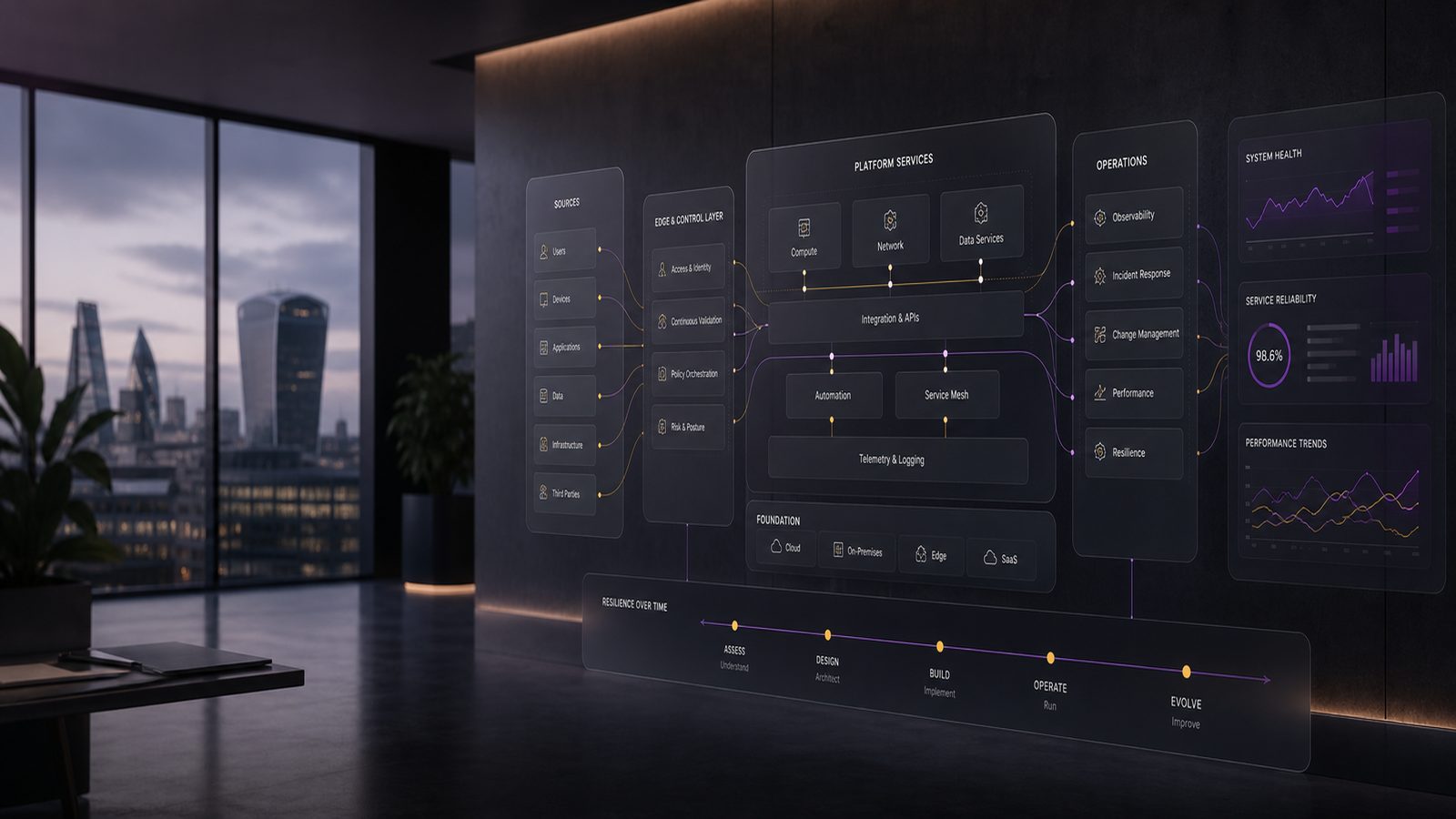
Operational security architecture for long-term sustainability
For many UK SMEs, security fails not because the business has no controls, but because the controls are hard to run. A design that looks strong on paper can still create delays, extra cost, and confusion for staff. Over time, that becomes a business risk in its own right. Systems are left unpatched, exceptions pile up, and people work around the process.
Operational security architecture is the discipline of designing security so it can be maintained, understood, and improved as the business grows. It is not only about stopping attacks. It is about making sure the organisation can keep trading, keep serving customers, and keep control of cost and effort. For an SME, that usually matters more than having the most advanced toolset.
Key takeaways
- Sustainable security architecture is designed around business operations, not just technical controls.
- Focus protection on the systems and data that would hurt most if they failed or were misused.
- Reduce complexity by removing unused access, services, and exceptions that no longer make sense.
- Build in visibility, recovery, and ownership so the team can operate security day to day.
- Review the architecture regularly because business change quickly creates new risk.
What long-term sustainable security architecture means for an SME
Sustainable security architecture is security that fits the way the business actually works. It supports daily operations instead of slowing them down. It can be maintained by the team you have, not the team you wish you had. And it keeps working when people leave, suppliers change, or the business adds new systems.
Why security needs to support day-to-day operations, not just block attacks
If a control is too awkward, staff will avoid it. If a process takes too long, the business will look for shortcuts. That is how weak habits form. A sustainable design reduces the chance of that happening by making the secure way the easy way.
This is especially important for SMEs with small teams. One person may manage user access, supplier checks, device setup, and incident handling. If each control needs specialist knowledge or constant manual effort, the whole model becomes fragile.
The business outcomes to aim for: resilience, manageable cost, and less disruption
When security architecture is working well, you should see a few clear outcomes:
- Less downtime when something goes wrong.
- Fewer urgent fixes and fire-fighting tasks.
- Lower risk of staff bypassing controls.
- More predictable spending on tools and support.
- Better confidence when taking on new customers or suppliers.
That is the real value of long-term design. It helps the business stay stable, rather than forcing the business to adapt around security.
Start with the business, not the tools
It is easy to begin with products, settings, and technical features. A better starting point is the business itself. What services make money? What would damage trust if it failed? What would create the biggest operational headache if it stopped for a day?
Security architecture should protect the parts of the business that matter most. That means understanding which systems support sales, customer service, finance, production, delivery, or regulated work. It also means knowing which systems are nice to have, but not essential.
Link security decisions to services, customers, and revenue
When you connect security to business services, decisions become clearer. For example, a customer portal that handles orders may need stronger access controls and better monitoring than an internal wiki. A payroll system may need tighter access and more careful backup handling than a shared marketing folder.
This approach also helps when budgets are tight. You can spend more where the business impact is highest and keep lighter controls where the risk is lower. That is a more realistic model for an SME than trying to protect everything equally.
Identify what would hurt most if it stopped working
A simple exercise is to ask three questions for each important system:
- What happens if it is unavailable for one hour?
- What happens if the wrong person can see or change it?
- What happens if the data is lost or corrupted?
The answers show where your architecture needs the most care. They also help you avoid spending heavily on low-value areas while leaving critical services underprotected.
Use a simple risk-based design approach
Risk-based design means you do not treat every threat as equally important. You look at what is most likely, what would cause the most harm, and what the business can realistically manage. This is a practical way to make trade-offs without guessing.
Define the main threats, likely failures, and most important assets
For most SMEs, the main concerns are not exotic attacks. They are more often things like stolen passwords, accidental data loss, supplier failure, misconfiguration, ransomware, or a system outage. These risks are common because they exploit ordinary weaknesses: too much access, poor visibility, weak recovery, or rushed change.
It helps to list your most important assets, such as customer data, finance systems, cloud accounts, and key devices. Then note the main ways each one could fail. That gives you a clear view of where architecture needs to be stronger.
Decide where to invest more protection and where to keep controls lighter
Not every system needs the same level of protection. A sensible design uses stronger controls for higher-value or higher-risk areas, and simpler controls elsewhere. For example, you may require tighter access, stronger logging, and more frequent review for finance systems, while keeping routine internal tools simpler.
This is also where good architecture avoids waste. If every system has bespoke controls, the business ends up paying for complexity that adds little value. If controls are standardised and risk-led, they are easier to support and explain.
Build in secure-by-design principles from the start
Secure-by-design means the system is built to reduce risk before it goes live. It is much cheaper to design out a problem than to bolt on a fix later. For SMEs, this is one of the most effective ways to keep security sustainable.
If you want a deeper explanation of the basics, our secure-by-design principles explained for SMEs article covers the core ideas in more detail.
Reduce attack surface by removing unnecessary access and services
Every extra account, service, port, integration, or admin route creates more to manage. It also creates more opportunities for mistakes. Reducing attack surface means removing what you do not need and turning off what is not in use.
In practice, that can mean:
- Deleting old accounts and unused integrations.
- Disabling remote access that is no longer required.
- Removing software and features that nobody uses.
- Limiting who can create new accounts or change settings.
The benefit is not only security. Fewer moving parts usually means fewer support calls and less maintenance.
Apply least privilege so people and systems only have what they need
Least privilege means giving people and systems only the access they need to do their job, and nothing more. It is one of the simplest ways to reduce damage if an account is misused or compromised.
For an SME, this often means reviewing who has administrator access, who can approve changes, and which service accounts have broad permissions. If access is granted because it is convenient, rather than because it is needed, the design will become harder to sustain.
Good access design is not about making work difficult. It is about making access deliberate, visible, and easy to review.
Design for visibility, detection, and response
Prevention matters, but it is never enough on its own. Some issues will get through. A sustainable architecture assumes that and makes sure the business can see what is happening, investigate it, and respond quickly.
For a practical view of the wider picture, see our article on centralised security visibility explained for SMEs.
Make sure important events can be seen and investigated
If you cannot see key events, you cannot manage them well. At a minimum, you should be able to tell when accounts are created, access is changed, admin actions are taken, and important systems fail. You should also know where to look when something seems wrong.
Visibility does not have to mean collecting everything. It means collecting the events that help you make decisions. Too much noise can be as unhelpful as too little data.
Plan how the business will respond when prevention is not enough
Response should be part of the architecture, not an afterthought. Ask who will decide, who will act, and what the fallback is if the main system is unavailable. If a suspicious login happens at 4pm on a Friday, the business should not be inventing the process in real time.
Simple response planning can include:
- Who can disable an account quickly.
- Who contacts suppliers or customers if a service is disrupted.
- How to isolate a device or user safely.
- How to preserve evidence for later investigation.
Make resilience part of the architecture
Resilience is what keeps the business going when something fails. That could be a cyber incident, a supplier outage, a cloud service problem, or a simple human mistake. Sustainable architecture expects failure and limits the damage.
Our backup and recovery architecture best practices for UK SMEs article goes into more detail on recovery planning.
Use backups, recovery planning, and fail-safe design to limit downtime
Backups are only useful if they can be restored when needed. Recovery planning should answer practical questions: how long can the business tolerate being down, what data can be lost, and who will restore services? These are business questions as much as technical ones.
Fail-safe design also matters. If a control fails, it should fail in a way that limits harm. For example, a system should not expose sensitive data just because one service is unavailable.
Avoid single points of failure and bottlenecks that create operational risk
Single points of failure are places where one problem can take down a whole service. Bottlenecks are points where too much depends on one person, one system, or one process. Both make security harder to sustain because they create pressure and delay.
Common examples include one administrator with all the knowledge, one internet connection, one backup location, or one approval step that nobody else can perform. Reducing these weak points makes the architecture more reliable and easier to run.
Keep communications and data flows protected
Information moves between people, devices, systems, and suppliers. If those data flows are not protected, the architecture is weaker than it looks. This is especially important when using cloud services, remote access, or third-party platforms.
For a practical overview, our secure communications over insecure networks explained for UK SMEs article covers the basics of protecting data in transit.
Use encryption and secure channels for sensitive information
Encryption means making data unreadable to anyone who should not see it. In simple terms, it protects information while it is being sent or stored. Secure channels help make sure the data is not intercepted or altered on the way.
For SMEs, the key point is not to chase technical detail for its own sake. It is to make sure sensitive information, such as customer records, credentials, and finance data, is not being sent in ways that are easy to intercept or misuse.
Treat external input carefully and validate what enters your systems
Anything coming from outside your own trusted environment should be treated carefully. That includes user input, supplier data, uploaded files, and automated feeds. If systems accept data without checking it properly, they can behave in unexpected ways.
Good architecture assumes external input may be wrong, incomplete, or malicious. Validation, filtering, and sensible limits reduce the chance of one bad input causing a wider problem. This is a design issue, not just a software issue.
Design for change, maintenance, and observability
Security architecture is not a one-time project. The business changes, suppliers change, staff change, and threats change. A sustainable design makes those changes manageable rather than risky.
If you are planning how systems should stay maintainable over time, our secure system design for maintainability and observability article is a useful companion piece.
Keep systems easy to update without creating new risk
Updates are part of normal operations. If patching or changing a system is painful, it will be delayed. That creates avoidable exposure. Good architecture makes change predictable, documented, and testable.
That usually means standard configurations, clear ownership, and a simple process for approving exceptions. The aim is not to stop change. The aim is to make change safe enough that the business can keep moving.
Use logging and monitoring to spot issues before they become incidents
Monitoring helps you notice when something is drifting away from normal. Logging helps you understand what happened. Together, they support both troubleshooting and security response.
For SMEs, the practical question is whether the team can actually use the information collected. If logs are gathered but never reviewed, or alerts are ignored because there are too many, the architecture is not sustainable. Keep it focused on the events that matter.
Governance that keeps the architecture sustainable
Even a good design will drift if nobody owns it. Governance is the part that keeps decisions clear, exceptions visible, and reviews regular. It does not need to be heavy. It does need to be consistent.
Set ownership for decisions, exceptions, and reviews
Every important control should have an owner. Someone needs to know why it exists, when it should be reviewed, and who can approve exceptions. Without ownership, controls become stale or are quietly bypassed.
It also helps to record why a decision was made. That makes it easier to revisit later when the business changes. A short note is often enough if it explains the risk and the trade-off.
Review the architecture regularly as the business, suppliers, and risks change
Regular review does not need to be a large exercise. A quarterly or six-monthly check can be enough for many SMEs. The point is to ask whether the design still fits the business.
Look for changes such as new systems, new suppliers, new remote working patterns, new customer requirements, or staff turnover. These are often the moments when architecture starts to drift away from reality.
A practical checklist for UK SMEs
Before approving a new system or major change, ask:
- What business problem are we solving?
- What data will the system hold or process?
- Who needs access, and who definitely does not?
- How will we know if it is misused or failing?
- How will we recover if it stops working?
- Who owns it after go-live?
For a quarterly review, check:
- Are there any unused accounts, services, or integrations?
- Have any exceptions become permanent?
- Are backups being tested, not just taken?
- Are logs and alerts still useful?
- Has the business changed in a way that affects risk?
- Are there any single points of failure that need attention?
Common mistakes that make security architecture harder to sustain
One common mistake is buying too many tools without a clear operating model. Tools do not create sustainability on their own. If nobody knows who will manage them, tune them, or respond to them, they become clutter.
Another mistake is designing controls that are too complex for the team to maintain. A control that only works when a specialist is available is not a good fit for most SMEs. Simpler, well-understood controls are often more effective in the long run.
A third mistake is treating architecture as a one-off project. If the business changes but the design does not, the gap between the two grows. That gap is where operational risk builds up.
Frequently asked questions
What is a long-term sustainability strategy for security architecture?
It is a way of designing security so it remains effective, affordable, and manageable as the business changes. The aim is to protect the organisation without creating processes or systems that are too hard to run. In practice, that means linking security to business priorities, reducing unnecessary complexity, and reviewing the design regularly.
How do you keep security architecture effective without making it too expensive or complex?
Start with the highest business risks and protect those first. Remove controls that do not add clear value. Standardise where you can, keep ownership clear, and make sure the team can actually operate the design. The best architecture for an SME is usually the one that balances protection with day-to-day practicality.
If you want help reviewing whether your current design is sustainable, a consultant can help you map the risks, simplify the operating model, and identify the changes that will make the biggest difference without adding unnecessary burden. Speak to a consultant.
Frequently asked questions
What is a long-term sustainability strategy for security architecture?
It is a way of designing security so it remains effective, affordable, and manageable as the business changes. The aim is to protect the organisation without creating processes or systems that are too hard to run. In practice, that means linking security to business priorities, reducing unnecessary complexity, and reviewing the design regularly.
How do you keep security architecture effective without making it too expensive or complex?
Start with the highest business risks and protect those first. Remove controls that do not add clear value. Standardise where you can, keep ownership clear, and make sure the team can actually operate the design. The best architecture for an SME is usually the one that balances protection with day-to-day practicality.
Comments are closed