
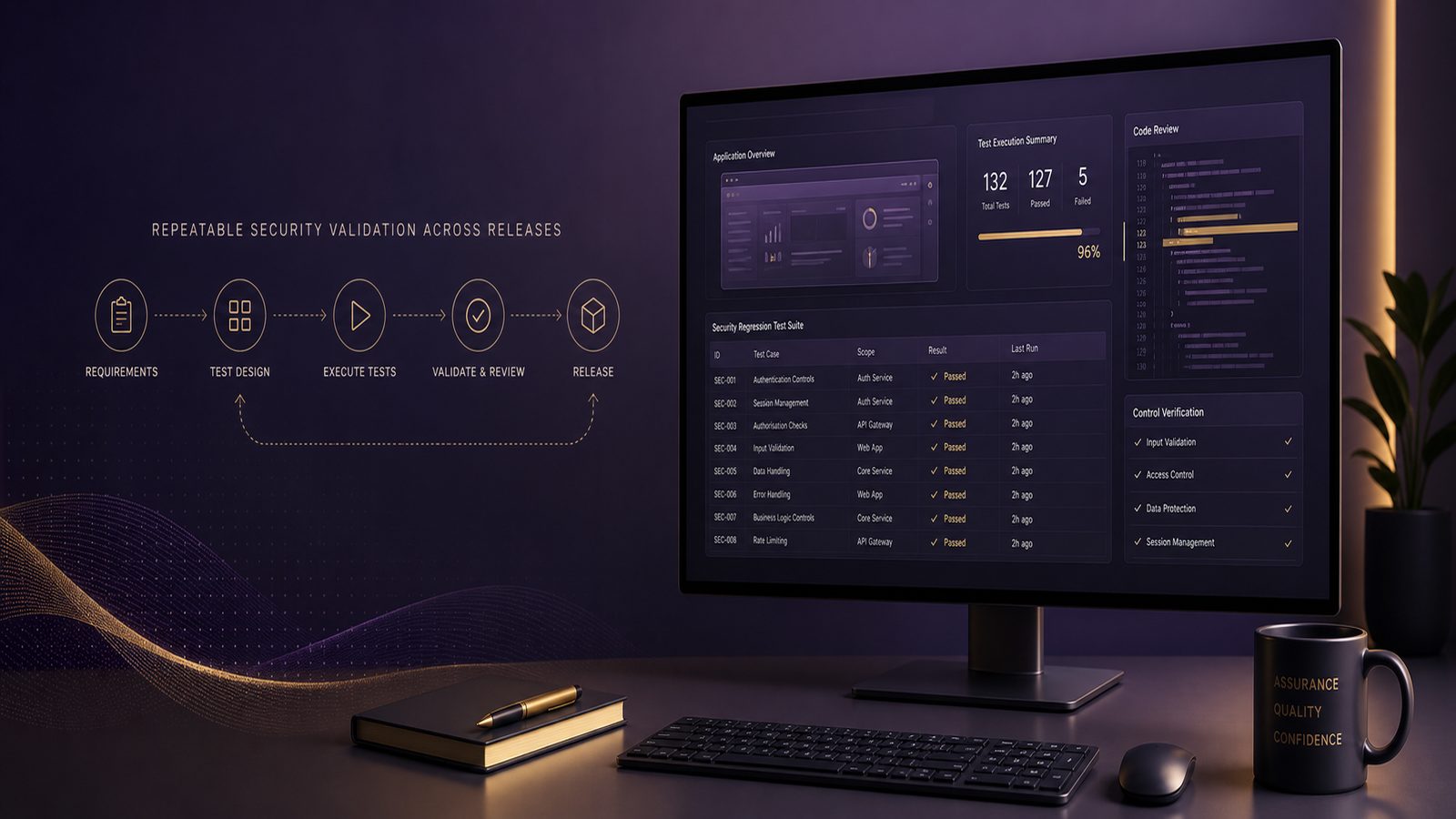
Security regression testing and abuse case testing for technical teams
Security testing is often treated as a point-in-time activity. A team runs a penetration test, fixes the findings, and moves on. That approach helps, but it does not stop the same weakness from returning in the next release, refactor, dependency update, or feature change. For technical teams, the more durable pattern is to build security regression testing and abuse case testing into the software delivery lifecycle.
In practice, this means two things. First, you repeatedly test security controls that have already failed before, or are likely to fail again. Second, you turn attacker goals and misuse paths into concrete test cases that can be run in CI/CD, in pre-release environments, or during manual validation. Done well, this gives you earlier signal, less rework, and a better chance of catching security issues before they become production incidents.
Why security regression testing belongs in the SDLC
Security regression testing is the security equivalent of functional regression testing. When a developer fixes an access control bug, changes a session library, or updates a dependency, the original issue may be gone but the underlying control can still be fragile. A later change can reintroduce the same weakness in a slightly different form.
How regressions happen after fixes, refactors, and dependency updates
Common sources of security regressions include refactoring authentication flows, changing role logic, altering API routes, introducing new front-end paths that bypass server-side checks, and updating frameworks or libraries that change default behaviour. Dependency updates are especially relevant where a package changes how it handles cookies, redirects, serialisation, or input parsing. A fix that only addresses one code path can also leave adjacent paths untested.
Security regressions are not always caused by coding mistakes. They can also arise from configuration drift, environment differences, or changes in infrastructure as code. For example, a route protected in one environment may be exposed in another because a gateway rule, header check, or RBAC mapping was not carried across consistently. Regression testing gives you a way to verify the control, not just the code.
Where security regression testing fits alongside unit, integration, and release testing
Security regression testing should sit alongside existing quality gates rather than replace them. Unit tests can validate low-level behaviour such as input validation or permission checks. Integration tests can confirm that services, identity providers, and gateways interact correctly. Release tests can verify the end-to-end behaviour of critical user journeys.
The security layer adds negative assertions. Instead of only checking that a valid user can complete a task, you also check that an unauthorised user cannot. Instead of only checking that a form accepts valid input, you also check that malformed or unexpected input is rejected safely. This is where security regression testing becomes valuable: it preserves the intent of the control over time.
What abuse case testing adds that threat modelling alone does not
Threat modelling helps you identify where things could go wrong. Abuse case testing goes one step further by turning those threats into testable scenarios. A threat model might tell you that an attacker could abuse a password reset flow, exploit a trust boundary, or manipulate business logic. An abuse case turns that into a concrete test: what happens if the user is not the account owner, if the token is reused, if the request is replayed, or if the role claim is missing?
Turning attacker goals into concrete negative test scenarios
Abuse cases are most useful when they are written from the attacker or misuse perspective. Examples include attempting to access another user’s record by changing an identifier, submitting a request with an expired session, replaying an API call, bypassing a client-side check, or using a lower-privileged role to invoke an administrative action. These are not exploit instructions. They are defensive test ideas that help you verify whether the control actually holds.
For technical teams, the value is that abuse cases are reusable. Once written, they can be mapped to automated API tests, UI tests, or manual validation steps. They also create a shared language between engineering, product, and security teams when discussing what should never be possible.
Using abuse cases to validate trust boundaries, authorisation, and business logic
Abuse case testing is especially useful for trust boundaries and authorisation logic. Many serious application issues are not about broken cryptography or missing patches. They are about the system trusting the wrong thing. Examples include trusting a client-side role flag, trusting a hidden field, trusting an unsigned token claim, or trusting that a workflow step will always be followed in order.
Business logic is another strong candidate. A system may technically authenticate and authorise users correctly, yet still allow misuse such as duplicate refunds, repeated coupon redemption, or unauthorised state transitions. Abuse case testing helps you focus on what the business process should prevent, not just what the framework already enforces.
Building a practical security regression test strategy
Not every security control needs a regression test on every build. The goal is to focus on high-value controls that are both important and likely to drift. A practical strategy starts with the controls that protect your most sensitive data, your highest-risk workflows, and your externally exposed interfaces.
Selecting high-value controls to test repeatedly, such as authentication, session handling, input handling, and access control
For most SMEs, the first candidates are authentication, session handling, input handling, access control, and workflow state transitions. These are the controls most likely to fail in ways that matter. If your application has APIs, also include object-level authorisation, function-level authorisation, and token validation. If you use single sign-on, include assertions around identity mapping, session expiry, logout behaviour, and privilege changes.
It is usually worth testing controls that have already failed in production or in a previous assessment. If a defect has happened once, it is a strong signal that the surrounding area deserves a permanent regression check. The same applies to controls that are hard to inspect manually, such as asynchronous authorisation checks or background jobs that act on behalf of a user.
Prioritising tests by risk, change frequency, and exploitability
A useful prioritisation model combines three factors: business risk, change frequency, and exploitability. A control protecting payment flows or customer data is higher priority than one protecting a low-value internal feature. A control in a frequently changed service is more likely to regress than one in a stable component. A weakness that can be triggered remotely and cheaply should be tested before a weakness that requires privileged access or unusual conditions.
This is a pragmatic way to avoid overbuilding the suite. Start with the controls that would hurt most if they failed, then expand as the product matures. You do not need hundreds of tests to get value. You need a small number of reliable checks that cover the most important failure modes.
Designing abuse cases from threat models and incident history
Threat models are a good source of abuse cases, but they are not the only one. In many organisations, the best test ideas come from previous defects, pentest findings, support tickets, and production incidents. Those sources show you where the system has already been brittle.
Mapping STRIDE-style threats to application behaviours and misuse paths
STRIDE is useful here because it gives structure to abuse case creation. Spoofing maps to identity and session misuse. Tampering maps to request manipulation and state changes. Repudiation maps to missing auditability or weak traceability. Information disclosure maps to over-broad responses, insecure object references, or data leakage. Denial of service maps to resource exhaustion or expensive operations. Elevation of privilege maps to role bypass and authorisation failures.
For each threat, ask what the concrete misuse path looks like in your application. What request, workflow, or API call would an attacker try to influence? What trust assumption would they try to break? What should the system do instead? This produces abuse cases that are specific enough to test and maintain.
Using past defects, pentest findings, and production incidents to create reusable abuse cases
Past defects are often the best source of regression tests because they are already proven to be realistic. If a previous issue involved a missing server-side check, a stale permission cache, or a workflow that could be skipped, convert that into a permanent test. Pentest findings can be treated the same way, provided they are translated into repeatable checks rather than one-off observations.
Production incidents are also valuable. If a customer support case revealed that users could see data they should not have seen, or that a workflow could be completed out of sequence, that is a strong candidate for an abuse case. The aim is not to recreate the incident in detail. It is to capture the control failure in a form that can be rerun after every relevant change.
Implementing tests in CI/CD without creating noise
Security regression testing only works if the pipeline remains trusted. If checks are too slow, too flaky, or too broad, teams will ignore them. The implementation challenge is to choose the right mix of automation and manual validation, and to run each test at the right point in the delivery process.
Choosing the right mix of automated checks, scripted API tests, and manual exploratory validation
Automated checks are best for deterministic assertions. Examples include verifying that a user without the right role receives a 403 response, that a session expires after logout, or that a known bad input is rejected. API-level tests are often more stable than UI tests because they avoid front-end timing issues and focus on the control itself.
Manual exploratory validation still has a place, especially for complex business logic, multi-step workflows, and controls that depend on human judgement. A good pattern is to automate the stable checks and reserve manual effort for the areas where the system behaviour is nuanced or where the risk is high but the test signal is hard to codify.
Managing test data, environment isolation, and pipeline gating for security checks
Security tests need realistic but safe test data. Use dedicated accounts, seeded roles, and isolated environments where possible. Avoid running destructive abuse cases against shared environments unless the test is explicitly designed for that purpose and the blast radius is understood. If a test manipulates state, reset it cleanly so later tests are not affected.
Pipeline gating should be selective. Not every security test needs to block every merge. A common pattern is to gate on fast, reliable checks in pull requests, then run broader security regression suites in staging or pre-release environments. If a test is flaky, fix the test before making it a gate. Otherwise you create alert fatigue and weaken confidence in the whole process.
Tooling and test patterns for technical teams
The right tools depend on your stack, but the underlying patterns are similar. You want repeatable checks that can be version-controlled, reviewed, and tied to specific controls.
Using Burp Suite, Playwright, Postman, pytest, or similar tooling for repeatable security checks
Burp Suite is useful for manual validation and for building repeatable HTTP-based checks where you need to inspect requests and responses closely. Playwright can be effective for end-to-end browser flows where the security control is visible in the UI but enforced server-side. Postman collections can work well for API regression suites, particularly when paired with environment variables and pre-request scripts. pytest, JUnit, or similar test frameworks are useful when your security assertions live close to service code or API integration tests.
The tool matters less than the pattern. Keep the test case readable, name it after the control it protects, and make the expected failure mode explicit. For example, a test should say that a user with role A cannot perform action B on object C. That makes the intent obvious when the test fails six months later.
Adding API-level assertions, negative test cases, and role-based access checks to existing test suites
One of the easiest ways to start is to extend existing functional tests with negative assertions. If you already test that a customer can view their own invoice, add a test that another customer cannot. If you already test that an admin can approve a request, add a test that a standard user cannot. If you already test a successful API call, add the same call with an expired token, missing scope, or altered object identifier.
Role-based access checks are especially effective when they are centralised. If your application has a matrix of roles and permissions, encode that matrix in a test fixture or helper so the suite can iterate through the expected outcomes. This reduces duplication and makes it easier to update tests when the authorisation model changes.
Measuring coverage and maintaining the suite over time
Coverage is not just the number of tests. A large suite can still miss the controls that matter most. Better metrics focus on what the tests protect and how well they map to the current architecture.
Tracking coverage by control, risk area, and application component rather than raw test count
Track coverage by control area, such as authentication, session management, object-level authorisation, business logic, and input handling. Also track it by application component, such as web front end, API gateway, identity integration, background jobs, and admin functions. This gives you a clearer view of where the suite is strong and where there are gaps.
It is also useful to tag tests by risk area or threat type. That makes it easier to answer questions such as whether you have enough coverage for privilege escalation, data exposure, or workflow abuse. Raw test count can be misleading because ten weak tests are less useful than three well-targeted ones.
Retiring brittle tests and updating abuse cases after architecture or feature changes
Security regression suites need maintenance. When architecture changes, some tests will become obsolete and others will need to be rewritten. A brittle test that fails for environmental reasons or UI timing issues should be fixed or removed. Otherwise it becomes background noise and people stop trusting the suite.
Update abuse cases whenever the product changes in a way that affects trust boundaries, roles, or workflows. New features often introduce new paths that bypass old assumptions. If a feature adds a new API, a new tenant model, or a new approval step, revisit the abuse cases around it. Treat the suite as a living artefact, not a one-time project.
Common failure modes and how to avoid them
There are a few patterns that regularly reduce the value of security regression testing. The first is relying too heavily on one-off penetration tests. Pen tests are useful, but they do not provide continuous assurance. The second is writing tests that only cover happy paths. If a test only proves that the system works when everything is correct, it is not a security regression test.
Another common issue is trying to automate everything too early. Some controls are better validated manually first, then automated once the expected behaviour is understood. A final issue is poor ownership. If no one owns the suite, it will drift. Assign responsibility for maintaining the tests, reviewing failures, and updating abuse cases after major changes.
For UK SMEs, the practical goal is not to build a perfect security lab. It is to make sure the software delivery process keeps checking the controls that matter most. Security regression testing and abuse case testing give you a repeatable way to do that. They help engineering teams catch control failures earlier, reduce the chance of reintroducing known issues, and build more confidence into each release.
If you want help shaping a practical approach for your development team, including how to align testing with your risk profile and delivery process, speak to a consultant.
FAQ
How is security regression testing different from penetration testing?
Penetration testing is usually a point-in-time assessment that looks for weaknesses across a system at a given moment. Security regression testing is repeatable and ongoing. It checks that known controls still work after code changes, dependency updates, or configuration changes. The two complement each other, but they are not the same thing.
What is the best way to turn a threat model into abuse cases and repeatable tests?
Start with the threat, identify the trust boundary or workflow it affects, and define the misuse path in application terms. Then write a negative test that proves the system rejects that misuse. If the test is stable and valuable, automate it. If the behaviour is complex or still evolving, keep it as a manual abuse case until the control is well understood.
For teams building or improving an ISO 27001-aligned ISMS, these tests can also support evidence of ongoing control verification, provided they are managed as part of your normal engineering and assurance process.
Comments are closed