
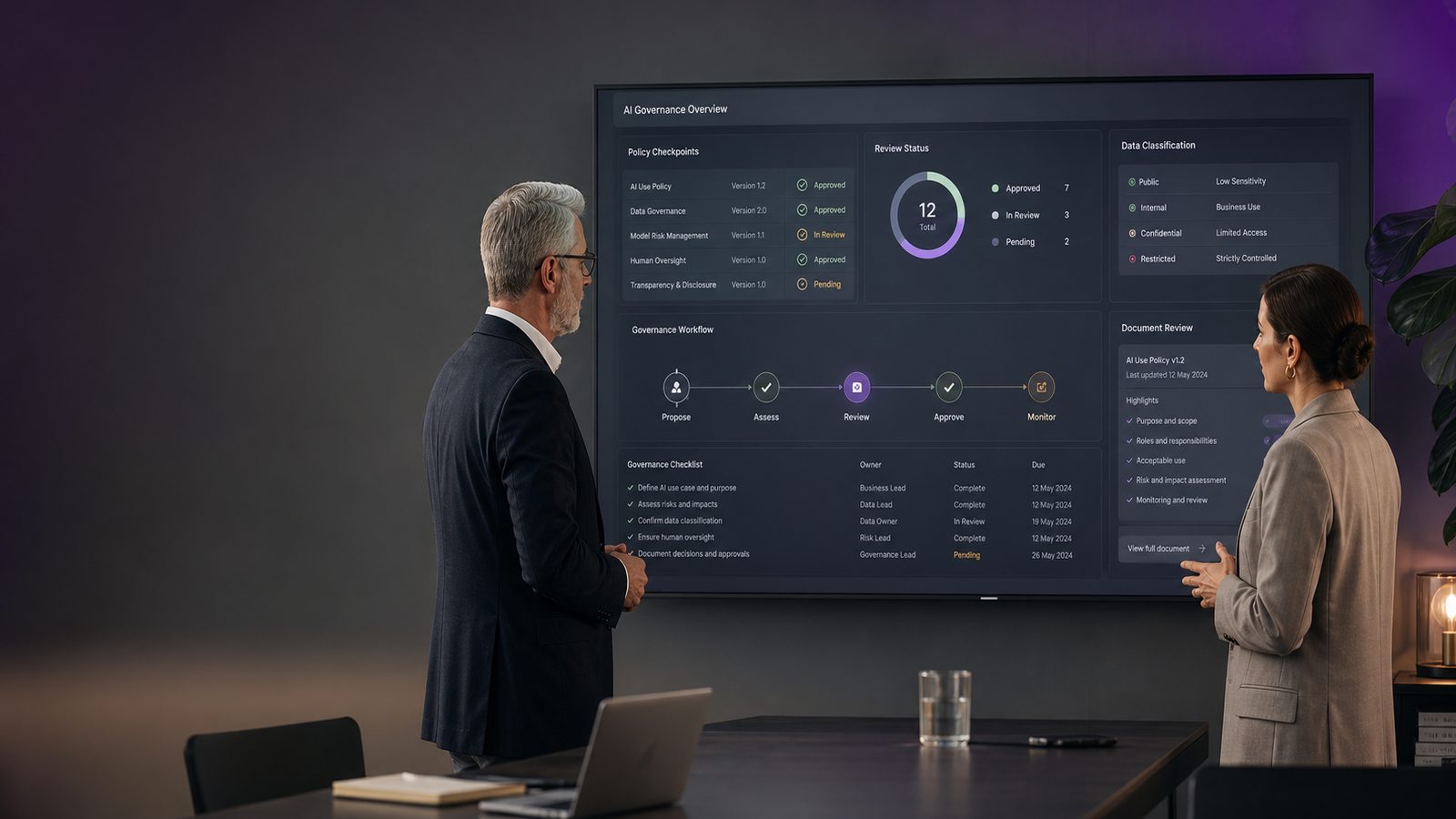
Responsible AI governance for SMEs: a practical guide for UK businesses
AI tools can save time, improve customer service, and help teams work faster. They can also create avoidable business risk if nobody is clearly responsible for how they are used. For many SMEs, the issue is not whether to use AI, but how to use it in a way that protects customers, staff, data, and reputation.
Responsible AI governance for SMEs is simply the set of rules, roles, checks, and reviews that make AI use safe enough for the business. It does not need to be heavy or complicated. In most small organisations, the right approach is practical, proportionate, and tied to everyday business decisions.
The aim is to avoid three common problems: staff using tools without approval, important decisions being made on unreliable outputs, and sensitive information being shared with a supplier without enough thought. Those mistakes can lead to poor service, wasted time, customer complaints, and loss of trust.
What responsible AI governance means in plain English
Why governance matters before you buy or build AI
Governance means deciding who can use AI, for what purpose, with what checks, and under what limits. It applies whether you are buying a ready-made tool, using a public chatbot, or building something more tailored for your business.
Without governance, AI use often grows informally. One team starts using a tool for drafting emails. Another uses it to summarise customer notes. Someone else pastes in a spreadsheet to save time. None of that is unusual, but it becomes a problem when nobody has considered the data involved, the quality of the output, or what happens if the tool gives the wrong answer.
How governance reduces business risk, cost, and reputational harm
Good governance helps you avoid expensive rework and awkward surprises. It reduces the chance of:
- staff acting on incorrect AI output
- customer or employee data being shared too widely
- unapproved tools creating hidden supplier risk
- inconsistent use across teams
- damage to trust if an AI-assisted decision goes wrong
For SMEs, the value is usually not in building a large control framework. It is in putting a few sensible guardrails around the tools people already want to use.
The main risks SMEs need to manage
Poor decisions, biased outputs, and staff overreliance on AI
AI output can sound confident even when it is wrong. That matters if staff use it to draft customer advice, screen job applicants, assess risk, or make operational decisions. If people trust the output too much, mistakes can spread quickly.
Bias is another concern. If a tool is used to support decisions about people, it may reflect patterns in its training data or the way it has been set up. That can lead to unfair or inconsistent outcomes. Even where the business does not intend to make automated decisions, the appearance of unfairness can still harm reputation.
Data leakage, supplier dependence, and weak oversight
Many AI tools rely on external suppliers. That means your business may depend on how the supplier stores data, trains models, handles access, and responds to incidents. If those points are unclear, the business may be taking on more risk than it realises.
Data leakage is also a practical concern. Staff may paste confidential information into a tool because it is convenient. That can include customer details, internal plans, pricing, or HR information. Once shared, you may not be able to control how that information is stored or reused.
Weak oversight creates a further issue. If nobody reviews how AI is being used, the business may not notice unsafe behaviour until there is a complaint, a mistake, or a security incident.
Set clear ownership and decision-making
Who should be accountable in a small business
In a small business, governance should not be left to chance. One person should be accountable for AI oversight, even if they are not the only person involved. That person is usually a senior manager, operations lead, or business owner.
The accountable person should make sure the business knows:
- which AI tools are approved
- what they can be used for
- what data must never be entered
- who reviews higher-risk use cases
- how issues are reported and acted on
If the business already has someone responsible for information security, data protection, or supplier management, AI governance should sit alongside those responsibilities rather than in a separate silo.
What to do if you do not have a dedicated security or data team
Most SMEs do not have specialist teams. That is fine. The answer is not to create bureaucracy. It is to assign simple responsibilities.
A practical model is:
- one senior owner for overall accountability
- one operational lead to manage approved tools and user requests
- one person to review privacy, security, and supplier questions before new tools are introduced
If the same person holds more than one role, that is acceptable in a small business. The important point is that the responsibilities are visible and documented.
Create a simple AI use policy
What staff should and should not use AI for
A short policy is often enough to start with. It should explain the approved uses of AI in plain language. For example, staff may be allowed to use AI to draft internal notes, summarise public information, or help with brainstorming. They may not be allowed to use it to make final decisions without review.
The policy should also state where AI must not be used, such as:
- final decisions about customers, employees, or applicants without human review
- anything that would expose the business to legal, financial, or safety risk if wrong
- tasks involving highly confidential information unless the tool has been approved
Keep the language practical. Staff should be able to read the policy and understand what to do on a normal working day.
How to handle customer, staff, and confidential data
One of the most important parts of the policy is data handling. Make it clear what types of information are prohibited or restricted. A useful approach is to divide data into simple categories:
- public information
- internal business information
- confidential information
- highly sensitive information, such as personal data, financial data, or HR records
Then define what can be entered into AI tools for each category. If the answer is not clear, default to caution. Staff should know that convenience is not a good reason to share sensitive information with an unapproved tool.
Check AI tools before you adopt them
Questions to ask suppliers about data use, access, and retention
Before approving a tool, ask simple questions about how it works and how the supplier handles your data. You do not need a long questionnaire to start with. Focus on the basics:
- What data does the tool collect?
- Is our data used to train the model?
- Who can access our data at the supplier?
- How long is data kept?
- Can we delete data when we stop using the tool?
- Where is the data stored?
- What happens if the supplier has a security incident?
If the supplier cannot answer these questions clearly, that is a warning sign. A tool that looks useful may still be unsuitable if the business cannot understand how its data is handled.
How to assess whether the tool is suitable for the business
Suitability is not only about features. It is about fit. Ask whether the tool matches the business need, the sensitivity of the data, and the level of risk involved.
For low-risk tasks, a simple tool may be fine. For higher-risk tasks, the business may need stronger controls, clearer supplier terms, and more human review. If the tool affects customers, staff, or regulated information, it should go through a more careful check before use.
A good rule is this: the more important the decision, the less the business should rely on AI alone.
Build basic controls around everyday use
Human review for important decisions
AI should support people, not replace judgement where the outcome matters. Important work should always have human review before action is taken. That includes customer-facing messages, hiring decisions, financial decisions, and anything that could create legal or reputational harm if wrong.
Human review does not need to be slow. It simply means someone checks whether the output is sensible, complete, and appropriate before it is used.
Logging, access control, and regular testing of outputs
Basic records help the business understand how AI is being used. You do not need a complex monitoring platform to start. Keep a simple record of:
- which tools are approved
- who can use them
- what they are used for
- any incidents or concerns
Access control matters too. Not every employee needs access to every tool. Limit access where possible, especially for tools that can handle sensitive information or affect important decisions.
It is also sensible to test outputs from time to time. Ask a few staff members to check whether the tool is still producing useful, accurate, and appropriate results. If quality drops or the business use changes, review the setup.
Train staff to use AI safely and sensibly
Practical examples of safe and unsafe use
Training works best when it is specific. Give staff examples they can relate to.
Safe use might include:
- drafting a first version of a marketing email for review
- summarising a public report
- creating a checklist from internal notes
Unsafe use might include:
- pasting customer records into an unapproved tool
- using AI output as the final answer for a complaint response without checking it
- relying on AI to make a decision about a person without human review
The goal is not to stop people using AI. It is to help them use it with judgement.
How to reduce shadow AI use across the business
Shadow AI means staff using tools without approval or oversight. It usually happens because people are trying to save time, not because they want to create risk.
You reduce shadow use by making the approved route easy to follow. That means:
- providing a short approved tools list
- explaining what data must not be shared
- making it clear who can approve new tools
- offering a safe way for staff to ask questions
If the approved process is too slow, staff will work around it. Simplicity is a control in itself.
Review and improve governance over time
What to monitor each quarter
AI governance should be reviewed regularly, but not obsessively. A quarterly check is often enough for an SME. Review:
- which tools are in use
- whether any new use cases have appeared
- any incidents, complaints, or near misses
- whether staff training needs refreshing
- whether supplier terms or data handling have changed
This gives the business a chance to catch problems early and keep the approach proportionate.
When to update policies after a new tool, incident, or business change
Update your policy when something meaningful changes. That might be a new supplier, a new use case, a change in the type of data being processed, or an incident that shows the current controls are not enough.
Do not wait for a major problem before making improvements. Small updates made early are usually cheaper and easier than a rushed fix after something has gone wrong.
A simple starter checklist for SMEs
Five actions to complete in the next 30 days
If you are starting from scratch, focus on the basics:
- Nominate one person to be accountable for AI governance.
- List the AI tools already in use across the business.
- Write a short policy covering approved use, prohibited use, and data handling.
- Check the main suppliers for data use, retention, and access arrangements.
- Brief staff on safe use and make it easy to ask questions.
How to keep the approach proportionate as AI use grows
As your use of AI grows, keep the controls aligned to the risk. A small business does not need a large governance programme on day one. It needs a sensible starting point, clear ownership, and a habit of review.
If you are unsure where to start, or if AI is already being used in ways that are hard to track, it may help to get outside advice. The right support can help you set practical controls without slowing the business down.
Speak to a consultant if you would like help turning this into a simple, workable approach for your organisation.
Frequently asked questions
Do small businesses really need an AI governance policy?
Yes, if AI is being used in the business at all. A policy does not need to be long or formal, but it should explain who can use AI, what it can be used for, what data must not be shared, and when human review is required. That helps reduce mistakes and keeps use consistent.
What is the simplest way to start governing AI use in an SME?
Start with one accountable owner, a list of approved tools, and a short policy for staff. Then check the main suppliers, brief the team, and review the position every quarter. That is usually enough to create a sensible baseline without adding unnecessary overhead.
Comments are closed