
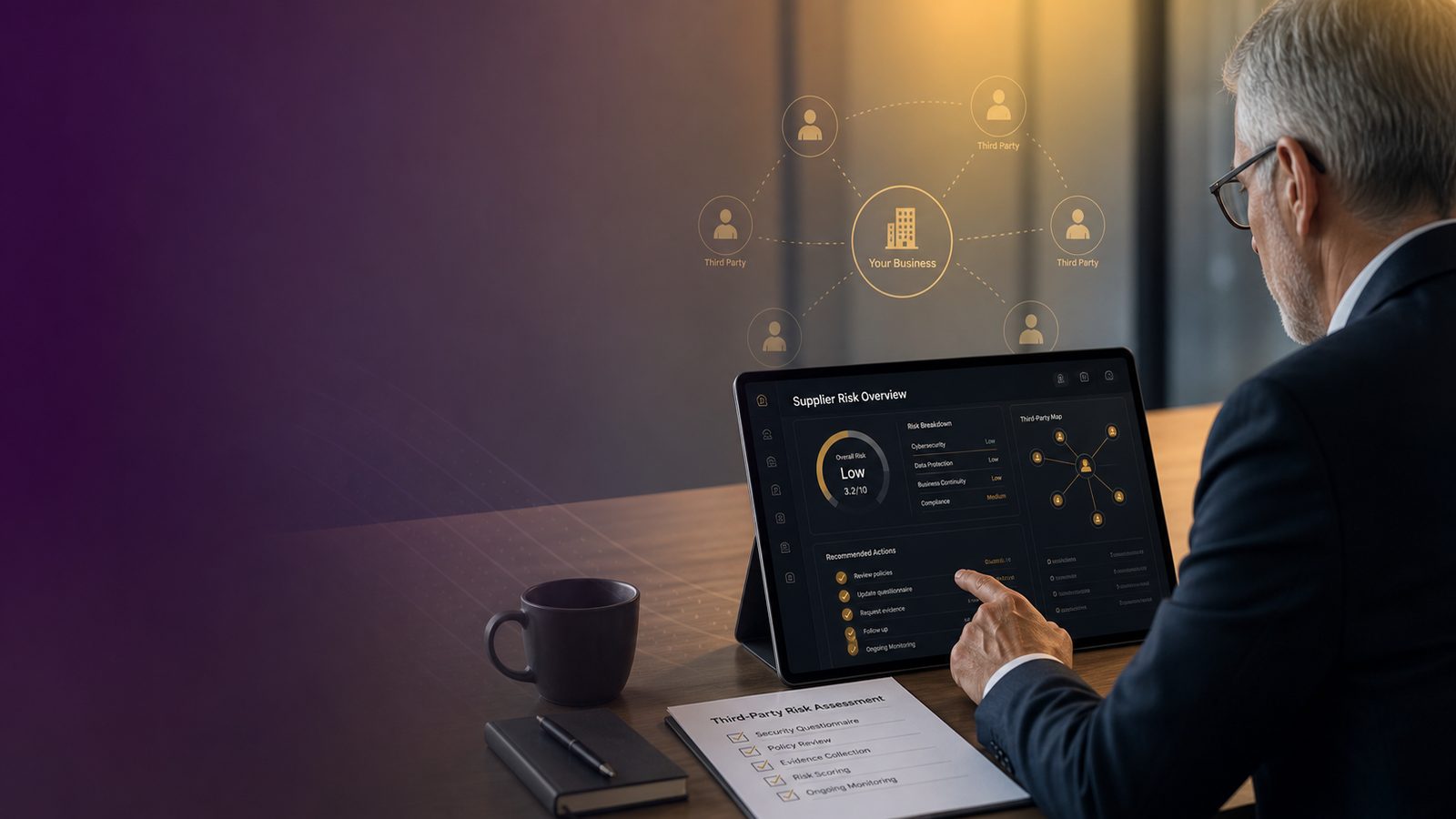
Third-party cyber risk assessments for SMEs: a practical guide for UK businesses
For many small and medium-sized businesses, the biggest cyber risk is not always inside the office. It often sits with the companies you rely on every day. That might be your payroll provider, IT support firm, cloud storage service, or outsourced accountant.
If one of those suppliers has weak security, your business can feel the impact quickly. Data can be exposed, systems can go offline, payments can be delayed, and customers may lose confidence. For an SME, that can mean lost revenue, extra costs, and time spent dealing with disruption instead of running the business.
That is why third-party cyber risk assessments matter. Done well, they help you focus on the suppliers that could genuinely affect your operations, reputation, and data. Done badly, they become a paperwork exercise that wastes time and still leaves gaps.
This guide explains how to assess third-party cyber risk in a practical way, without needing a technical background.
What third-party cyber risk means in plain English
Third-party cyber risk is the risk that a supplier, contractor, or service provider could create a security problem for your business. That problem might come from poor controls, a mistake, a cyber incident at their end, or the way they handle your information.
You do not need to be a cyber specialist to understand the basic issue. If another organisation can access your data, connect to your systems, or affect your ability to operate, their security matters to you.
Why suppliers, contractors, and service providers can affect your business risk
Suppliers often have more access than business owners realise. They may hold customer records, process payments, manage email, maintain systems, or support remote access. If that access is not controlled properly, the supplier becomes part of your risk picture.
The business impact can include:
- Loss of customer or staff data
- Service downtime
- Fraud or unauthorised payments
- Contract disputes and extra recovery costs
- Damage to trust and reputation
Common examples for UK SMEs, such as payroll, IT support, and cloud services
Typical third parties that deserve attention include:
- Payroll providers handling staff data and bank details
- IT support firms with remote access to your systems
- Cloud services storing files, email, or customer information
- Accountants and bookkeepers processing financial records
- Marketing agencies using customer contact lists
- Software suppliers that connect to your business systems
Not every supplier needs the same level of checking. A local printer is not the same as a cloud provider storing sensitive data. The key is to match the depth of assessment to the risk.
Which third parties matter most
Most SMEs do not have the time to assess every supplier in detail. That is fine. The goal is not to inspect everyone equally. The goal is to focus on the suppliers that could cause the most harm if something went wrong.
How to group suppliers by business impact and access to data
A simple way to group suppliers is by two questions:
- How much would it hurt the business if this supplier failed or was compromised?
- What access does the supplier have to your data, systems, or money?
Using those questions, you can split suppliers into three broad groups:
- High risk: suppliers with access to sensitive data, business-critical systems, or payment processes
- Medium risk: suppliers that handle some business information but do not control core operations
- Low risk: suppliers with little or no access to sensitive information or systems
A simple way to decide where to focus first
If you are starting from scratch, begin with the suppliers that:
- Hold personal data, financial data, or confidential business information
- Can log into your systems or connect remotely
- Support essential services such as email, payroll, finance, or customer systems
- Would be difficult to replace quickly if they failed
This approach keeps the work manageable. It also helps you spend time where it matters most, rather than creating a long list of low-value checks.
What to check before you rely on a supplier
Before you place trust in a supplier, ask a few straightforward questions. You are trying to understand whether they can protect your information, keep services running, and tell you quickly if something goes wrong.
Questions about data handling, access, backups, and incident reporting
Useful questions include:
- What information will you hold or process for us?
- Who in your organisation can access it?
- How do you protect it when it is stored and when it is sent between systems?
- Do you make regular backups, and how quickly can services be restored?
- How do you manage staff access, especially when people leave or change roles?
- How will you tell us if you suffer a cyber incident that affects our data or services?
- Do you use subcontractors, and if so, how are they checked?
These questions are useful because they focus on practical risk, not technical detail for its own sake.
How to spot warning signs without needing technical expertise
You do not need to be a specialist to notice warning signs. Be cautious if a supplier:
- Cannot explain how they protect your data in simple terms
- Refuses to answer basic questions about access or incident reporting
- Has no clear contact point for security issues
- Wants broad access without a clear business reason
- Cannot show any evidence of basic security practices
A supplier does not need to be perfect, but they should be able to explain their approach clearly and provide reasonable evidence.
How to assess risk without overcomplicating it
For SMEs, a lightweight assessment is usually enough. You do not need a complex scoring model. You need a consistent way to decide whether the risk is acceptable and what action to take.
A lightweight approach using impact, likelihood, and control strength
Consider three things:
- Impact: how bad would the outcome be if the supplier failed or was compromised?
- Likelihood: how likely is a problem, based on what you know?
- Control strength: how strong are the supplier’s protections and your own safeguards?
For example, a supplier holding customer data and providing remote support would usually deserve a closer look than a supplier sending occasional invoices.
You can keep the assessment simple by using categories such as low, medium, and high. The important thing is to apply the same approach each time so decisions are consistent.
How to record decisions so they are easy to explain later
Keep a short record for each important supplier. Include:
- What service they provide
- What data or access they have
- Why they were classed as low, medium, or high risk
- What evidence you reviewed
- What action was taken
- When the supplier will be reviewed again
This record is useful for internal decision-making and for showing that you have taken a sensible, proportionate approach. It also helps if staff change and someone new needs to understand why a supplier was approved.
What good evidence looks like
Evidence does not need to be complicated. You are looking for enough information to support a sensible decision, not a mountain of documents.
Examples of useful documents and answers from suppliers
Useful evidence may include:
- A completed supplier questionnaire
- A summary of the supplier’s security controls
- Policies covering access, incident reporting, and data handling
- Evidence of staff training or access control processes
- Details of backup and recovery arrangements
- Independent assurance reports, where appropriate
Sometimes a clear written answer is enough, especially for lower-risk suppliers. For higher-risk suppliers, you may want more detail and supporting documents.
When a questionnaire is enough and when you may need more assurance
A questionnaire can be enough when the supplier has limited access, the service is not business-critical, and the data involved is low sensitivity.
You may need more assurance when the supplier:
- Handles sensitive or personal data
- Has privileged access to your systems
- Supports a critical business function
- Would be hard to replace quickly
In those cases, ask for stronger evidence and consider whether extra protections are needed before you proceed.
How to reduce risk when a supplier falls short
Not every supplier will meet your preferred standard straight away. That does not always mean you must stop using them. It means you need to decide how to manage the gap.
Practical options such as limiting access, adding contract terms, or increasing monitoring
Common ways to reduce risk include:
- Limiting the data the supplier can see
- Giving access only to the people who need it
- Removing remote access where it is not necessary
- Adding security requirements to the contract
- Requiring prompt incident reporting
- Increasing monitoring of activity or service performance
- Using a different supplier for higher-risk work
These measures are often more effective than simply asking for a promise that security will be good.
How to decide whether to accept, reduce, transfer, or avoid the risk
When a supplier falls short, you usually have four choices:
- Accept: the risk is small enough to live with
- Reduce: put controls in place to lower the risk
- Transfer: share some of the risk through contract terms or insurance, while recognising that this does not remove the operational impact
- Avoid: do not use the supplier, or stop using them, if the risk is too high
For SMEs, the best choice is often to reduce the risk in practical ways rather than trying to eliminate it completely.
A simple third-party assessment process for SMEs
You do not need a large programme to get started. A short, repeatable process is usually enough.
A short checklist you can use before onboarding or renewing a supplier
Before onboarding or renewing an important supplier, check:
- What service they provide and why it matters
- What data they will handle
- What access they will have
- Whether they have basic security controls in place
- Whether they can report incidents quickly
- Whether the contract reflects the risk
- Whether the risk has been approved by the right person
If the supplier is high risk, involve someone senior enough to make a business decision, not just a procurement or admin process.
How often to review suppliers and what should trigger a reassessment
Review important suppliers at least once a year, and sooner if something changes. Triggers for reassessment include:
- A new service or system is added
- The supplier starts handling more sensitive data
- There is a cyber incident or major outage
- The supplier changes ownership or subcontractors
- Your own business changes how it uses the service
Regular review matters because supplier risk is not static. A supplier that was acceptable last year may no longer be suitable if the relationship changes.
How this supports wider security and ISO 27001 work
Supplier risk management is not a separate task that sits on its own. It supports wider information security work by helping you understand where your business depends on others and what protections are needed.
For organisations building an information security management system, supplier checks help with risk assessment, control selection, and ongoing review. They also make it easier to show that security decisions are based on business risk rather than guesswork.
Why supplier risk management matters for an information security management system
An information security management system is simply a structured way of managing security over time. Supplier checks fit into that because third parties can affect confidentiality, integrity, and availability. In plain English, that means they can affect who sees your information, whether it stays accurate, and whether services stay available.
How to keep the process proportionate for a small business
The best approach is to keep it simple:
- Focus on the suppliers that matter most
- Use a short set of questions
- Ask for evidence only where the risk justifies it
- Record decisions in a way that is easy to revisit
- Review regularly, but not more often than needed
That gives you a practical process that supports better decisions without creating unnecessary admin.
Final thoughts
Third-party cyber risk assessments for SMEs are about making sensible decisions, not creating perfect paperwork. If a supplier can affect your data, your operations, or your reputation, you need enough assurance to trust them with confidence.
Start with the suppliers that matter most. Ask clear questions. Look for simple evidence. Record your decisions. Then review them over time.
If you want help building a proportionate supplier risk process, or aligning it with wider information security work, speaking to an experienced consultant can save time and help you focus on the right priorities.
Key points to remember:
- Focus on the suppliers that could affect your data, operations, or reputation most.
- Keep the assessment proportionate, evidence-based, and easy to review over time.
Optional next step: if you would like support tailoring this approach to your business, speak to a consultant.
Frequently asked questions
What is the difference between supplier assurance and a third-party cyber risk assessment?
Supplier assurance is the wider process of checking whether a supplier is suitable and trustworthy. A third-party cyber risk assessment is the part of that process focused specifically on cyber security, data handling, access, and resilience. In practice, the two often overlap.
How often should an SME review third-party cyber risk?
For important suppliers, review them at least once a year. Review them sooner if the service changes, the supplier has an incident, or the business starts relying on them more heavily. Lower-risk suppliers can usually be reviewed less often.
Comments are closed