
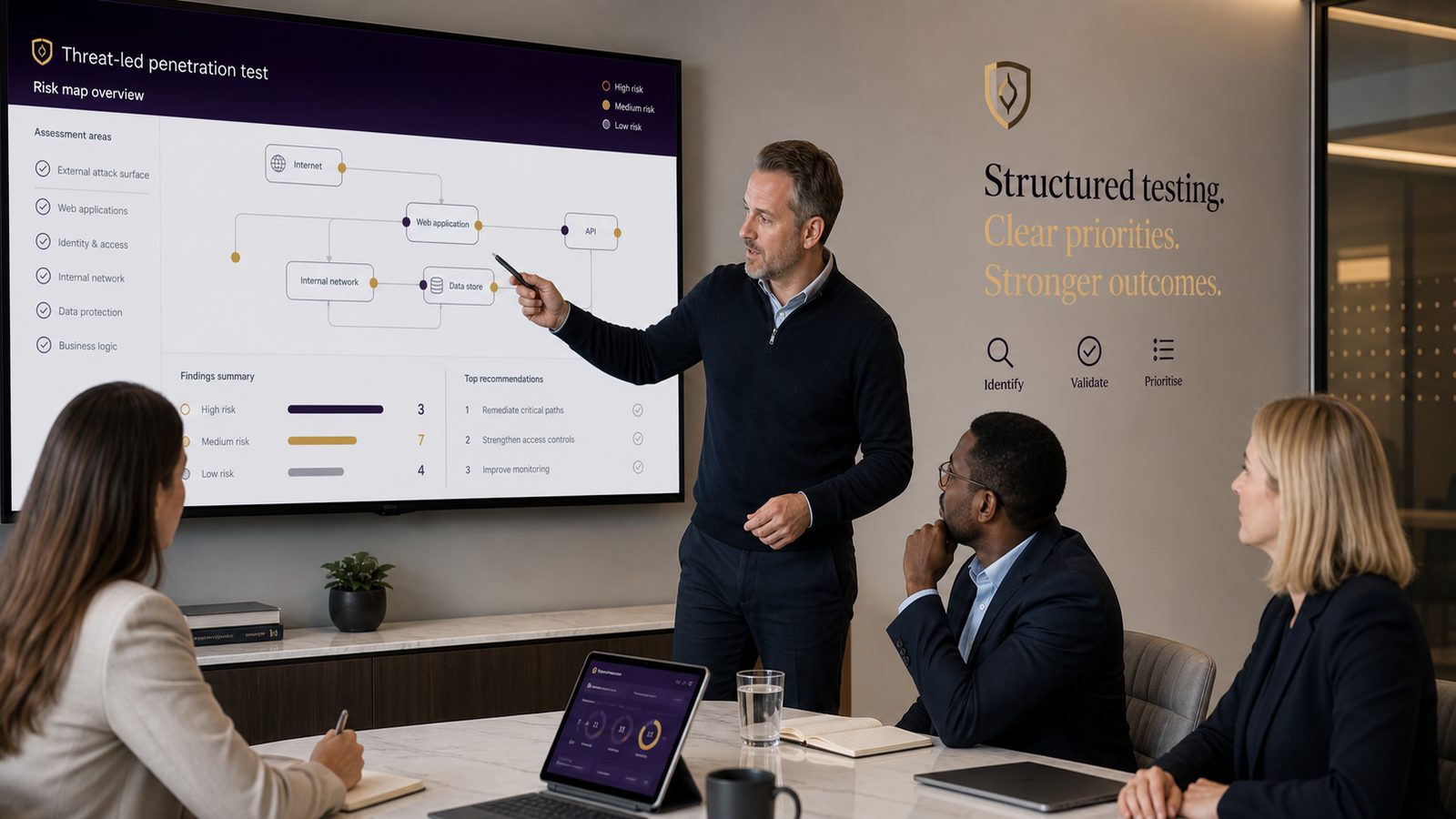
For many UK SMEs, the real question is not whether to test security, but how to test it in a way that leads to better decisions. A well-run security test should help you understand where the business is exposed, what could realistically go wrong, and where to spend money first.
That is where threat-led penetration testing can be useful. In simple terms, it is a controlled security test shaped around the threats most relevant to your organisation. Instead of checking everything in a generic way, the exercise focuses on the systems, people, and business processes that matter most to you.
For an SME, that can mean better value for money, clearer priorities, and findings that are easier to act on. It can also reduce the risk of spending time on issues that look serious in a report but have little practical impact on the business.
What threat-led penetration testing means in plain English
A penetration test is a simulated attack carried out with permission. The aim is to find weaknesses before someone else does. A threat-led penetration test takes that a step further by starting with the threats that are most relevant to your business.
That could include:
- ransomware disrupting operations
- account takeover through weak passwords or stolen logins
- exposure of customer or staff data
- abuse of remote access tools
- weaknesses in internet-facing systems
The test is then designed around those realistic risks. That makes the output more useful for decision-makers because it is tied to business impact, not just technical flaws.
How it differs from a standard penetration test
A standard penetration test often checks a defined set of systems against common weaknesses. It is still valuable, but it can be broad and sometimes fairly generic.
A threat-led approach is more focused. It asks questions such as:
- Which attack paths would matter most to us?
- Which systems would cause the biggest disruption if they were compromised?
- Which user accounts or services would an attacker most likely target?
For an SME, that focus can make the difference between a report that sits on a shelf and one that drives action.
Why the threat model matters more than a generic checklist
The threat model is simply a structured view of what you are trying to protect and who might try to harm it. In practice, it helps the tester understand what matters most to your business.
If your company relies heavily on email, remote access, or a customer portal, those areas may deserve more attention than less critical systems. If a short outage would stop sales, that changes the priority. If you hold sensitive personal data, that changes the risk again.
Without that context, testing can become a box-ticking exercise. With it, the findings are more likely to reflect the risks you actually face.
Why an SME might choose this approach
SMEs usually have limited time, limited budget, and a small number of people responsible for security. That means every test needs to earn its place.
Threat-led penetration testing is often chosen because it helps answer practical business questions:
- Where are we most exposed?
- What would an attacker probably try first?
- Which weaknesses would hurt us most?
- What should we fix before the next budget cycle?
Focusing effort on the most likely business risks
Not every weakness deserves the same level of attention. A low-risk issue on a non-critical system may be less important than a smaller weakness that could affect payroll, customer service, or access to finance systems.
That is one of the main strengths of a threat-led approach. It helps you focus on the areas where a successful attack would create the most disruption, cost, or reputational damage.
Using testing to support better investment decisions
Many SMEs know they need to improve security, but it can be hard to decide what to do first. A good test can support those decisions by showing which controls are working, which are weak, and which gaps create the most risk.
That can help you justify spending on:
- stronger account protection
- better monitoring and alerting
- improved backup and recovery
- safer remote access
- staff awareness and process changes
In other words, the value is not just in finding problems. It is in helping you spend money more wisely.
What a good engagement should cover
A useful test starts with clear agreement on what is being tested and why. If the scope is vague, the results are often vague too.
Defining the systems, users, and business processes in scope
Scope should be based on business importance. For example, you might include:
- your public website or customer portal
- email and collaboration tools
- remote access for staff or suppliers
- key internal systems such as finance or customer records
- cloud services that support day-to-day operations
You should also think about user groups. Staff, contractors, administrators, and third parties may all present different risks.
Agreeing success criteria, rules of engagement, and safe boundaries
Before any testing begins, both sides should agree what is allowed and what is not. This is often called the rules of engagement. In plain English, it means the boundaries of the exercise.
That should cover:
- which systems are in scope
- which times testing can take place
- who to contact if something unexpected happens
- what actions are off limits
- how to avoid disruption to the business
For SMEs, this matters because even a well-intentioned test can create problems if it is not carefully controlled.
How to prepare without overcomplicating it
You do not need a huge amount of preparation, but you do need the right information. The aim is to help the tester understand your business well enough to focus the exercise properly.
Gathering the right background information
Useful background usually includes:
- a simple list of important systems and services
- an overview of how staff access those systems
- any recent incidents or near misses
- known weaknesses or previous test findings
- business periods to avoid, such as month-end processing or peak sales periods
If you already have a risk register or a list of key business services, that can be a helpful starting point. The more clearly you can explain what matters to the business, the more useful the test will be.
Choosing internal contacts and making sure staff know what to expect
Pick one person who can make decisions and one person who can handle day-to-day coordination. In a small business, that may be the same person. You should also identify someone who can respond quickly if the tester needs clarification.
It is sensible to brief relevant staff in advance. They do not need every detail, but they should know:
- the test is authorised
- who is coordinating it
- what to do if they notice unusual activity
- who to contact if they are unsure
This reduces confusion and helps avoid unnecessary alarm.
What the findings should tell you
The best reports do more than list technical weaknesses. They explain what those weaknesses mean for the business.
Turning technical issues into business risk
A finding is most useful when it answers questions such as:
- Could this lead to downtime?
- Could it expose customer or staff data?
- Could it allow unauthorised access to key systems?
- Could it damage trust with customers or suppliers?
That translation from technical issue to business risk is essential. It helps managers understand why a finding matters and what should happen next.
Prioritising fixes by impact, likelihood, and effort
Not every issue can be fixed at once. A practical report should help you prioritise by considering:
- impact: how bad would it be if the issue were exploited?
- likelihood: how realistic is the attack path?
- effort: how difficult or costly is the fix?
This gives you a sensible order of work. Often, the best first steps are the ones that reduce the most risk for the least effort.
Common mistakes SMEs should avoid
Treating the exercise as a one-off tick-box activity
A test is only useful if it leads to action. If the report is filed away and nothing changes, the business has paid for information without reducing risk.
It is better to treat the exercise as part of an ongoing improvement cycle. That means fixing the most important issues, checking progress, and retesting where needed.
Testing without a clear plan for follow-up action
Another common mistake is commissioning a test before deciding who will own the findings. If nobody is responsible for remediation, the results can stall.
Before the test begins, decide:
- who will review the report
- who will assign actions
- how fixes will be tracked
- when progress will be checked
This keeps the exercise practical and prevents good findings from being wasted.
How to use the results to improve security over time
The real value of threat-led testing comes from what you do afterwards. The findings should help shape your wider security work, not sit apart from it.
Linking outcomes to policies, controls, and awareness
If the test shows that weak passwords, poor access control, or unclear processes are creating risk, those issues should feed into policy and training as well as technical fixes.
For example, you may need to improve:
- how access is approved and removed
- how staff are trained to spot suspicious activity
- how remote access is protected
- how backups are tested and recovered
This is where a test becomes part of a broader security programme rather than a standalone event.
Using repeat testing to show progress and reduce repeat issues
Repeating the exercise after key improvements can show whether the business has genuinely reduced risk. It can also help confirm that the same weaknesses are not reappearing.
For SMEs, that can be especially useful when you need to demonstrate improvement to customers, insurers, or internal stakeholders, without making claims you cannot support.
Questions to ask a provider before you start
If you are considering this kind of testing, ask practical questions before you commit.
How they tailor the test to your business
Ask how they will understand your business model, key services, and most important risks. A good provider should be able to explain how they will shape the test around your priorities, not just their standard process.
How they report findings and support remediation
Ask what the report will include, how findings will be prioritised, and whether the output will be understandable to non-technical managers. It is also worth asking whether they can support follow-up discussions after the test so you can turn findings into action.
For SMEs, that support can be just as important as the testing itself.
Final thoughts
Threat-led penetration testing is most useful when it reflects the threats that matter to your business. For UK SMEs, that usually means focusing on the systems, users, and processes that would cause the greatest disruption if something went wrong.
Done well, it gives you clearer priorities, better use of budget, and a more realistic view of where your security stands. It should help you make decisions, not just collect findings.
If you want help deciding whether this approach fits your organisation, or how to scope it sensibly, speak to a consultant who can help you align testing with business risk and practical next steps.
Frequently asked questions
What is threat-led penetration testing in plain English?
It is a controlled security test that is shaped around the threats most relevant to your organisation. Rather than checking everything in a generic way, it focuses on the systems, people and business processes that matter most to you. That usually makes the findings easier to act on and more relevant to business decisions.
How is threat-led penetration testing different from a standard penetration test?
A standard penetration test often checks a defined set of systems against common weaknesses, so it can be broader and more generic. A threat-led approach starts with the attack paths that would matter most to your business, such as remote access, email, customer portals or internet-facing systems. For SMEs, that focus can help turn the report into practical priorities rather than a long list of issues.
What should be included in the scope of a threat-led test?
The scope should be based on business importance, not just technical convenience. Common examples include your public website, email and collaboration tools, remote access, finance systems, customer records and cloud services that support day-to-day operations. It is also sensible to think about different user groups, such as staff, contractors, administrators and third parties.
How do we prepare for a threat-led penetration test?
You do not need a large amount of preparation, but the tester does need enough background to focus the exercise properly. A simple list of important systems, how staff access them, any recent incidents or near misses, and any known weaknesses is usually a good start. It also helps to note any business periods to avoid, such as month-end processing or other busy times.
What should we agree before testing starts?
Both sides should agree the rules of engagement before any testing begins. In practice, that means confirming which systems are in scope, when testing can take place, who to contact if something unexpected happens and what actions are off limits. Clear boundaries help reduce the chance of disruption and keep the exercise controlled.
Comments are closed