
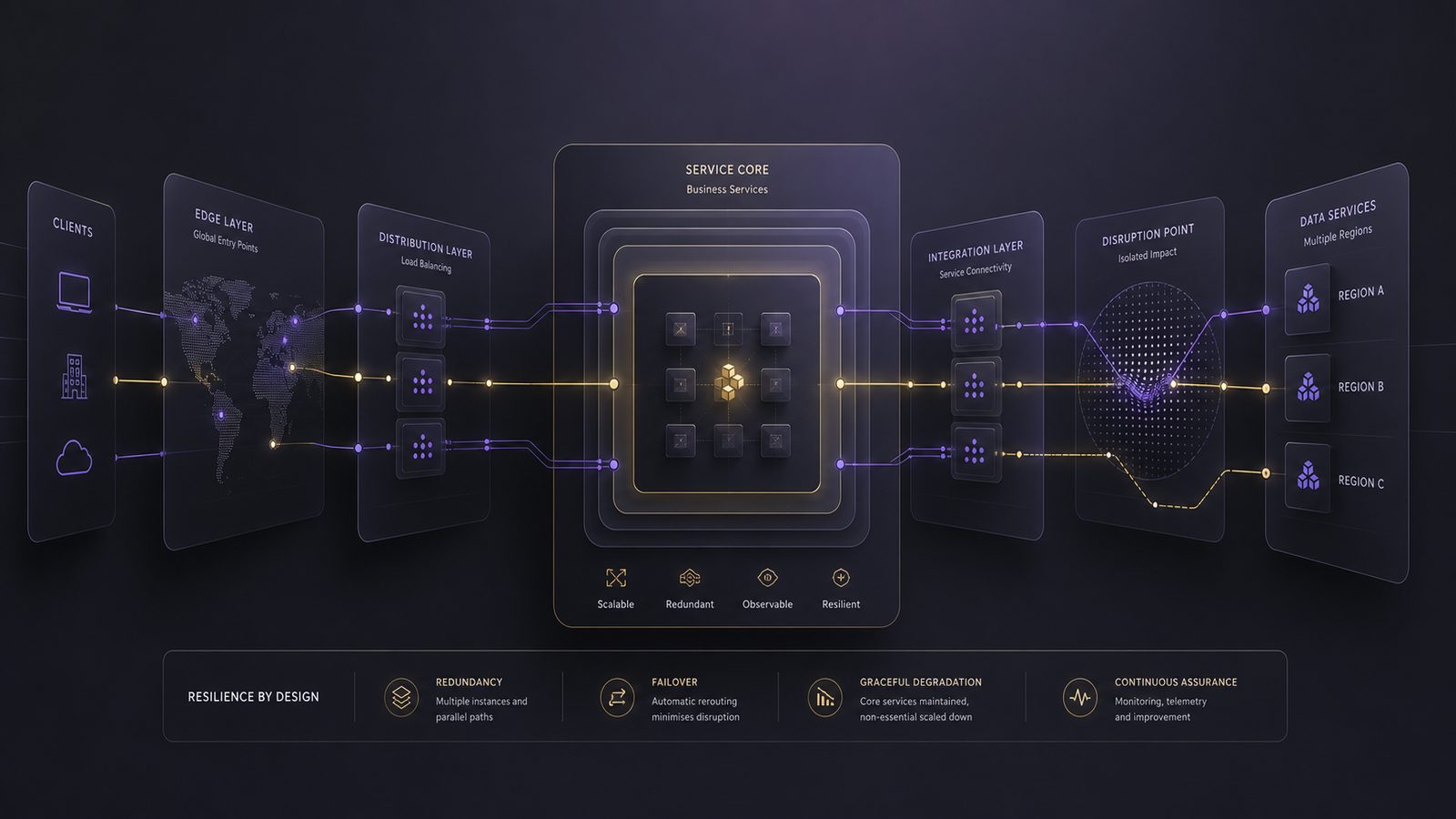
Ensuring systems are resilient to both attack and failure
For many UK SMEs, resilience is still treated as a separate conversation from security. One team looks after uptime, another looks after cyber controls, and recovery is discussed only after something goes wrong. In practice, those boundaries do not hold up. A system that is secure but fragile can fail under load, a system that is available but poorly protected can be compromised, and a system that recovers slowly can turn a small incident into a business-wide disruption.
Resilient architecture is the discipline of designing systems so they continue to deliver acceptable service when things go wrong. That includes malicious events such as credential theft, ransomware, abuse of exposed interfaces, and denial of service, as well as non-malicious events such as software defects, cloud service issues, capacity exhaustion, and human error. For technical practitioners, the goal is not perfection. It is to reduce blast radius, shorten impact windows, and make recovery predictable.
What resilience means in security architecture
In security architecture, resilience is best understood as a combination of three properties: availability, integrity, and recoverability. Availability is whether the service can be used when needed. Integrity is whether data and processing remain trustworthy. Recoverability is how quickly and safely the service can be restored after compromise or failure.
These properties interact. A highly available service that accepts unauthenticated requests may remain online while exposing data or business logic. A tightly locked-down service may be secure but fail closed in a way that stops trading. A system with excellent backups may still be operationally weak if restores take too long or depend on components that were never tested together.
For SMEs, the practical question is not whether a control is strong in isolation. It is whether the overall design can tolerate a realistic combination of events. For example, can your customer portal continue to serve read-only content if the write path is unavailable? Can your identity platform survive a regional outage? Can your support team still operate if endpoint protection quarantines a critical admin workstation? These are architecture questions, not just control questions.
Start with a threat and failure model
Resilience work should begin with a model of how the system can be attacked and how it can fail. Data-flow diagrams are a useful starting point because they show trust boundaries, data stores, external dependencies, and entry points. Once you have the flows, apply STRIDE to identify spoofing, tampering, repudiation, information disclosure, denial of service, and elevation of privilege.
That attack view should be paired with a failure view. Map single points of failure, dependency chains, and operational bottlenecks. A payment service may depend on identity, DNS, a message queue, a database, a third-party API, and a secrets store. If any one of those components fails, the business impact may be disproportionate to the technical fault. The architecture should make those dependencies visible.
A practical method is to ask two questions for each component:
- What happens if this component is compromised?
- What happens if this component is unavailable?
If the answer to both questions is “the whole service stops”, you have found a design weakness. In many SME environments, the same weakness appears repeatedly: a single admin account, a single internet-facing gateway, a single region, or a single database with no tested restore path.
Data-flow diagrams also help with prioritisation. Not every path needs the same level of protection. Focus first on routes that cross trust boundaries, handle sensitive data, or support privileged actions such as authentication, payment, administration, and software deployment.
Build layered controls without creating brittle systems
Defence in depth remains useful, but only if the layers are designed to complement each other rather than duplicate the same assumption. A common mistake is to add more controls at the edge while leaving internal trust too broad. If an attacker gets past the perimeter, they should not inherit broad access to the rest of the environment.
At the identity layer, use least privilege and role-based access control, or RBAC, so users and services receive only the access they need. Separate human administrator roles from application service identities. Use just-in-time elevation where possible, and make privileged actions visible in logs. For cloud and SaaS environments, review conditional access, device trust, and MFA enforcement for administrative paths as well as normal user access.
At the network layer, segmentation reduces lateral movement and limits the spread of both malware and operational faults. In practice, this means separating user, server, management, and backup networks, and restricting east-west traffic to known application paths. Microsegmentation can be valuable where workloads are sensitive or highly interconnected, but it should be introduced carefully so that policy sprawl does not become a maintenance burden.
At the application layer, secure defaults matter. Services should reject unknown input, fail safely, and avoid assuming that upstream systems are always healthy. At the data layer, separate production, backup, and administrative access paths. Protect secrets with a dedicated vault or key management service, and avoid embedding credentials in code, images, or configuration files that are widely distributed.
The design principle is simple: if one layer fails, the next layer should still reduce the impact. That does not mean every layer must be maximised. Overly strict controls can create brittle systems, especially where operational teams need to respond quickly during an incident. The right balance is one that preserves control without making the service impossible to run.
Design for graceful degradation and safe failure
Resilient systems do not always stay fully functional, but they should degrade in a controlled way. Graceful degradation means the service continues to provide the most important functions even when supporting components are unavailable. Safe failure means the system stops in a way that avoids data loss, privilege escalation, or uncontrolled retries.
Several engineering patterns are particularly useful here. Timeouts prevent a service from waiting indefinitely on a slow dependency. Retries can help with transient faults, but they should use backoff and jitter so they do not amplify an outage. Circuit breakers stop repeated calls to a failing dependency and allow the system to recover. Bulkheads isolate workloads so one failing component does not consume all available resources.
These patterns are often discussed in reliability engineering, but they are equally relevant to security. An attacker who induces slow responses, resource exhaustion, or error conditions can trigger the same failure modes as a genuine outage. If your application retries aggressively against a compromised or overloaded dependency, it may worsen the incident.
Define degraded modes for your core business services. A customer portal might allow account viewing but suspend changes. An internal workflow system might queue requests for later processing. A reporting platform might serve cached data rather than live queries. The key is to decide these behaviours in advance, not during an incident.
For critical workflows, document what must continue to work, what can be delayed, and what should be disabled if the system is under stress. This is especially important for SMEs that rely on a small number of applications to support sales, finance, operations, and customer service.
Make recovery part of the architecture, not an afterthought
Recovery design should be built into the system from the beginning. Backups are necessary, but they are only one part of recoverability. You also need restore procedures, dependency ordering, access to clean credentials, and a way to verify that recovered systems are trustworthy.
Start by defining recovery objectives for each important service. Recovery time objective, or RTO, is how long the business can tolerate the service being down. Recovery point objective, or RPO, is how much data loss is acceptable. These are business decisions, but they should drive technical design. A low RTO may require warm standby or automated failover. A low RPO may require more frequent backups, replication, or transaction logs.
Immutable backups are particularly valuable against ransomware and destructive attacks because they reduce the chance that an attacker can alter or delete recovery data. However, immutability alone is not enough. You should test restore paths regularly, including the order in which services come back. For example, identity, DNS, secrets, and database services may need to be restored before application tiers can function.
Restore testing should include more than file recovery. Validate full system rebuilds, configuration recovery, and access control restoration. Check whether backup credentials are separate from production credentials, whether backup repositories are reachable from compromised endpoints, and whether backup logs are monitored for anomalies.
Failover assumptions also need testing. If you rely on a secondary site or cloud region, confirm that the application actually works there with current code, current data, and current dependencies. Many organisations discover during a real event that their failover environment is incomplete, stale, or missing permissions.
Improve detection and response to shorten impact windows
Resilience is not only about preventing incidents. It is also about detecting them quickly and containing them before they become systemic. Centralised telemetry is essential. Collect logs and alerts from identity, endpoint, application, network, and infrastructure layers into a SIEM or similar platform so patterns can be correlated across the stack.
For technical teams, useful signals include failed authentication bursts, privilege escalation events, unusual admin activity, service account misuse, unexpected changes to firewall or IAM policy, backup deletion attempts, and repeated dependency failures. The objective is to distinguish a normal fault from a fault caused or amplified by malicious activity.
Response playbooks should be aligned to architecture. If a service is compromised, what is isolated first? If a dependency is failing, what is throttled or disabled? If a privileged account is suspected to be abused, how is access revoked without locking out recovery teams? These decisions should be documented and rehearsed.
Automation can reduce response time, but it should be bounded. For example, automatic containment may be appropriate for a known malicious process, but not for every anomaly. Poorly tuned automation can create self-inflicted outages. The safest pattern is to automate low-risk actions, such as ticket creation, enrichment, and evidence capture, while keeping disruptive actions under clear control.
Detection and response should also feed back into design. If repeated alerts point to a noisy dependency, a brittle integration, or a weak access pattern, treat that as an architecture issue rather than just a monitoring problem.
Operationalise resilience through engineering and governance
Resilience only lasts if it is maintained through change. Every significant release, infrastructure change, or supplier integration can alter the risk profile. That is why resilience checks should be part of change management, architecture review, and release pipelines.
In practice, this means asking a small set of questions before changes go live: does the change introduce a new trust boundary, a new dependency, or a new single point of failure? Does it alter backup coverage, logging, or recovery procedures? Does it change the blast radius if the component is compromised? If the answer is yes, the change should be reviewed with resilience in mind.
Useful metrics include recovery time, restore success rate, mean time to detect, mean time to contain, and the proportion of critical services with tested restore procedures. Error budgets can also be helpful where teams operate service-level objectives, because they make reliability trade-offs explicit. For SMEs, the exact metric set matters less than the discipline of measuring whether the architecture still behaves as intended.
Governance should support, not slow down, engineering. A lightweight architecture review checklist can be enough if it covers identity, segmentation, secrets, logging, backup, failover, and degraded-mode behaviour. The aim is to make resilience a normal design consideration rather than a special project.
Practical starting points for SMEs
If you are improving an existing environment, start with the highest-value services and the most obvious weak points. A sensible sequence is:
- Map the critical service and its dependencies.
- Identify the single points of failure and high-privilege access paths.
- Introduce segmentation and least privilege where the blast radius is too wide.
- Review timeouts, retries, and dependency handling for brittle behaviour.
- Verify backup immutability and restore procedures.
- Centralise logs and define response playbooks for the most likely failure and attack scenarios.
This approach is incremental and realistic for smaller teams. It does not require a complete redesign. It does require honest visibility into how the system actually behaves under stress.
Ensuring systems are resilient to both attack and failure is ultimately about designing for the conditions you hope never happen, but should still be ready for. If you want help turning these principles into a practical architecture review or an ISMS-aligned improvement plan, speak to a consultant.
FAQ
How is resilience different from high availability in security architecture?
High availability focuses on keeping a service running despite component failure. Resilience is broader. It includes availability, but also security containment, integrity protection, recovery design, and the ability to operate in degraded modes after an attack or fault.
What are the most useful design patterns for limiting blast radius during both attacks and outages?
The most consistently useful patterns are least privilege, segmentation, timeouts, circuit breakers, bulkheads, immutable backups, and tested restore procedures. Together, they reduce how far a problem can spread and how long it takes to recover.
Should SMEs aim for full failover everywhere?
Not usually. Full failover is expensive and can add complexity. A better approach is to reserve it for the most business-critical services and use graceful degradation, strong recovery procedures, and clear prioritisation for the rest.
Comments are closed