
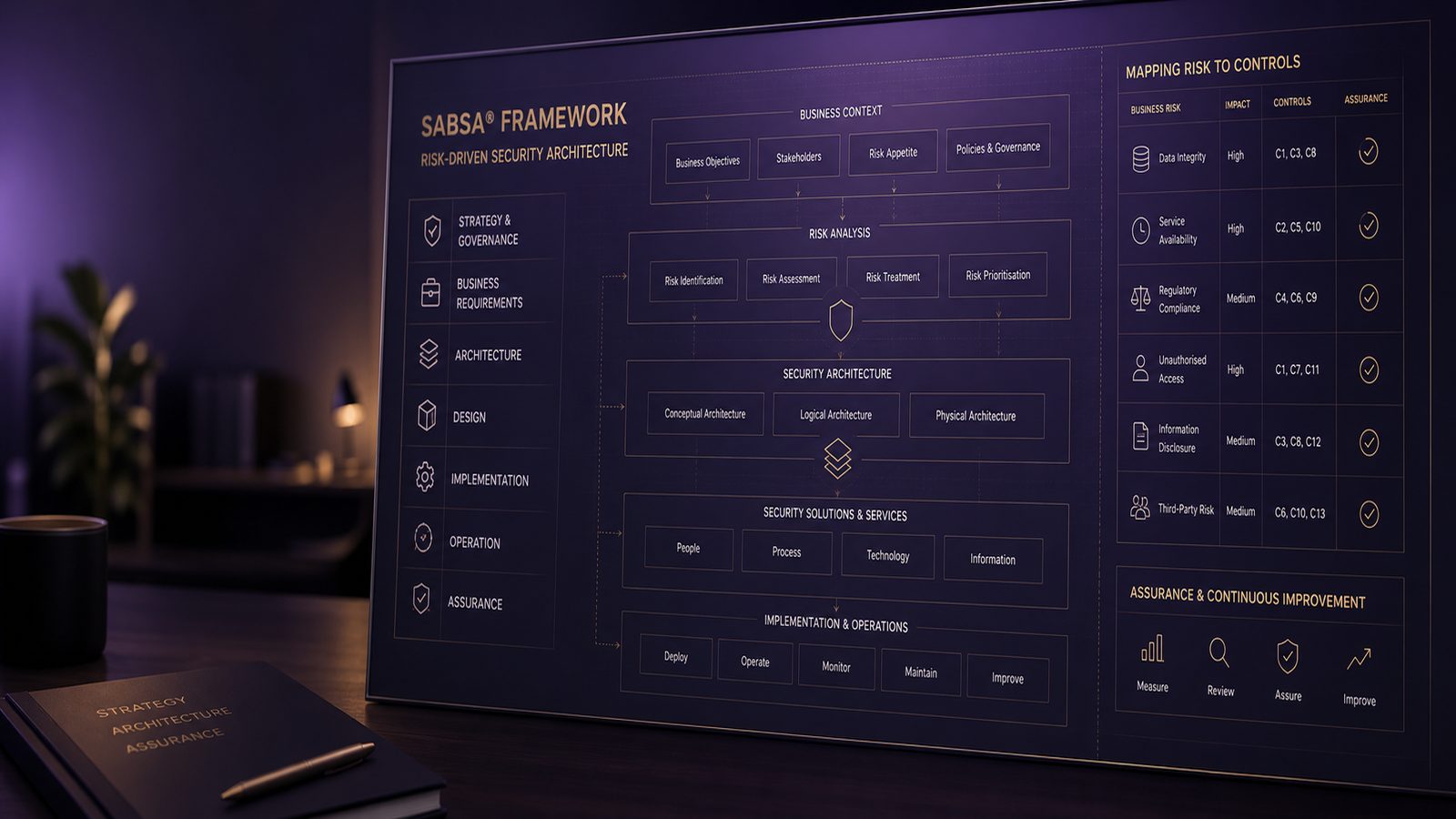
What SABSA is and where it fits in security architecture
SABSA is a framework for building security architecture from business risk downwards. It uses six layers (contextual, conceptual, logical, physical, component, operational) and a matrix of six questions to make every control traceable to a business need. Here is how it works and a worked example for a mid-sized organisation.
For a UK SME, SABSA matters because security decisions are often made in fragments. One team buys an identity tool, another adds logging, and operations harden a few servers, but the result is not always a coherent design. SABSA helps you connect those pieces.
In plain terms, SABSA asks a simple question: what does the business need to protect, what could go wrong, and what security properties must the architecture provide to reduce that risk? It is not a checklist and it is not a product selection method. It is a way to make security design traceable, so you can explain why a control exists and what risk it addresses.
That makes SABSA useful when you are designing a new platform, reviewing an existing service, or trying to rationalise controls that have grown over time. It is especially helpful for SMEs because it supports pragmatic trade-offs. You do not need enterprise scale to benefit from a disciplined approach to security architecture. In fact, smaller organisations often gain more because they have less room for duplicated tooling, unclear ownership, and controls that nobody maintains.
SABSA also sits well alongside other methods. Threat modelling helps you identify what can go wrong in a system. NIST Cybersecurity Framework helps you organise outcomes such as Identify, Protect, Detect, Respond, and Recover. TOGAF gives you a broader enterprise architecture method. SABSA complements these by focusing on the security view and the traceability from business attributes to controls. If you already use threat modelling or a framework such as NIST CSF, SABSA can provide the architectural structure that turns those findings into design decisions.
The SABSA layers and how to use them in practice
SABSA is often described through layers or views that move from business context to technical implementation. The exact terminology varies slightly between sources, but the practical idea is consistent: start with business requirements, then progressively refine them into architecture and controls.
The contextual view defines the business attributes you care about. These are not technical controls. They are qualities such as confidentiality, integrity, availability, traceability, privacy, resilience, and recoverability. For example, a finance system may need strong integrity and auditability, while a customer portal may prioritise availability and identity assurance.
The conceptual view turns those attributes into security services and control objectives. At this stage you are deciding what the security architecture must achieve, not how it will be built. For example, if the business attribute is traceability, the control objective may be that all privileged actions are attributable to a named user and retained in tamper-resistant logs.
The logical view describes the security mechanisms and patterns needed to meet those objectives. This is where you start thinking about role-based access control, network segmentation, centralised logging, key management, secure session handling, and backup isolation. The focus is still design, not vendor choice.
The physical view maps the logical design to actual technologies and platforms. Here you decide whether identity is enforced through Microsoft Entra ID, whether logs go to a SIEM, whether segmentation is implemented with security groups, firewall rules, or cloud network controls, and how recovery is operationalised.
The component view goes one level deeper into configuration and implementation details. This is where you define policy settings, conditional access rules, log retention periods, backup immutability settings, or infrastructure-as-code patterns. For a technical practitioner, this is the layer where architecture becomes deployable.
The value of the layered approach is traceability. If someone asks why a control exists, you should be able to trace it back to a business attribute and a risk statement. That makes architecture reviews easier, helps with change control, and reduces the chance of adding controls that look sensible but do not actually address the underlying risk.
A practical way to use the layers is to document them in a short architecture pack for each important service:
- Business process or service
- Key business attributes
- Threats and failure modes
- Security objectives
- Logical controls
- Technology choices
- Operational ownership
Building a SABSA-style risk model for an SME
A SABSA-style risk model starts with the business, not the technology estate. For an SME, that usually means identifying the services that would hurt most if they failed, were manipulated, or became unavailable. Examples might include payroll, customer ordering, case management, remote access, or a SaaS platform that underpins revenue.
Once you have identified the important service, define the assets that matter. These include data, identities, systems, integrations, and operational dependencies. A common mistake is to focus only on data. In practice, identity systems, admin accounts, API keys, and backup repositories are often just as important.
Next, identify the main threat scenarios and failure modes. SABSA does not replace threat modelling, but it benefits from it. You can use STRIDE to structure the analysis if that helps. For example:
- Spoofing: an attacker uses stolen credentials to impersonate a user or administrator
- Tampering: data is altered in transit or at rest
- Repudiation: actions cannot be attributed to a specific user
- Information disclosure: sensitive data is exposed to the wrong party
- Denial of service: a critical service becomes unavailable
- Elevation of privilege: a low-privilege account gains admin rights
From there, define control objectives in business language. If the service is customer-facing, one objective may be to keep the service available even if one application node fails. If the service handles regulated or sensitive data, another objective may be to ensure only approved staff can access records, and that access is logged. If the service supports finance, you may need stronger approval workflows and segregation of duties.
Risk appetite then shapes the architecture. A business with low tolerance for downtime may accept higher infrastructure cost for redundancy, health checks, and failover. A business with limited operational capacity may prefer simpler controls that are easier to run, even if they are not the most advanced option. SABSA helps you make those trade-offs explicit rather than accidental.
For example, if your risk appetite says that unauthorised access to customer records is unacceptable, that should drive design choices such as:
- Single sign-on with strong authentication
- Role-based access control, or RBAC, to limit who can see what
- Privileged access management for administrators
- Centralised logging of access and changes
- Periodic access reviews
If your risk appetite says that a short outage is tolerable but data loss is not, the design may favour immutable backups, tested restore procedures, and replication over expensive active-active infrastructure.
Using SABSA to design controls that actually fit the business
SABSA is most useful when it leads to controls that are proportionate. For SMEs, the goal is not to deploy every possible security measure. The goal is to choose the right controls for the risk, the operating model, and the budget.
Identity and access management is usually the first place to start. If identity is the new perimeter, then access design becomes a core architectural concern. Use RBAC where roles are stable and understandable. Use attribute-based controls or conditional access where context matters, such as device compliance, location, or sign-in risk. Keep privileged access separate from standard user access. For cloud environments, make sure administrative roles are tightly scoped and reviewed.
Logging and monitoring should be designed as part of the architecture, not bolted on later. Decide which events are security-relevant before implementation. Typical examples include authentication events, privilege changes, configuration changes, data exports, and backup failures. Centralise logs into a SIEM if you need correlation, alerting, and retention. If you also use XDR, define which detections belong in the endpoint layer and which belong in the broader security monitoring stack.
Segmentation is another area where SABSA helps avoid over-engineering. The question is not whether to segment everything. The question is where segmentation reduces material risk. For many SMEs, useful boundaries include user devices, servers, management networks, production and non-production environments, and sensitive application tiers. In cloud environments, this may be implemented through virtual networks, security groups, private endpoints, and identity-based access rather than traditional VLANs alone.
Resilience controls should be chosen according to the business impact of failure. If a service is critical, design for graceful degradation, not just prevention. That may mean rate limiting, queueing, circuit breakers, health checks, and fallback modes. For ransomware resilience, immutable backups and isolated recovery credentials are often more valuable than complex perimeter controls. Recovery design should include restore testing, not just backup success reports.
Secure communications also belong in the architecture. Use TLS for data in transit, and consider mutual authentication for service-to-service communication where trust boundaries are tight. For APIs, validate inputs, enforce schema checks, and reject unexpected data early. These are not just application coding concerns. They are architectural controls that reduce the chance of malformed or malicious input causing downstream issues.
The main trade-off in SME environments is usually between protection, usability, and operational cost. A control that is theoretically strong but too complex to run will often fail in practice. SABSA encourages you to choose controls that can be operated consistently. That is often the difference between a design that looks good on paper and one that actually improves security.
Practical implementation approach for small teams
If you are introducing SABSA into a small team, do not try to model the whole organisation at once. Start with one critical service or business process. Choose something with clear business value and visible risk, such as customer onboarding, remote admin access, or a revenue-generating application.
Run a short workshop with the people who understand the service best. That should include someone from the business, someone who owns the platform, and someone who understands security or infrastructure. Keep the session focused on a few questions:
- What would hurt most if this service failed or was compromised?
- What information, identities, and systems does it depend on?
- What security properties matter most: confidentiality, integrity, availability, traceability, privacy, or resilience?
- What controls already exist?
- Where are the gaps or single points of failure?
Document the output in a way that both engineers and leaders can use. A good format is a one-page architecture summary with a simple diagram, a risk table, and a control mapping. Avoid long narrative documents that nobody updates. The point is to create a living design reference, not a shelf artefact.
For engineers, include enough detail to implement the design. That may mean naming the identity provider, the logging destination, the backup platform, the segmentation boundaries, and the approval workflow for privileged access. For leaders, include the business rationale and the residual risk in plain English. That makes it easier to approve trade-offs and understand exceptions.
It also helps to record decisions explicitly. For example: why was a simpler control chosen over a more complex one? Why is a service allowed to fail over manually rather than automatically? Why is a particular log retention period acceptable? These decisions matter later when the environment changes or when someone asks why a control is missing.
Common SABSA mistakes and how to avoid them
The first common mistake is treating SABSA as a documentation exercise. If the output is only a diagram or a matrix, the architecture has not really been designed. The value comes from the decisions, the traceability, and the operational ownership. Keep the artefacts lightweight, but make sure they lead to action.
The second mistake is starting with technology. If you begin by asking which tools to buy, you can easily end up with controls that do not match the risk. SABSA works best when the business attributes and risk appetite are clear first. Technology comes later.
The third mistake is over-engineering before the risk is understood. SMEs often do not need elaborate control stacks. They need a small number of well-chosen controls that are consistently applied. A well-designed identity model, good logging, tested backups, and sensible segmentation often deliver more value than a larger but poorly operated toolset.
The fourth mistake is failing to assign ownership. A control without an owner will drift. If logging is important, who reviews alerts? If access reviews are required, who performs them and how often? If backups are critical, who tests restores and what counts as success? SABSA should make ownership visible.
How SABSA supports ongoing governance and change
Security architecture is not a one-off activity. Business processes change, suppliers change, cloud services change, and the threat landscape changes. SABSA supports ongoing governance because it gives you a structured way to review whether the architecture still matches the business.
Set review points around meaningful change, not arbitrary dates alone. Good triggers include new systems, major supplier changes, mergers, new data types, changes in remote access, and significant incidents. When a change is proposed, ask whether it affects the business attributes, the threat model, or the control objectives. If it does, the architecture should be updated.
Metrics can help, but keep them sensible. Useful measures might include privileged accounts reviewed on time, backup restore tests completed, critical log sources onboarded to the SIEM, or high-risk exceptions still open after their review date. Avoid vanity metrics that do not inform decisions.
Exceptions should also be managed deliberately. In real organisations, not every control can be implemented immediately. If you accept an exception, record the reason, the compensating controls, the expiry date, and the owner. That keeps risk visible and prevents temporary decisions becoming permanent by accident.
For UK SMEs, SABSA is most valuable when it helps you make better design decisions with limited time and budget. It gives structure without forcing unnecessary complexity. Used well, it can improve resilience, reduce wasted effort, and make security architecture easier to explain to both technical teams and business stakeholders.
If you want support turning risk into a practical security architecture, a consultant can help you shape the first workshop, define the architecture views, and turn the outputs into a workable implementation plan.
Frequently asked questions
Is SABSA only useful for large enterprises, or can SMEs use it effectively?
SMEs can use SABSA effectively, especially when they need to prioritise limited resources. The framework is scalable. You do not need a large architecture function to benefit from its core idea, which is to link business risk to security design decisions.
How does SABSA relate to NIST CSF, TOGAF, and threat modelling in a real project?
They solve different problems. Threat modelling identifies what can go wrong in a system. NIST CSF helps organise security outcomes and maturity. TOGAF provides a broader enterprise architecture method. SABSA connects business attributes and risk to security architecture decisions, so it works well alongside the others rather than replacing them.
What is the best first step for a small team?
Pick one critical service, identify the main business attributes and risks, and document the key controls and owners. That gives you a practical starting point without trying to model the whole organisation at once.
Do we need specialist tools to use SABSA?
No. You can start with a whiteboard, a spreadsheet, and a simple architecture template. Tools help with scale, but the method itself is about disciplined thinking and traceable decisions.
How do we know if the architecture is working?
Look for evidence that the controls are implemented, owned, and tested. Examples include successful restore tests, reviewed access rights, centralised logs, and documented exceptions with expiry dates. The aim is not perfection, but a design that consistently reduces the risks that matter most.
If you are reviewing a new platform or trying to improve an existing one, SABSA can provide a practical structure for making security decisions that fit the business rather than fighting it.
Comments are closed