
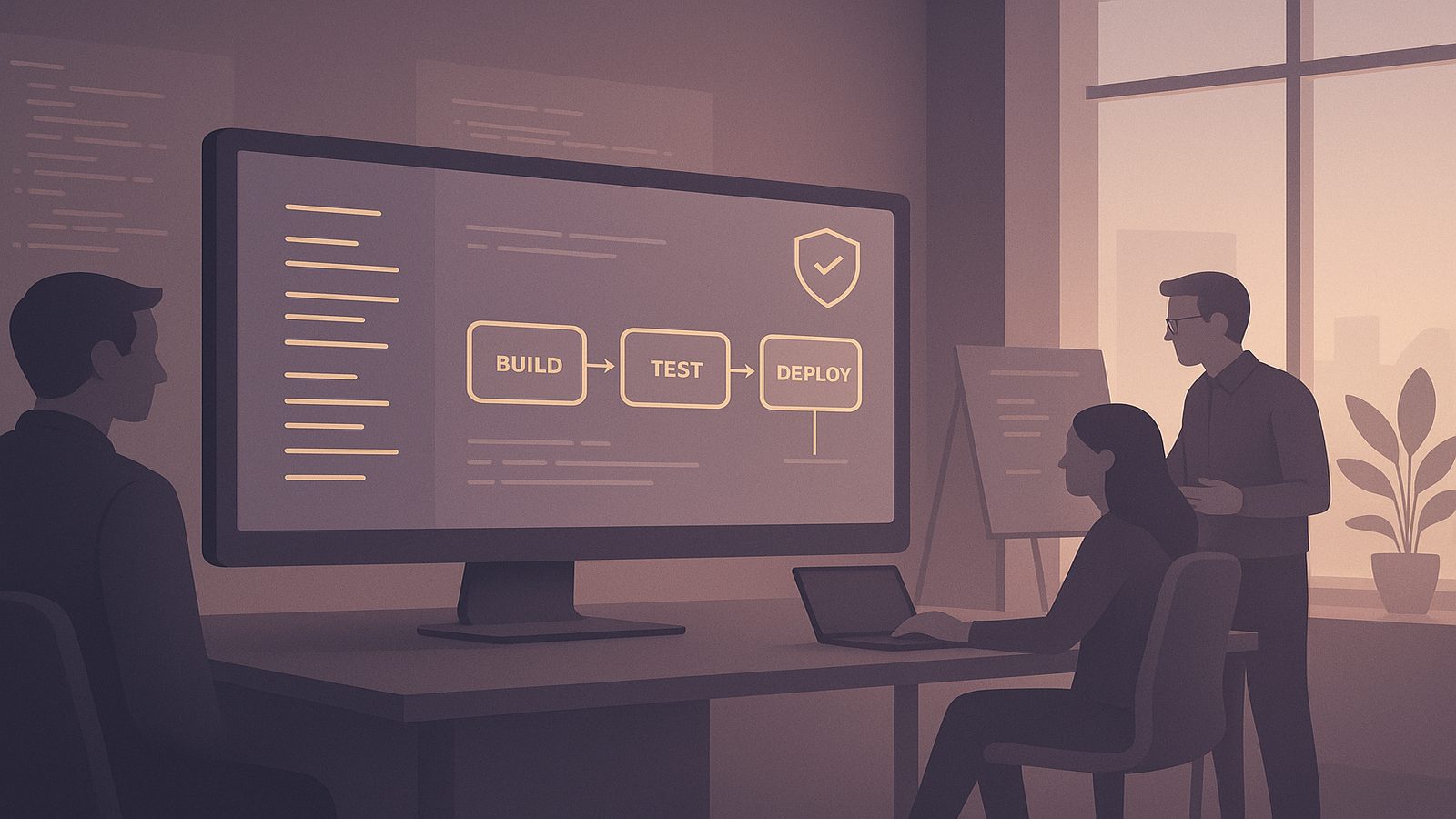
DevSecOps explained for growing technology businesses
For many growing technology businesses, the pressure is familiar. Product teams want to ship quickly, operations want stability, and security needs to reduce risk without becoming a bottleneck. DevSecOps is the practical way to bring those priorities together.
In simple terms, DevSecOps means building security into everyday software delivery rather than leaving it as a separate step at the end. It is not a single tool, and it is not a one-off project. It is a way of working that helps teams spot issues earlier, fix them more cheaply, and release with more confidence.
For UK SMEs, the appeal is straightforward. You may not have a large security team, but you still need a sensible way to manage software risk. A well-designed DevSecOps approach can help you do that without adding unnecessary process.
What DevSecOps means in plain English
DevSecOps combines development, security, and operations. The idea is that security should be part of the same delivery flow as coding, testing, deployment, and support. Instead of waiting for a final review, teams build checks into the places where work already happens.
How it differs from traditional development and operations
In a traditional setup, developers write code, operations teams deploy it, and security may only review it near release or after a problem is found. That can work for small changes, but it often creates delays and rework when security issues are discovered late.
DevSecOps changes the sequence. Security requirements are considered earlier, checks are automated where possible, and delivery teams share responsibility for keeping software safe. The aim is not to remove accountability. It is to make security part of normal delivery rather than an exception.
Why security works best when it is built into delivery
Security issues are usually easier to manage when they are found close to the point of change. A weak dependency, a leaked secret, or an unsafe configuration is much simpler to fix during development than after deployment. Early checks also reduce the chance that teams will treat security as someone else’s job.
That said, DevSecOps is not about checking everything all the time. For a growing business, the right approach is to focus on the controls that reduce the most risk for the least disruption.
Why growing technology businesses adopt DevSecOps
Most SMEs do not adopt DevSecOps because it sounds modern. They adopt it because it helps them deliver software in a more controlled way as the business grows.
Reducing rework and late-stage security surprises
Late security findings are expensive. They can delay launches, create pressure on engineers, and force emergency fixes that distract from planned work. If a vulnerability is found after release, the business may also need to manage customer concerns, support effort, and possible service disruption.
DevSecOps reduces those surprises by making common checks routine. That means fewer last-minute escalations and a better chance of keeping delivery on schedule.
Supporting faster releases without losing control
Some leaders worry that adding security will slow the team down. In practice, the opposite is often true once the basics are in place. Automated checks can run in the background, giving developers quick feedback. Clear release criteria can reduce debate. Good logging and monitoring can help teams understand what changed if something goes wrong.
The result is not perfect certainty. It is better control with less friction.
The core building blocks of a practical DevSecOps approach
A useful DevSecOps model has three parts: people, process, and tooling. If one of those is missing, the approach tends to become either too manual, too slow, or too dependent on a single individual.
People, process, and tooling
People means making sure developers, operations staff, and security owners understand their roles. In a smaller business, one person may cover more than one role, but the responsibilities still need to be clear.
Process means deciding when security checks happen, who reviews exceptions, and what happens when a control fails. The process should be simple enough that teams can follow it consistently.
Tooling means using automation where it adds value. That might include code scanning, dependency checks, secret detection, and deployment controls. Tools should support the process, not define it.
Where security checks fit into the delivery lifecycle
Security can be added at several points in the lifecycle:
- During planning, by identifying sensitive features and higher-risk changes.
- During design, by checking assumptions about data, trust boundaries, and access.
- During development, by scanning code and checking dependencies.
- During testing, by looking for common weaknesses and configuration issues.
- During release, by confirming approvals, logging, and rollback options.
- During operations, by monitoring for unusual behaviour and patching known issues.
Not every control needs to exist at every stage. The key is to place checks where they are most useful and least disruptive.
How to introduce DevSecOps without slowing teams down
The best way to introduce DevSecOps is gradually. Trying to change everything at once usually creates resistance and confusion. A phased approach gives the business time to learn what works.
Start with the highest-risk applications and changes
Begin with the systems that matter most to the business. That may include customer-facing applications, services that handle personal or payment data, or products that are deployed frequently. These are often the places where a small improvement in control has the biggest effect.
It also helps to focus on the types of change that carry more risk, such as authentication, access control, payment flows, or integrations with third parties. You do not need to treat every feature equally. Risk-based prioritisation is more realistic for SMEs.
Use lightweight controls that match the size of the business
DevSecOps should fit the team, not the other way round. A small engineering function may only need a few well-chosen controls to begin with. For example, a simple pull request review process, automated dependency scanning, and a basic release checklist can go a long way.
As the business grows, you can add more depth. The important point is to avoid building a process so heavy that people work around it.
Common DevSecOps controls SMEs can prioritise
There are many possible controls, but a practical SME programme usually starts with the basics. These are the measures that tend to deliver the most value early on.
Code scanning, dependency checks, and secret detection
Code scanning checks source code for patterns that may indicate security weaknesses. It is not perfect, but it can highlight issues early and consistently.
Dependency checks look at third-party libraries and packages used by the application. This matters because modern software often relies on many external components, and weaknesses in those components can affect your product.
Secret detection helps identify credentials, API keys, and tokens that should not be stored in code or shared in repositories. Preventing secret leakage is one of the simplest and most valuable early controls.
Release approvals, logging, and basic security testing
Release approvals do not need to be bureaucratic. For higher-risk changes, a second set of eyes can help confirm that the right checks have been completed and that any exceptions are understood.
Logging records important events such as logins, permission changes, and deployment activity. Good logs help teams investigate issues and understand what happened if something looks unusual.
Basic security testing might include targeted checks before release, such as verifying access controls, testing common input handling issues, and confirming that error messages do not reveal too much information. The aim is to test the areas most likely to matter, not to create a full laboratory environment.
How to measure whether DevSecOps is working
It is easy to collect tool output and assume that means progress. In reality, DevSecOps should be measured by whether it improves delivery and reduces avoidable risk.
Practical indicators for leaders and delivery teams
Useful indicators include:
- How many security issues are found before release rather than after.
- How long it takes to fix high-priority findings.
- How often teams bypass controls, and why.
- Whether automated checks are producing useful feedback or too many false positives.
- Whether release delays are caused by unclear requirements or late security decisions.
These measures are more helpful than counting tools alone. A business can have many scanners and still miss the point if the findings are not acted on.
Balancing speed, quality, and risk
Good DevSecOps is a balancing act. If controls are too weak, the business takes on unnecessary risk. If controls are too heavy, teams may slow down or ignore them. The right balance depends on the sensitivity of the system, the pace of change, and the resources available.
Leaders should look for a steady improvement in confidence, not a promise that every risk has been removed.
Typical mistakes to avoid
Many DevSecOps efforts struggle for the same reasons. The good news is that these issues are usually avoidable.
Treating DevSecOps as a tooling project only
Buying scanners is easy. Changing behaviour is harder. If the business focuses only on tools, it may generate reports without improving outcomes. Teams need clear ownership, sensible thresholds, and a process for dealing with findings.
Tools are useful, but they are only one part of the picture.
Adding controls that are too heavy for the team
Another common mistake is copying a large enterprise model into a smaller business. That often leads to slow approvals, duplicated checks, and frustration. SMEs usually do better with a small number of controls that are well understood and consistently applied.
If a control is regularly bypassed, it is worth asking whether it is poorly designed rather than blaming the team.
A sensible starting point for UK SMEs
If you are starting from scratch, aim for progress rather than perfection. A 90-day plan can help you build momentum without overcommitting.
A phased approach for the first 90 days
Days 1 to 30: Identify the most important applications, the highest-risk changes, and the current delivery process. Agree who owns security decisions and where the main gaps are.
Days 31 to 60: Introduce a small number of controls, such as dependency scanning, secret detection, and a simple review step for higher-risk changes. Make sure the team understands why these controls exist.
Days 61 to 90: Review what is working, remove friction where needed, and add one or two more controls if the team is ready. Focus on improving the quality of findings and the speed of remediation.
This phased approach is usually more effective than trying to redesign the whole delivery model at once.
When to bring in external support
External support can be useful when you need help prioritising risk, designing a practical control set, or aligning DevSecOps with wider governance. It can also help if your team is growing quickly and delivery practices have not kept pace.
For some UK SMEs, the most valuable support is not a big transformation programme. It is a short, focused engagement that helps the business agree what good looks like and how to implement it in a realistic way.
DevSecOps is best understood as a business enabler. It helps growing technology businesses release software with more confidence, reduce avoidable rework, and keep security close to the work that matters. The most successful programmes are usually simple, phased, and built around the way the team already operates.
If you want to improve your delivery approach without adding unnecessary overhead, start with the highest-risk areas, automate the basics, and keep the process proportionate.
For advice on shaping a practical approach for your organisation, you can speak to a consultant.
Frequently asked questions
What does DevSecOps mean in plain English?
DevSecOps means building security into everyday software delivery rather than leaving it until the end. It brings development, security, and operations into the same delivery flow so checks happen where work already takes place. For a growing business, that usually means earlier feedback, less rework, and a more practical way to manage software risk.
How is DevSecOps different from traditional development and operations?
In a traditional setup, security may only review changes near release or after a problem is found. DevSecOps changes that sequence by considering security requirements earlier and automating checks where possible. The aim is not to remove accountability, but to make security part of normal delivery.
What are the main building blocks of a practical DevSecOps approach?
A useful DevSecOps approach usually has three parts: people, process, and tooling. People need clear responsibilities, process should define when checks happen and how exceptions are handled, and tooling should automate useful tasks such as code scanning, dependency checks, secret detection, and deployment controls. The tools should support the process, not replace it.
Where should security checks fit into the software delivery lifecycle?
Security checks can be added during planning, design, development, testing, release, and operations. For example, you might identify higher-risk changes early, scan code and dependencies during development, and confirm approvals and rollback options before release. The key is to place controls where they are most useful and least disruptive.
How can a growing business introduce DevSecOps without slowing teams down?
A phased approach usually works best. Start with the highest-risk applications or changes, such as customer-facing systems, services handling personal or payment data, or areas like authentication and access control. Lightweight controls and risk-based prioritisation help keep the process manageable for SMEs.
Comments are closed